


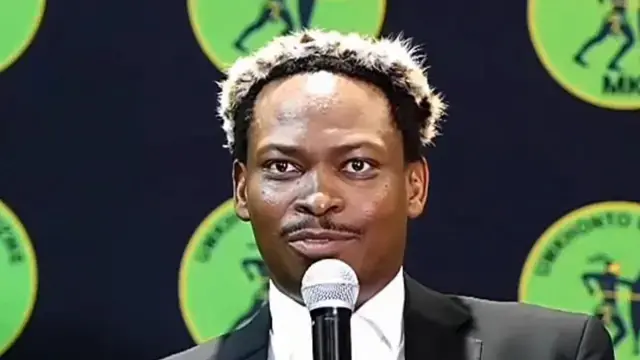
The uMkhonto weSizwe Party’s Johannesburg mayoral candidate Bongani Baloyi has assured residents that he will remain the party’s candidate for the November local government elections, despite the party’s history of repeatedly changing its senior leadership.
The Jacob Zuma-led party last week announced that Baloyi, the former Midvaal mayor, would contest the Johannesburg mayoral election on its behalf.
But the party’s frequent leadership changes have raised questions about whether its candidates and office-bearers can expect to remain in their positions for a full term.
Since its inception in 2023, the MK Party has had three deputy presidents, eight secretary-generals, three deputy secretary-generals and six chief whips in Parliament since 2024. There have also been changes to the positions of national organiser and chairperson.
In August last year, after the removal of former secretary-general Floyd Shivambu, Zuma said some members were lucky that he had not fired them. He said he would not beg anyone to remain in the party, regardless of their influence in the party or society.
Baloyi was previously removed as the party’s head of elections. He said concerns about whether there could be changes to the Johannesburg mayoral candidacy were understandable but insisted the party would provide stability at municipal level.
“We appreciate the concerns that City of Johannesburg residents would have and South Africans broadly, but it is safe to say uMkhonto weSizwe has had a lot of movement at the very top, but at the level below that, uMkhonto weSizwe is insulated,” he said.
“Johannesburg and the positions just below are insulated. The party is clear and that is why they identified strategic and competent talent to be able to lead, understanding that this is not just a one-year thing but a complete-term focus where people have to be committed and working for a full term.”
Baloyi said the party would demonstrate that it could provide stability in municipalities and would act responsibly in dealing with any issues that might arise.
He also said the party had been surprised by the level of interest in its Johannesburg plans since his appointment, particularly from middle- and upper-income areas.
The MK Party has been accused of being a regional party, whose support is concentrated in KwaZulu-Natal, where it performed strongly in the 2024 general elections. It has, however, been seeking to expand its support base beyond the province.
Baloyi said the party was strong in Johannesburg’s townships. Interest from more affluent areas had been unexpected.
“Midrand has been extremely interesting, Sandton, your Rosebank, so the people who have reached out want to work with us and give us an ear. The biggest surprise has been the middle class and the upper-level areas, which have excitement and they really want to engage with us.”
He said that included residents involved in community policing forums, body corporates and ratepayers’ associations.
“Over and above where we are strong, we have been extremely surprised by the interest and excitement it has triggered there by individuals who want to, in their organised structures they have in those areas, like your CPFs, some of their body corporates and others like your ratepayers’ associations.”
For Baloyi, it showed that people wanted an alternative that was credible and had genuine capacity to take over Johannesburg.
The MK Party has also been seeking to expand beyond its KwaZulu-Natal stronghold, making inroads in the Eastern Cape and Mpumalanga, where it emerged as the second-biggest party after the ANC in the 2024 general elections.
There had been an assumption that the party would focus primarily on Johannesburg’s townships and informal settlements in an attempt to challenge the ANC and Economic Freedom Fighters.
But Baloyi said the party’s strategy was broader than that.
Last year, a Democratic Alliance source told the Mail & Guardian that the party would be counting on lower voter turnout in these areas to strengthen its position, arguing that its own constituencies were more likely to vote.
Baloyi dismissed the strategy, saying parties banking on low turnout in townships and informal settlements should rethink their approach.
He said the MK Party would work to ensure turnout of more than 55% in those areas.
“The ball has just changed with uMkhonto weSizwe. It has really disrupted the foregone conclusion and thinking that it would be led by others. The landlord has arrived and everything will change,” he said.