


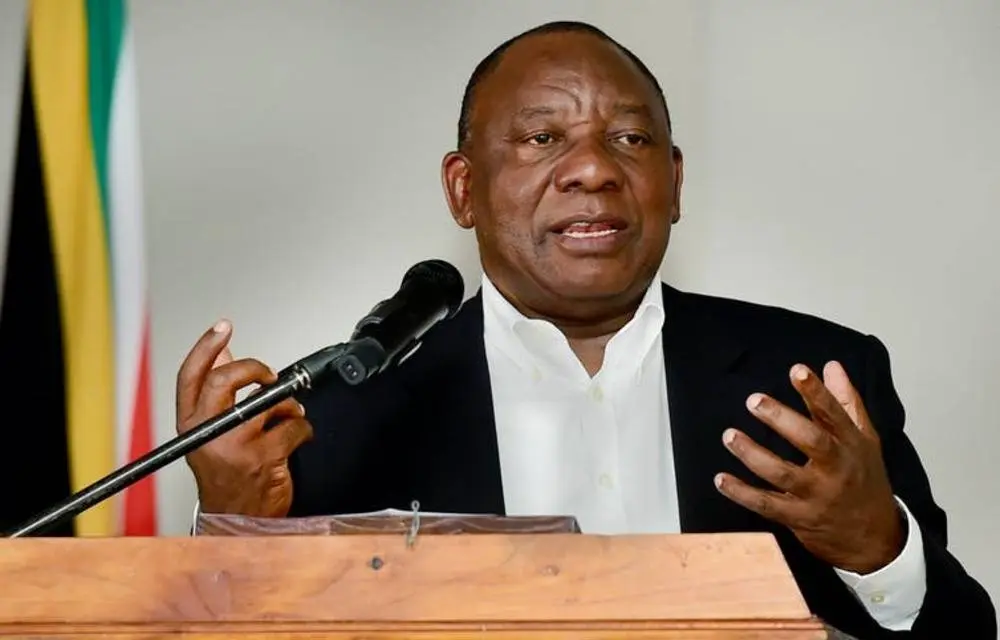
The government cannot "build its way out of failure", President Cyril Ramaposa says, noting that for too long, municipalities have focused on constructing new infrastructure while neglecting the assets on which communities depend.
On Thursday, the government launched the Revised White Paper on Local Government, describing it as a landmark moment in the evolution of South African democracy.
The revised policy document aims to rectify long-standing institutional weaknesses and address the structural challenges plaguing municipalities across the country.
Analysts and officials view the policy review as a critical catalyst that will transform municipal operations
Speaking at the launch of the policy document, Ramaphosa said the government must acknowledge, without qualification, that too many municipalities were failing to meet the needs and expectations of the people they were meant to serve. He said the situation could not continue.
Ramaphosa said too many communities had grown accustomed to unreliable services, deteriorating infrastructure and unresponsive municipal administrations.
"Nearly three decades after the original White Paper was adopted, we are undertaking a bold reset of the local government system. Local government is the sphere of government closest to the people. From the biggest metro to the smallest village, it is where the promise of democracy is most directly experienced. It is also where the failure to deliver services is most acutely felt."
The president said the policy document represented a reform that went to the heart of the relationship between the government and the public.
He said local government impacted the water flowing from taps, the electricity lighting homes, the roads residents travelled on, the refuse collected from streets and the communities in which children were raised.
Ramaphosa said that for millions of South Africans, their experience of governance was not primarily formed by what happened in Parliament, provincial legislatures or national departments but by what happened in their municipalities.
"It is shaped by whether the water runs when they open a tap. Whether the streetlights work when they return home at night. Whether the roads are safe, whether sewage flows into their streets and whether their complaints are heard and acted upon.
"When these services work, people experience the promise of democracy. When they fail, it is not merely an inconvenience. It affects people's health, their livelihoods, their safety and their dignity. It undermines their confidence in government and weakens their faith in the institutions of our democracy," Ramaphosa added, noting that was precisely why the Revised White Paper on Local Government had been introduced.
He said the policy document was not simply about changing legislation or rearranging institutions. Rather, it aimed to transform the lived experience of citizens by addressing structural weaknesses and outdated assumptions.
"It directly tackles the acute challenges facing local government today, including overlapping mandates, unsustainable finances, corruption and weak capability in municipal administrations."
Ramaphosa admitted that many of the challenges plaguing local government were systemic, explaining that apartheid's spatial engineering left a local government system divided along racial lines and marked by unequal revenue potential.
Wealthy municipalities with well-developed infrastructure were historically joined with poor municipalities that had inadequate services and virtually no revenue base.
He said that after the 1998 White Paper was enacted into law, the government had underestimated how highly politicised appointments would open the door to corruption, malfeasance and a lack of accountability.
"Today, our people live with these consequences and to address these consequences, we need to go to the cause. The White Paper sets out to tackle dysfunction by reforming the entire system, not merely by responding to its symptoms."
He said the government must move away from repeatedly rescuing struggling municipalities, focusing instead on building their long-term capability. Additionally, residents who could afford to pay for services must contribute their fair share.
Ramaphosa said public office must be restored to its proper purpose: serving the people.
He called on political leaders to respect the legal responsibilities of professional administrators, emphasising that municipal officials must be held strictly accountable.
"We need councils that lead with integrity, provide effective oversight and put residents ahead of factional or personal interests. We need administrations led and staffed by people appointed for their competence and commitment to public service."
There had to be real consequences when public resources were stolen, procurement was manipulated or public duties were neglected. "The exercise of accountability must be fair, lawful and consistent, regardless of status, political affiliation or personal connections. Communities must be partners in governance, not spectators to it."
The document enjoined the national government to support and regulate the work of local government, ensuring that municipalities were equipped to fulfil their responsibilities effectively. The policy framework aimed to strengthen support to municipalities while enabling decisive intervention where necessary to guarantee service delivery.
To achieve that, the policy document introduced crucial changes, suggesting a review of the current one-size-fits-all approach to municipal powers and functions.
"Some municipalities are well equipped to carry out particular functions, while others may lack the scale, the revenue base or the capability to do so. Where a municipality is unable to carry out a particular responsibility, that responsibility should be assigned elsewhere. In many cases, service provision would be better undertaken at a regional scale or through partnerships and concession arrangements."
Ramaphosa said residents had a right to know what their municipality had promised, what resources it possessed and whether it was delivering on the mandates.
"Participation cannot be reduced to meetings where people speak but nothing changes. Trust will not be restored by speeches. It will be restored when a reported fault is fixed promptly [and] when a resident receives an honest response to a complaint," he said, adding that for too long, some municipalities have built new infrastructure while neglecting the assets on which communities depend.
"Revenues from the sale of electricity and water are diverted to other functions, instead of being reinvested in the infrastructure needed to deliver those services. We cannot build our way out of failure if we do not maintain what we have already built.
"Going forward, revenues from the sale of electricity and water will be ring-fenced and used to maintain infrastructure before anything else. This will ensure that our infrastructure is brought back up to standard and sustained for future generations."
He said the Cabinet had endorsed a phased approach to implementing the policy document. This rollout would be supported by a time-bound Local Government Transition Management Body featuring coordinated leadership from the Department of Cooperative Governance, The Presidency and National Treasury.
The president clarified that the body would not usurp the legal duties of ministers, provinces, councils or municipal administrations. Instead, its purpose was to ensure that critical reforms did not fall through institutional cracks, that difficult decisions were made and that commitments were strictly followed through.
"A single Local Government Transition Plan will set out what will change, who is responsible, what must happen first and how progress will be measured.
"Some reforms will require legislation, new financing arrangements, new institutional capabilities and, possibly, constitutional amendments."
Ramaphosa concluded by noting that in less than two weeks, on 4 November, South Africans would vote in the Local Government Elections.
He acknowledged that while political parties and candidates might compete vigorously for votes and disagree on policy, they shared an obligation greater than party advantage once elected: ensuring the municipality worked.
Disagreements in municipal councils must never become an excuse for an unapproved budget, an abandoned project or the collapse of an essential service.
"Our people must never be held hostage by political instability. And so we urge every registered voter to make their voice heard on the 4th of November."