


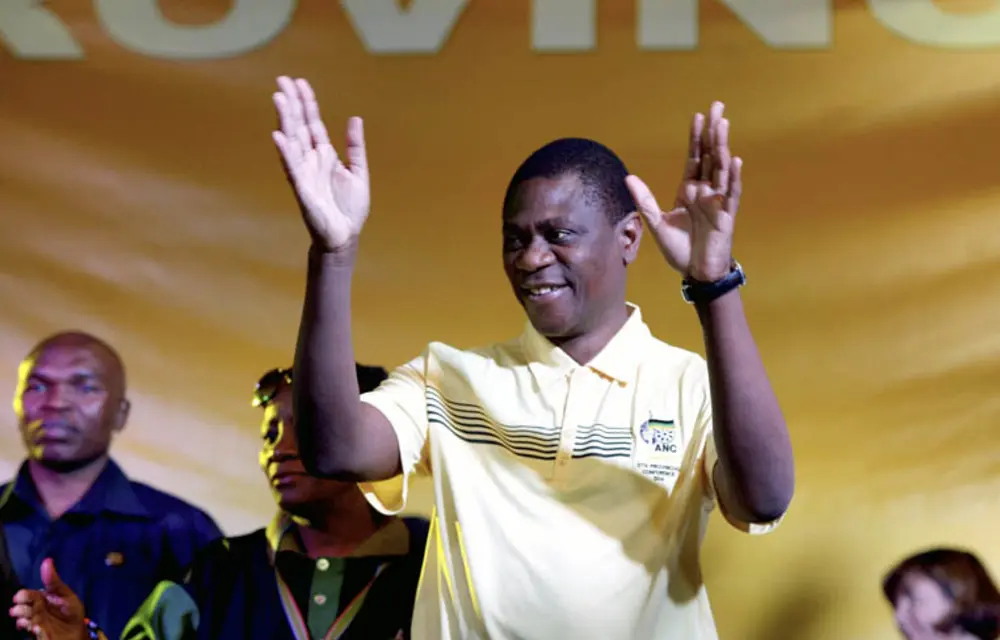
Deputy President, Paul Mashatile, called on South Africans to honour the legacy of liberation struggle stalwart Oliver Reginald Tambo by participating in democracy, holding leaders accountable and working together to address the country's social and economic challenges.
Speaking at the O.R. Tambo wreath-laying ceremony at Tamboville Cemetery in Wattville, Ekurhuleni, on 27 October, Mashatile said Tambo's commitment to freedom and equality should continue to guide the country's democratic journey. Held under the theme “Honouring O.R. Tambo's Legacy: Inspiring Active Citizenship and Responsible Voting”, the ceremony was a reminder that the freedoms secured through the liberation struggle come with a responsibility to protect and strengthen democracy.
“The greatest tribute we can pay to O.R. Tambo is not simply to remember him each year. It is to live by the values he embodied,” Mashatile said. He argued that democracy cannot begin and end at the ballot box, but depends on citizens who remain informed, participate in public life and hold elected representatives accountable for their decisions.
Born on 27 October 1917, Tambo devoted his life to the struggle against apartheid and served as president of the African National Congress (ANC) from 1967 to 1991. During his years in exile, he worked to sustain the liberation movement and build international solidarity against apartheid. He died on 24 April 1993, before South Africa's first democratic elections in 1994, which extended the right to vote to citizens of all races.
Reflecting on this history, Mashatile compared Tambo's journey to that of the biblical Moses, who led his people out of captivity but did not enter the promised land. Tambo, he said, fought for a democratic South Africa that he would never fully experience.
“Every election is an opportunity to honour those who fought, suffered, and died for the freedoms we enjoy today. Every vote cast is a tribute to their sacrifice,” Mashatile said. He urged citizens to make informed electoral choices and recognise the responsibility that comes with choosing their representatives.
He also stressed that political differences must be expressed peacefully, warning against violence, intimidation and lawlessness during elections. “Democracy thrives when political differences are expressed through debate and the ballot box, not through conflict and division,” he said.
Mashatile acknowledged that South Africa continues to face serious challenges, including poverty, unemployment, inequality, crime and gender-based violence. While the government has a central responsibility to address these issues, he said that lasting progress would require cooperation among the government, civil society, business, and communities.
He pointed to volunteering, supporting vulnerable people, and confronting corruption as practical ways for citizens to contribute to stronger communities, making the point that nation-building cannot be left to the government alone.
“Those of us entrusted with positions of leadership in Government have a particular responsibility to lead this journey. We must provide vision, direction, and service to the people,” he said. His remarks placed responsibility on leaders as well as citizens, stressing that public representatives must serve ethically and respond to the needs of the people who elected them.
This is particularly important at the municipal level, where decisions about water, sanitation, electricity, roads and other essential services directly affect residents' daily lives. Beyond voting, residents can engage with their municipalities, raise concerns, and monitor whether elected representatives are fulfilling their responsibilities.
As South Africa reflects on Tambo's contribution to the liberation struggle, Mashatile said the country must continue working towards a united, non-racial, non-sexist, democratic and prosperous society. He acknowledged that the promise of freedom remains incomplete while poverty, unemployment and inequality continue to affect communities, arguing that every generation has a responsibility to confront the challenges of its time.
“We are the custodians of his legacy. We are the beneficiaries of the freedom for which he fought, and we bear the responsibility of ensuring that future generations inherit a country that is more secure and more prosperous than the one we inherited,” Mashatile said.
His message was that remembering Tambo must mean more than gathering at his graveside each year. It must also be reflected in how South Africans vote, how leaders serve and how communities work together to build a country founded on justice, equality and human dignity.