

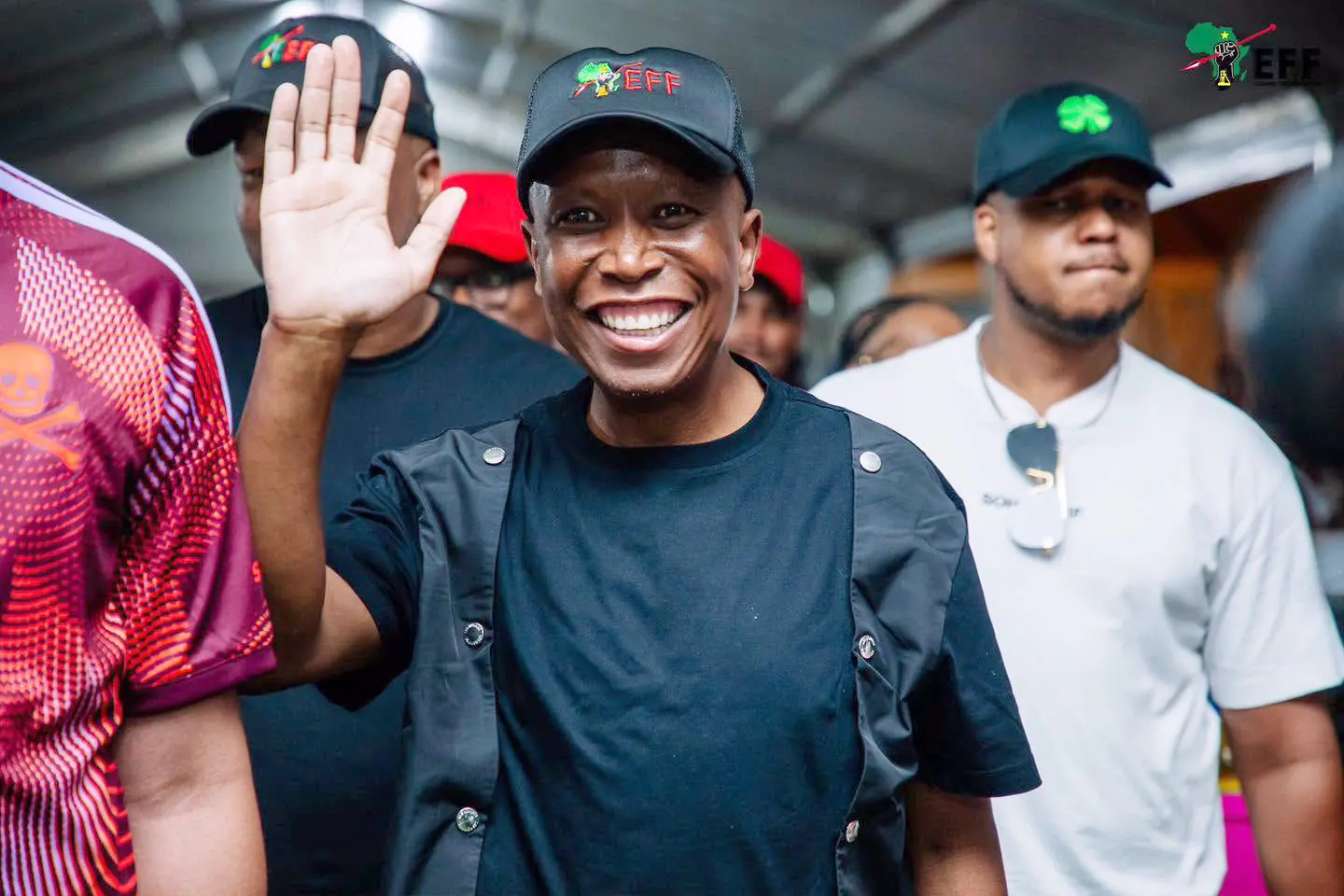
The Helen Suzman Foundation’s (HSF) bid to oust EFF leader Julius Malema from the Judicial Service Commission (JSC) is set to be heard in the Western Cape High Court next week.
The HSF wants the high court to declare invalid and set aside National Assembly Speaker Thoko Didiza’s April 30 decision that declined to ensure the house considered Malema’s suitability to be designated to the JSC.
If the order is granted, the foundation wants the National Assembly to be directed to consider whether to replace Malema as a designee to the JSC within 20 court days and be directed to consider all relevant circumstances including the EFF leader’s conduct. In addition, the HSF wants the high court to declare the JSC Act constitutionally invalid insofar as it does not oblige the commission to adopt a code of conduct for commissioners. As just and equitable relief, the foundation asks the high court to suspended the declaration of invalidity for 24 months in order to allow parliament an opportunity to remedy the constitutional defect.
The foundation says that during the period of suspension, section 6A is deemed to be read-in to the JSC Act as 6A Code of conduct for commissioners. The commission must compile a code of conduct for commissioners within two months.
“The code of conduct for commissioners must at minimum address the conduct required of commissioners both during proceedings of the JSC and generally; and provide sanctions for acting in a manner that violates the code, including requesting a designating or nominating body to replace a commissioner,” reads the court papers.
Additionally, according to the HSF, if Parliament fails to cure the constitutional defect within 24 months from the date of the order or within an extended period of suspension, the interim reading-in order will become final.
The foundation says Malema, who has been a JSC member since 2014, repeatedly attacks judges and magistrates when they rule against the EFF and drags judicial officers into political skirmishes while sitting on the body that appoints judges.
“Malema thus sits on the body that appoints our judges, while at the same time maligns and undermines their credibility when they apply the law against him. The credibility of the judiciary is critical in a constitutional democracy,” the HSF states.
It also notes that Malema’s conduct has been occurring for quite some time but his recent conduct after his criminal conviction and sentencing for unlawful use of a firearm requires the National Assembly to consider whether his continued membership of the JSC is tolerable .
“I emphasise that the HSF makes no comment as to Malema’s political or social views or the objectives and policies of his political party, the EFF.
“The HSF supports the right of every South African to exercise their rights of freedom of expression, freedom of belief and opinion, and political activity in a lawful manner,” the foundation’s executive director Naseema Fakir says.

The HSF says it does not believe that the judiciary is free from criticism. “Quite the contrary: debate, even robust debate, about the judiciary is necessary in our democracy,” the foundation says.
The HSF says Malema was recently convicted on five criminal charges and sentenced to an effective five years’ imprisonment.
However, he has appealed against the sentence and successfully applied for leave to appeal against his conviction.
“It is possible that a consequence of the determination of the appellate process will be that he is disqualified from membership of the National Assembly by virtue of section 47(1) of the Constitution,” Fakir says.
She adds that she expresses no opinion about whether that will be the outcome.
“But if it is, Malema’s current membership of the JSC will automatically come to an end. That would however not render this application moot, because it is not concerned only with Malema’s current membership of the JSC,” Fakir adds.
In response, Malema says that while he accepts that the country’s legal system permits any interested party from bringing a dispute to court, the HSF’s case is nothing more than an abuse of court process.
“I do not say this lightly. If HSF truly had a genuine, bona fide concern that my statements bring the National Assembly, the JSC and the appointment of the judges into disrepute, the question arises as to why this application was not brought at an earlier stage,” he said.
Malema says the HSF’s failure to bring its case, even as far back as 2019, speaks to the foundation’s ulterior purpose to target his membership, as a leader of the opposition, to sit on the JSC.
“It is also an attempt to stifle my ability to make political speech and to restrain my freedom of expression. I invite this court to take this into account when it considers the issue of costs,” he stated.
Malema denied that his statements unfairly maligned and undermined the credibility of the judges and the judiciary.
“As a member of the National Assembly I have taken an oath of office to uphold the Constitution and the rule of law.
“I take my responsibility as the leader of the EFF, a member of the National Assembly and as a member of the JSC very seriously.
“I accept that the views that I express are not popular. However, that does not mean that I should be silenced because my views are unpopular,” he says.
Malema opposes the grant of the relief sought by the HSF as it seeks to have him removed from the JSC and has not made out a proper case for the remedy it seeks, let alone that the relief is not available as a matter of law.
“The factual basis on which HSF brings this application does not support the extraordinary relief sought. The case does not present a live issue for determination by this court and/or will have no practical effect. “The matter is moot. On this ground alone, the application falls to be dismissed with costs,” he says. Malema insists that the relief that HSF seeks is extensive, extraordinary and impermissible because it violates the separation of powers doctrine.
“With respect, the relief that HSF is seeking effectively amounts to this Court telling the National Assembly how to do its work.
“Similarly, this court cannot take over the functions of the legislature,” he maintained.
The case will be heard next Wednesday, November 11.