


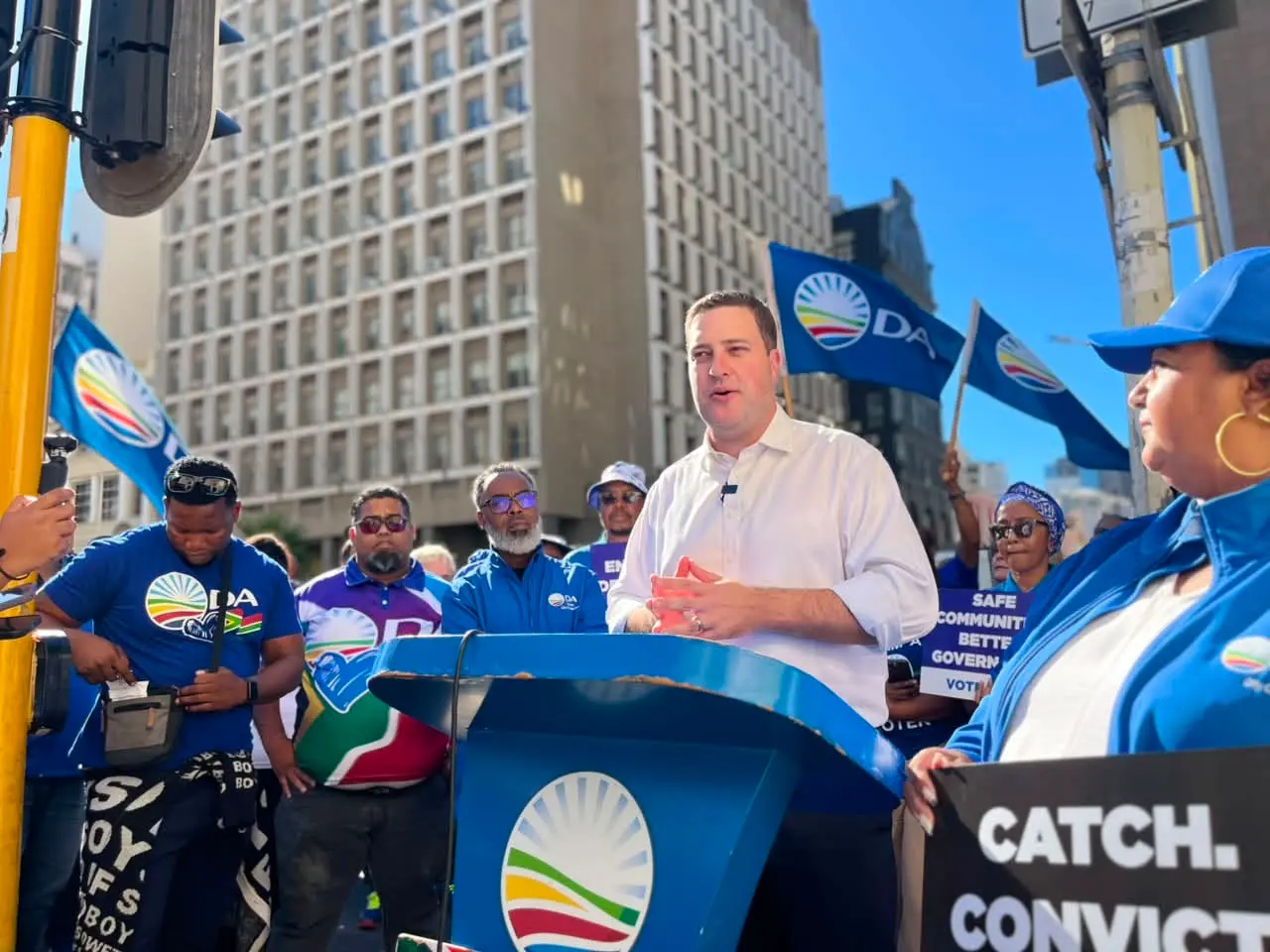
The Democratic Alliance (DA) has not ruled out taking the mayoral positions in municipalities where it has emerged as the largest party, including Johannesburg, Nelson Mandela Bay and Ekurhuleni, as negotiations over the formation of new local governments approach.
With 76% of the votes counted by Friday morning, the ANC stood at 31.88% nationally, the DA at 24.27% and uMkhonto weSizwe at 9.26%.
The party has previously advocated proportional power-sharing in municipalities governed through coalitions with the ANC.
However, DA leader Geordin Hill-Lewis declined to say whether it would continue to insist on this arrangement. He said it would be unwise to reveal the party's negotiating position before coalition talks begin.
“We stood up for this idea of proportionality, that the idea of seats in government should always be proportionate to the number of seats that you bring to the government and that is still very much our view,” Hill-Lewis told journalists at the results centre on Friday morning.
He said, however, that he would not commit himself to this position because doing so would put the party in a difficult position by revealing to its negotiating partners what its guidelines would be before coalition negotiations.
Some ANC members in the Free State and Gauteng had called on the party not to form a coalition with the DA. The ANC’s Johannesburg regional secretary has gone as far as saying that if the national leadership allowed them to negotiate a coalition, the DA would be the last party they would engage with.
However, some party members believe that a two-party coalition with the DA in hung municipalities would provide more stability than working with multiple other partners.
It is up to the ANC’s national leadership to provide direction on how the party should approach the coalition talks.
“There’s lots and lots of positions inside that party [ANC] on who they should work with or who they should not work with,” Hill-Lewis said.
“There are some people who favour success and stability in government, there are some people who favour what makes them emotionally happy and there are some people who favour those they are most friendly with.”
He said that was an issue for the ANC to resolve but hoped that the party’s leadership would provide direction from the very top.
“I'm interested in our position and our position is that we are going to put the people of these towns and cities first and we are committed to a stable, corruption-free government.”
Reflecting on the DA's performance, Hill-Lewis said he would have struggled to believe, even a few years ago, that the party would come within a handful of percentage points of the ANC in the 2026 elections.
With the ANC having dominated South African politics for more than three decades, he described the result as an extraordinary moment.
“I must pinch myself. That is an extraordinary political outcome in our country.”