

The Democratic Alliance (DA) has been shut out of coalition arrangements in Gauteng’s three metropolitan municipalities after the ANC brought together a broad alliance of predominantly black political parties under an emerging pact dubbed Operation KZO (Keep Zille Out).
ActionSA leader Herman Mashaba confirmed to the Mail & Guardian on Thursday that negotiations with the ANC and other parties had effectively concluded, with only the allocation of positions in municipalities and the finalisation of governing arrangements outstanding.
The parties convened a high-level meeting at Emoyeni Conference Centre in Parktown on Thursday morning, attended by representatives of more than 10 political organisations.
Those involved included the ANC, MK Party, EFF, ActionSA, Build One South Africa (Bosa), Rise Mzansi, the South African Communist Party (SACP), Inkatha Freedom Party (IFP), African Transformation Movement (ATM) and the Patriotic Alliance (PA).
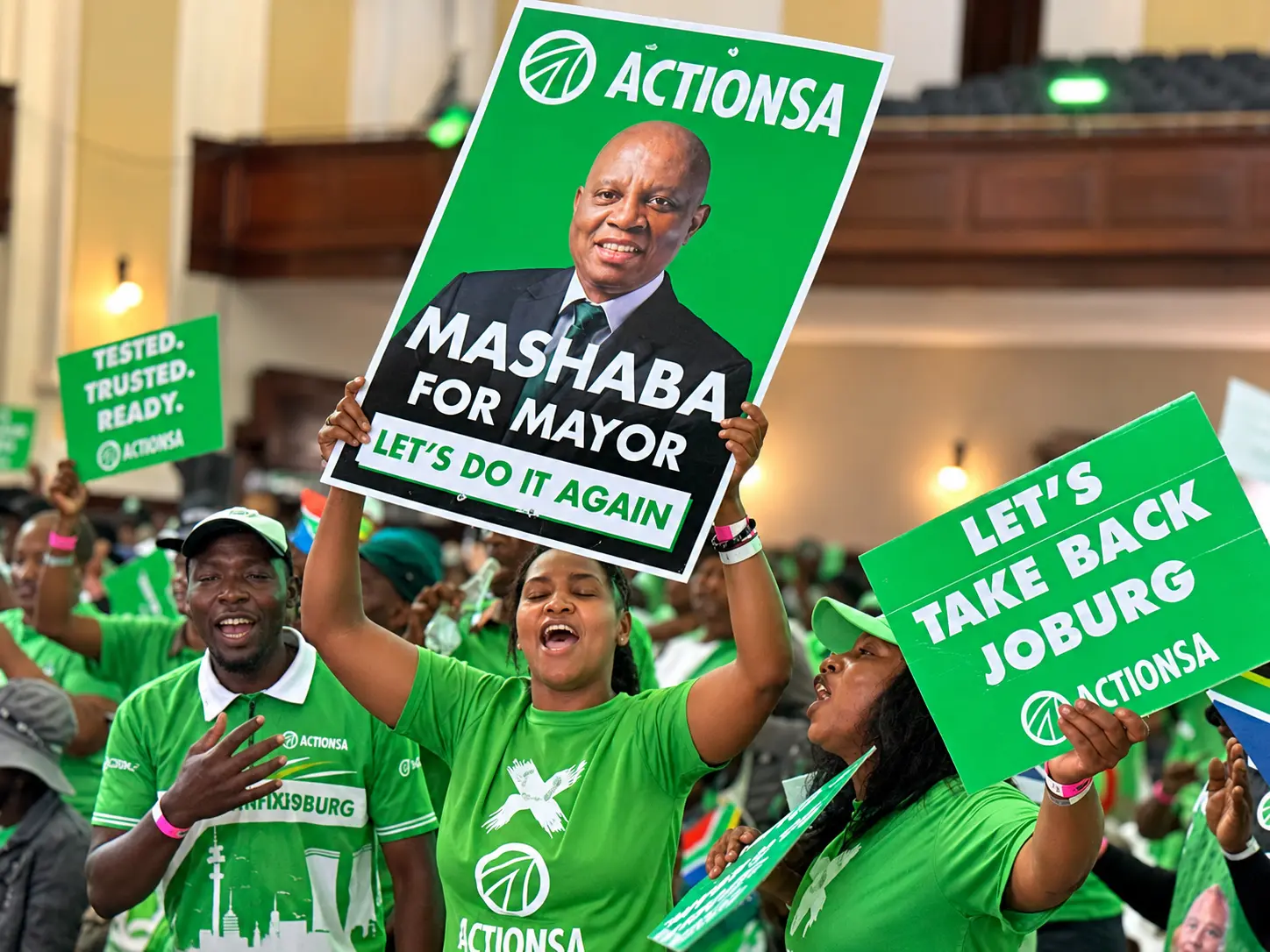
Under the agreement, Mashaba is set to become Johannesburg mayor, while ActionSA’s Nasiphi Moya will retain the mayoral chain in Tshwane. The ANC will nominate a mayor for Ekurhuleni.
“We want to replicate in Joburg what Nasiphi did in Tshwane and double her efforts there,” Mashaba said.
The businessman-turned-politi-cian has emerged as a kingmaker in Gauteng’s coalition negotiations, opting to work with the ANC and other parties rather than pursue an agreement with the DA.
Although Mashaba downplayed his influence, sources involved in the negotiations told the M&G that he had shown strong leadership, a willingness to compromise and a readiness to work with the parties at the negotiating table.
negotiating from a position of weakness,” the source said.
The source suggested that the DA’s promotion of its leader, Geordin Hill- Lewis, as a possible replacement for Zille in Johannesburg, although disputed by the party, was an attempt to test ActionSA’s response to the prospect of a DA mayoral candidate.
The ANC’s choice at local government could have far-reaching implications for the government of national unity (GNU), raising questions about the DA’s continued participation in the national executive ahead of the 2029 elections.
The parties have concluded negotiations on a coalition arrangement to govern 10 of Gauteng’s 11 municipalities. Only the allocation of political positions and the finalisation of the coalition’s governing modalities remain outstanding.
“As far as negotiations are concerned, the ANC is desperate to elbow the DA out of the coalition. Its only option is to ingratiate itself with Herman Mashaba,” a source involved in the talks said.
The PA’s rejection of the DA’s overtures also suggests that it recognises where political power will probably lie in the emerging coalition arrangements.
“ActionSA prefers to work with the ANC. It can get more from the ANC than from the DA. The ANC is The source said the ANC’s recent national executive committee deliberations reflected growing discomfort within the party about the political consequences of its partnership with the DA.
Disagreements between ANC and DA ministers have further strained relations, with the source arguing that the DA could use its position in the GNU to exert greater influence over the ANC.
ActionSA, meanwhile, is increasingly viewed by the ANC as the lesser of two political evils.
A task team, coordinated by Gauteng premier Panyaza Lesufi, will oversee the allocation of positions, finalise the coalition’s governing arrangements and determine its political leadership.
Lesufi chaired the multiparty meeting at Emoyeni on Thursday.
Mayoral committee portfolios and other political positions will be distributed among participating parties according to their representation in the respective municipal councils.
The arrangement represents a significant political setback for the DA, which emerged as the largest single party in all three metros but failed to secure an outright majority in any of them.
The DA secured 34.79% of the vote in Johannesburg, 34.37% in Tshwane and 30.68% in Ekurhuleni.
However, the combined numbers of the ANC, ActionSA, EFF and MK Party give the parties a majority in each municipality.
In Johannesburg, the four parties, ANC, EFF, ActionSA and MK Party, hold 138 seats in the 270-seat council, two more than the 136 required for a majority.
In Ekurhuleni, they have 128 of 224 seats, comfortably above the 113 needed.
In Tshwane, their combined 109 seats give them one more than the 108 required.
ActionSA has maintained that its participation in coalition arrangements must be anchored in service delivery, financial stabilisation and infrastructure renewal.
Its reluctance to enter a coalition with the DA while Zille remains central to the party’s political direction has been a major obstacle to cooperation between the two parties.
The strained relationship between Zille and Mashaba has further complicated the prospect of an agreement.

Following multilateral discussions in Sandton on Wednesday, EFF secretary-general Marshall Dlamini said the parties were negotiating as equals and had put aside their ideological differences in the interests of residents.
He said there would be no big brother in the proposed arrangement, signalling that coalition partners would have to negotiate power-sharing on an equal footing.
The DA has warned that excluding it from coalition arrangements despite its emergence as the largest party in all three metros would undermine the electoral outcome.
Hill-Lewis has described efforts to exclude the party from municipal coalitions as a profound error, warning that voters would ultimately hold political parties accountable.
Mashaba told the M&G that negotiations with the DA had failed to get off the ground after the party did not meet his demand that Zille and Tshwane mayor Cilliers Brink be removed from the equation before talks could proceed.
“They wasted a week and a half, and the train has moved,” he said.
Mashaba said the DA was the first party to approach ActionSA, with Hill-Lewis contacting him to start discussions.
“We were prepared to listen to anyone who wanted to work with us, and the DA was in fact the first to reach out. Hill-Lewis sent me a WhatsApp message, and I called him and told him that we could talk as long as Zille and Brink are not part of the deal. I explained that we can’t take black votes to give to two individuals we know don’t care about people like me.”
Mashaba said Hill-Lewis met him last Thursday, and he reiterated that ActionSA would not enter an agreement while Zille and Brink remained involved.
“They want to see me again today [Thursday], and we are happy to meet, but the train isn’t stopping. We wish to sign our deal today or tomorrow.
“We are drafting our coalition agreement with consensus on tackling corruption, improving service delivery and public service.
“We are happy with the progress made and how things are turning out,” he said.
Mashaba also contrasted Action- SA’s campaign resources with those of the DA, saying he had spent just R180 000 a month campaigning in Gauteng, compared with Zille’s R2 million budget.
Despite the disparity, he said, ActionSA had made significant inroads in traditional ANC strongholds, including Soweto, Tembisa and Atteridgeville.
“They had the money but we dominated the space. The voters invested in us because our message resonated with them,” he said.
The Gauteng agreement could have consequences beyond municipal politics, particularly for the DA’s participation in the national GNU, where it shares power with the ANC.
The negotiations have unfolded against growing resistance within the ANC to its national partnership with the DA.
The ANC Youth League and senior party figures, including Lesufi, have called on President Cyril Ramaphosa to remove DA ministers from the cabinet.
The Gauteng arrangement could strengthen those within the ANC who want to replace the DA as its preferred governing partner with parties in the emerging provincial coalition.