


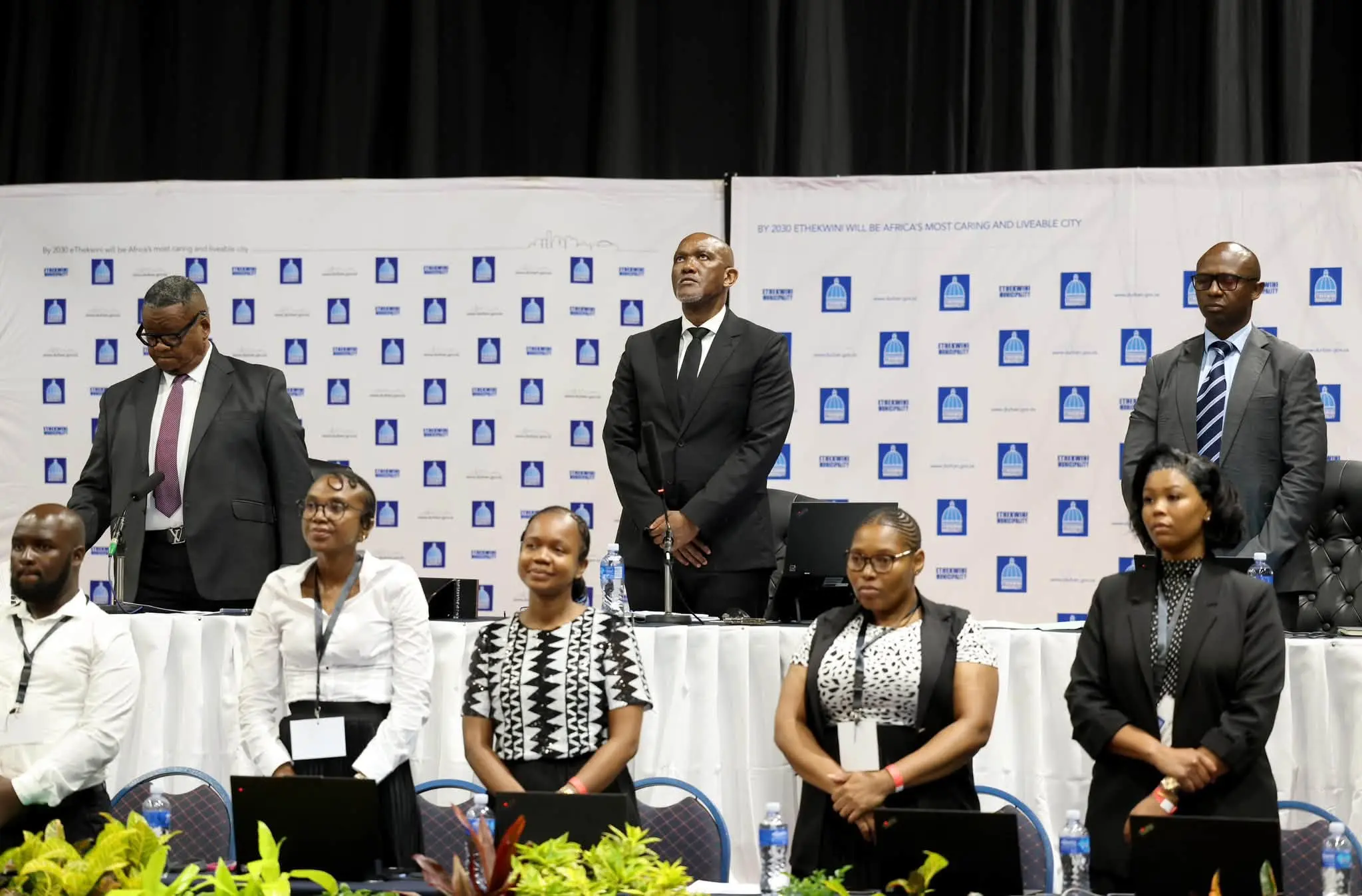
The race for the eThekwini metro mayoral chain has been marred by allegations of money changing hands in a desperate bid to win the echelons of power at the coast-based council.
Friday is the D-Day for the only metro in KwaZulu-Natal to elect the political executive office-bearers, which will lead the council for the next five years.
The outcome of the 2026 municipal government elections saw no party securing the outright majority in the 223-seat council.
For any party to call the shots, it needs at least 112 seats. The uMkhonto weSizwe Party (MK Party), although it received the lion’s share of the eThekwini vote, couldn’t garner sufficient numbers to govern alone.
The status quo forced the various political parties to scout for like-minded partners with whom they will constitute government through the government of local unity (GLU) pact.
Early predictions pointed to the MK Party and ANC banding together to form a majority government and include, among other parties, the likes of ActionSA, IFP and EFF.
With the clandestine nature of the coalition negotiations, coupled with the posture and political alignment that unfolded in some councils this week, no party can claim, without a doubt, to have eThekwini metro in the bag.
The sitting, which was adjourned for two days to give parties an opportunity to solidify their pacts, reconvenes on Friday.
An MK Party provincial leader privy to the negotiations told the Mail & Guardian that although the party was hopeful that it would amass sufficient numbers to occupy mayorship of eThekwini, it was treading carefully.
“The trend we have been observing is that political parties are entering these negotiations in bad faith. In some of the councils where we had where the MK Party was locked out despite having the biggest share of the local vote.
thought we held one position with some parties, they decided to vote against us.
“We can’t rule out that money has changed hands. We saw what happened in Mandeni where the EFF sold us out and gave their seat to the ANC and EFF. We suffered the same blow in the NDZ [Dr Nkosazana Dlamini-Zuma] local municipality and KwaDukuza.
“People with whom we had agreed, threw us under the bus. We are prepared for anything,” the source said.
The Mandeni local municipality, in the north coast of Durban, held its council inauguration on Wednesday. The MK Party went to the council sitting buoyed by the number of seats it had secured, putting the party in pole position to take over the council.
But it wasn’t to be.
Out of the 35 council seats, the MK Party secured 17 needing only one seat to govern. The IFP and the ANC garnered eight seats each while the DA and the EFF took home a solitary seat apiece.
Eighteen seats are needed to form a government. The EFF was the final arbiter and propelled the DA, IFP and ANC to a slim majority. It was the same fate in the NDZ municipality under the Harry Gwala district The council has 29 seats with 15 needed to secure a governing majority. The MK Party is leading with 12 seats, ANC 11, IFP three, DA two and EFF secured a single seat. It was the ANC who were re-elected back to office through the assistance of the IFP who were in turn rewarded with a speaker position.
On Thursday, the MK Party was also dealt a severe blow when it lost the strategic council of KwaDukuza on the KZN north coast, which covers, among other residential areas, the affluent suburb of Ballito.
The ANC splinter party had the biggest vote share — 22 seats — while the DA and IFP secured 14 each. The ANC, DA and IFP joined forces and toppled the MK Party. It was the same scenario in several rural councils across the province.
Zwakele Mncwango, the chairperson of ActionSA in KwaZulu-Natal, also warned of seat-buying and backdoor agreements.
“I raised serious concerns about political parties entering council meetings without formal, written coalition agreements,” Mncwango said. “The unfolding developments in municipal councils who have already elected its leadership are precisely why I raised those concerns. Political commitments made behind closed doors, without formal agreements and accountability mechanisms, leave room for betrayal, political opportunism and instability.”
He also cautioned that there were damning allegations that had surfaced before the crucial sitting which risked tainting the proceedings.
“Even more disturbing are the emerging allegations that certain political parties or councillors are being bought to influence the election of office-bearers.
“If these allegations are true, it means corruption has already begun before these administrations have even assumed office. Coalitions must be founded on principles, integrity, transparency and a clear programme of action, not political expediency or personal enrichment,” he said.
The eThekwini situation is also exacerbated by the sudden resignation of five councillors who were sworn in during Tuesday’s adjourned council sitting. The development will probably have a bearing on the outcome of the executive council composition. It was not immediately established which political parties the resigned councillors belonged to.
Senzelwe Mzila, the eThekwini metro spokesperson confirmed the resignations to the M&G.
“Yes, I can confirm that the municipal manager has received letters of resignation from the five councillors and they are being processed. I cannot disclose their names at this stage,” he said.

Former mayor Cyril Xaba is known to have resigned barely two days after being sworn in. The move is a clear indication that the ANC will not contest the mayorship portfolio. The ANC is expected to push for the re-election of ex-council Speaker Thabani Nyawose in the same post while Minah Lesoma will be fielded as Chief Whip.
The MK Party, on the other hand, has put forward its mayoral candidate and party national chairperson, Apostle Mxolisi Phakathi.
The DA has stuck to its guns that Haniff Hoosen become the first eThekwini mayor for the party.
ActionSA is believed to be eyeing the deputy mayoral post under the MK Party-led pact.
The DA in KZN drew the line in the sand, saying it would not enter into a coalition where the MK Party was involved.
The blue brigade instead advocated for the parties under the banner of the government of provincial unity to extend their pact further to local level.
“We will continue to pursue the GPU model because it provides stability and surety to govern over the next five years. There is obviously some compromise that is required. We’re not an unreasonable party,” Dean McPherson, the DA KZN chairperson, said.
As it stands, the top parties in the metro in terms of the vote share are the MK Party with 86 seats, DA 57, ANC 37, IFP 15, ActionSA seven and the EFF four.
eThekwini, with an annual budget of just over R75 billion, is the heart of the provincial economy.
The position of an office-bearer comes with lucrative perks — whoever is elected mayor will take home an annual remuneration of more than R1.7 million plus other fringe benefits.
The new national limits for municipal political office bearers, as contained in the recently released Government Gazette, also states that the city Speakers and deputy mayors will walk away with about R1.3 million a year.
The members of the mayoral committees and individuals serving as council whips and chairperson will also earn more than R1.3 million annually plus perks.