


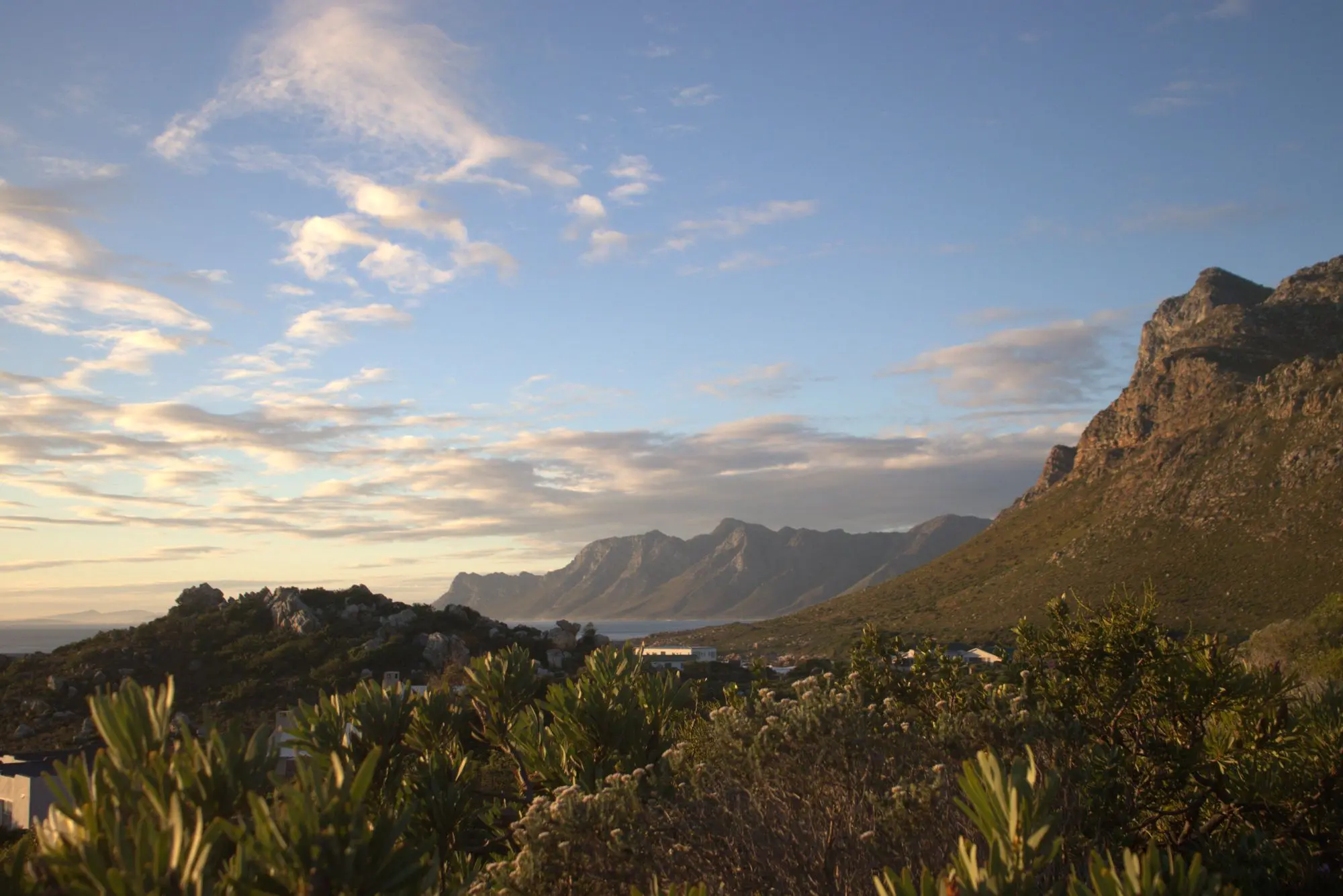
Winter sunlight filters over the fynbos carpeting the slopes of the Kogelberg above Rooiels, a small seaside village bordering Pringle Bay on the Western Cape coast. Restios sway among low, fine-textured shrubs, while flowering proteas splash the mountainside with pink against pale sandstone and the restless blue waters of False Bay beyond.
This unique landscape lies in the Kogelberg Biosphere Reserve between Rooiels and Pringle Bay, linking mountain, wetlands and coast.
This extraordinary ecosystem rewards patience.
As Dine van Zyl walks these mountains almost every day, she has learned to notice details most visitors would miss. In the mornings the fragrance of one shrub, Berzelia albiflora or coffee bush, fills the air with the aroma of freshly brewed coffee. "Not just any coffee," she laughs. "Koffiehuis."
Van Zyl and her husband, Graham McCleland, have spent years documenting the extraordinary biodiversity surrounding Rooiels on their Rooiels Fynbos website.
Their observations have helped to reveal exactly why conservationists have spent years trying to protect the Rooiels Corridor, a strip of habitat linking the Kogelberg mountains with the False Bay coastline.
That effort has now received an unexpected boost. A bequest to WWF South Africa, together with partnerships involving CapeNature, the City of Cape Town and private landowners, has created an opportunity to secure large parts of the ecological corridor, between Rooiels and Pringle Bay, through biodiversity stewardship as a conservation mechanism.
Steve Gildenhuys, a retired former CapeNature conservation manager, walks slowly, stopping every few metres to point out plants hidden among the seemingly uniform shrubs. After decades in conservation, he still speaks about the Kogelberg with the excitement of someone discovering it for the first time.
"This is widely regarded as the heart of the biome because there's a heck of a lot of endemics in this area," he says, sweeping his arm across the mountains. "Apparently this is where it all originated and diversified from."
Scientists see the Kogelberg as one of the richest centres of plant diversity on Earth. Hundreds of endemic species occur here, many found nowhere else, alongside Cape leopards, Cape sugarbirds and an astonishing diversity of insects, reptiles and other wildlife.
Yet the same mountain scenery and sweeping ocean views that draw conservationists also attract developers. Houses, roads and fences steadily fragment landscapes that wildlife has used for millennia.
Tim Attwell, an ordained Methodist minister who retired to devote more of his time to conservation, says protecting the corridor is about much more than preserving scenic beauty. It's about safeguarding an ecological link that is increasingly under pressure from urban development.
Gesturing towards a dramatic rocky outcrop known locally as Leopard's Cave, he tells how camera traps have captured Cape leopards moving through these mountains, reminders that the corridor is used not only by the region's extraordinary plants but by animals that depend on connected landscapes.
"They move from here all the way inland," he says. "That just illustrates the fact that in nature things move. Things need connectivity. They need to get from one place to another to feed, to breed and so on.
"And it's not just leopards. We're talking about birds, seeds, insects. For the sustainability of landscapes, you've got to have access to all sorts of organisms, from plants to every kind of animal."
The corridor links mountain to coast, protecting two critically endangered vegetation types—Kogelberg Sandstone Fynbos on the rocky slopes and Hangklip Sand Fynbos on the coastal flats—as well as the valley-bottom wetlands that connect them into a functioning ecological system.
Many of the plant species occur nowhere else on Earth. Threats include urban expansion, invasive alien plants, climate change and even a soil-borne root pathogen that hikers can unknowingly spread on their boots, potentially devastating small, isolated populations of rare plants.
"Not a day goes by that we take this for granted," says Gildenhuys, who lives in Pringle Bay. "We wake up with this every day and feel completely blessed."
For Van Zyl, who has called Rooiels home since 1989, understanding fynbos begins with slowing down.
"With fynbos, you must think of the fine," she says. "Most people will just see bushes. But you've got to stop, sit down and look."
She has spent decades doing exactly that. Over time, one discovery led naturally to another. While Van Zyl photographed flowers, McCleland became fascinated by insects.
Together they began noticing the intricate relationships between plants and the creatures that pollinate them. A flowering protea attracted sugarbirds. Another relied on butterflies. A ground-hugging protea depended on mice visiting under cover of darkness. "If you lose one, you break that link."
Years of careful observation have also led to discoveries.
Van Zyl recalls reading how the early botanist William Patterson described hillsides covered in the striking yellow Erica patersonii. Today, the endangered mealie heath is known from only a handful of locations around Pringle Bay, Betty's Bay and Kleinmond. Despite walking the Rooiels mountains for years, Van Zyl had never seen it there herself.
Then came the 2017 fire. "After the fire we walked and suddenly there it was—a whole stand of beautiful yellow Erica," she says. The flames had removed taller vegetation, revealing plants that had quietly persisted beneath it.
During a two-day BioBlitz in April, volunteers, conservationists and citizen scientists documented 136 flora species with the help of citizen science platform, iNaturalist.
Combined with years of observations uploaded to iNaturalist, the records have revealed 213 plant species and at least 29 threatened species found on the property, including Kogelberg silkypuffs, Hangklip silkypuffs, Mealie heath, Marsh pagoda, Flame pincushions, Cape clawless otters, Cape rockjumpers and ground woodpeckers.
Gildenhuys says citizen scientists like Van Zyl and McCleland are helping reveal just how much remains unknown. "Sometimes we don't even understand what we've got," he says. "We're at the thin edge of the wedge."
The bequest from the late Mike Harrison to WWF-SA means that it is now the owner of a smallholding, portion 137 of Farm 559, which will soon be declared a new nature reserve.
"This development has created a unique opportunity to draw a line in the sand to secure a unique stretch of coastline," according to the conservation organisation. "With our partners, WWF is working to bring this dream into reality."
The rich biological diversity of the Western Cape is not being sufficiently protected and is under threat. "This is partly due to lack of resources but also because 80% of the land that has important biodiversity lies outside of formally protected areas on privately or community owned land," it says.
This is where stewardship comes into play. Rather than purchasing every ecologically important property, stewardship encourages landowners to conserve their natural landscapes while receiving technical support from conservation authorities.
Jan Coetzee, WWF-SA's landscape manager for the Cape Floristic Region, says the project came together only after years of planning, partnerships and a measure of good fortune.
"We didn't know the bequest was coming," he says. "But all the biodiversity assessments and planning had already been done. At the same time, we were fortunate to secure funding for biodiversity stewardship, which meant we could appoint a [biodiversity] extension officer to start working with more than 40 landowners."
Protecting ecological corridors depends on "perfect timing, passionate people and planning," he says. "You can't buy all this land. It's just too expensive, especially with property prices rising in this area. That's why stewardship is so important. It's an opportunity to work with landowners and secure these key properties before development closes those gaps."
After more than 15 years working on ecological corridors in the Western Cape, Coetzee says the Rooiels project shows what long-term collaboration can achieve.
"Fifteen years ago, half the people thought we were nuts," he laughs. "Now we're standing here looking at what's possible. The only way you get there is through partnerships and sometimes a thick skin."
Cliff Dawes, from the City of Cape Town's biodiversity management branch, says the Rooiels Corridor also strengthens ecological links. "We already own two properties in the corridor and we're busy securing a third. It just makes such good sense and it links our Steenbras Nature Reserve to the coast."
For Van Zyl, conservation begins with paying attention. She laughs as she tells how what starts as a long walk often ends after only 500m. "There's just so much to see."
Nearly four decades after arriving in Rooiels, she still finds herself stopping to photograph another flower, another insect or marvelling at another unexpected connection.
"We're both retired. We both had demanding jobs and now we don't know how we ever had time to work because we're so involved in this," she says. "To be in Rooiels and to be recording the data, it's very good for the soul."
The lesson she has learned from this remarkable landscape is deceptively simple. "The more you look, the more you see."