

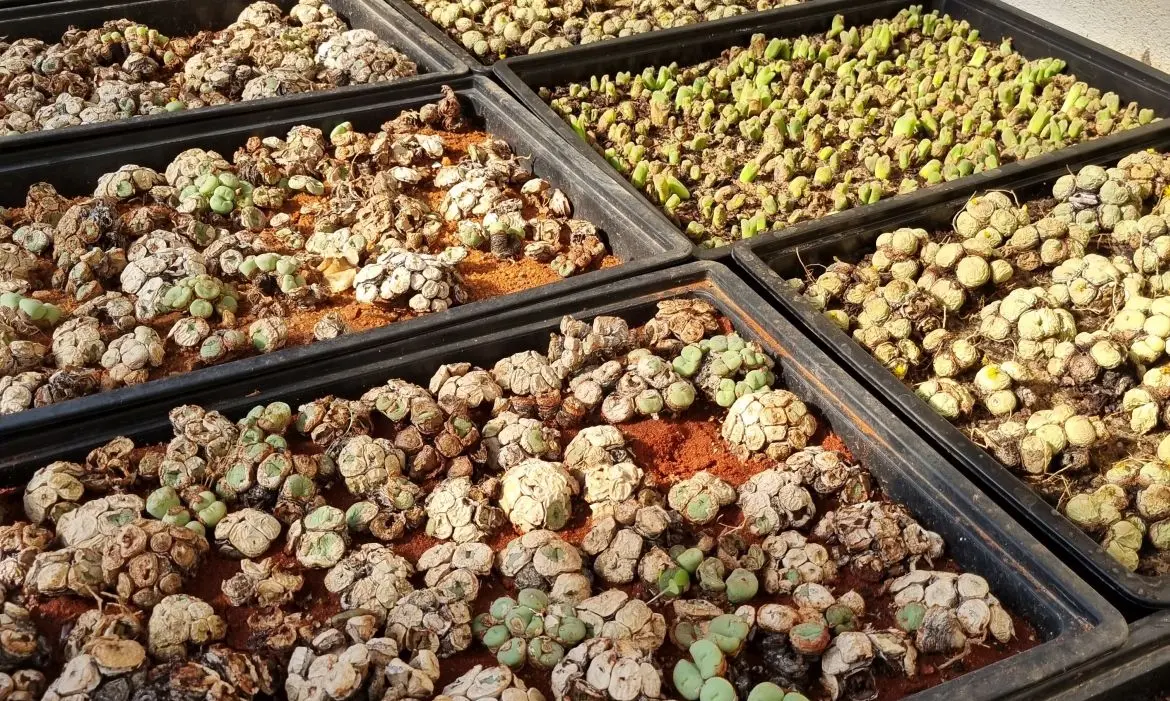
Dr Theressa Frantz remembers the moment that she fell in love with South Africa’s succulents.
It was the spring of 2014, at the launch of the Knersvlakte Nature Reserve, a vast protected area in the Succulent Karoo renowned for its extraordinary diversity of rare, endemic plants.
Frantz, now the executive manager of biodiversity research, science and policy advice at the South African National Biodiversity Institute (Sanbi), said she was “absolutely in awe and spellbound” by the tiny plants emerging from the Knersvlakte’s white quartz gravel.
More than a decade later, that fascination has turned to distress.
“It’s quite heartbreaking for me to see the succulents that have been confiscated,” Frantz told a Western Cape parliamentary dialogue on succulent poaching this week.
A local crime with a global market
For Deon Hignett, the capability manager for biodiversity conservation at CapeNature, the loss reflects a crisis that has grown beyond a niche conservation concern.
“It has evolved into a sophisticated transnational environmental crime that threatens globally unique biodiversity and requires a coordinated response from conservation authorities, law enforcement agencies, custom officials and international partners,” he said.
Flora crime constitutes more than half of CapeNature’s crime investigations. “The scale is far greater than many people realise,” he said.
Since 2018, more than 2.5 million illegally harvested plants have been seized in the Western Cape, while CapeNature estimates that less than 25% of the illegal trade is intercepted.
“The numbers we see are only a fraction of the true damage occurring on the ground,” Hignett said.
Seven species of Conophytum, a genus of tiny, highly specialised succulents and two subspecies are now considered functionally extinct in the wild. “This is no longer isolated collecting by enthusiasts as it was in the past; it’s organised environmental crime targeting entire plant populations.”
The Succulent Karoo is a globally significant biodiversity hotspot containing more than 6 000 plant species, many found nowhere else in the world. Some occur only on a single hill, valley or quartz field.
Hignett recalled encountering the Burgers onion (Conophytum burgeri), whose entire known population occupied a patch of quartz veld roughly the size of a tennis court.
“This room was bigger than that entire population of that species’ distribution.”
Many succulent species evolved over millions of years and can take decades to reach maturity.
“Once they’re removed from the wild, they cannot simply be replanted and replaced. When these species disappear South Africa and the world lose them forever."
The trade is driven by international demand. Criminal syndicates finance procurement, recruit local harvesters and move plants through transport networks before exporting them internationally.
The plants can then be sold online for hundreds or even thousands of dollars. “That’s one small plant the size of my thumbnail for over $1 000 (R16 000),” Hignett said.
“This is a profit-driven international crime network, not simply local harvesting.”
Criminal networks adapt as enforcement struggles
David Newton, programme office director for Traffic in Southern Africa, said the problem was not new. The NGO, which tackles the illegal wildlife trade, began working on succulent trafficking in 1995, warning about exports to about 30 countries and fragmented laws. “Very little happened after that report and things sort of simmered along.”
Then, in about 2019, organised harvesting surged. Covid-19 lockdowns helped transform the way the trade operated, he said, as international traders who could no longer enter South Africa began organising local people to collect plants for them.
Newton described the trade as “a local crime that has a global market and runs in various tiers”.
At the bottom are local harvesters — often unemployed residents and sometimes schoolchildren — who are paid a fraction of the eventual value to dig plants out by hand. Couriers then move and store the plants before they are exported through porous borders. At the top are international buyers in China, South Korea, Japan, Europe and elsewhere.
Newton has seen how the market has evolved. Japan was the main driver when Traffic began its research in the 1990s but China has become an important market, particularly for Conophytum. “These are the same trade routes that also carry rhino horn, abalone and ivory. This is organised wildlife crime.”
But enforcement alone will not solve a problem with deep socio-economic roots, he said. In recent fieldwork conducted in the Northern Cape, 61% of residents identified unemployment as the main driver, while more than 80% of households relied on at least one social grant.
Harvesters can receive between R10 and R150 a plant, while some report making R10 000 during a five-day collecting trip. “This is good income for that area but we must be clear that couriers and overseas buyers take much larger profits,” Newton said. Communities call the money vloekgeld or cursed money. “It eases hardship for a few weeks but builds nothing lasting. If we want to cut this illegal trade we have to offer people a transformative or a sustainable alternative.”
Newton said the deterrent was failing. A 2023 Traffic report found that while plants worth about R47 million had been seized across 90 cases over five years, fines typically ranged between R3 000 and R10 000 and prison terms were often suspended.
Only 8.8% of residents interviewed for Traffic’s socio-economic study rated enforcement as effective. “Why does the reward outweigh the risk?” Newton asked.
He said the response to succulent trafficking remained fragmented, with species losing protection across provincial boundaries and capacity constraints — including corruption allegations in the Northern Cape — leaving the Western Cape carrying much of the response.
Porous borders with few surveillance tools allow exports to slip through, he said, while plant traders exploit gaps between agencies and across the country.
There are, however, examples of what coordinated enforcement can achieve. Newton cited the case of notorious international plant poacher Bang Su Kim, in which 60 000 endemic Conophytum plants were recovered and a R2.5 million fine secured through cooperation between South African authorities, the US Fish and Wildlife Service and the Convention on International Trade in Endangered Species of Wild Fauna and Flora process.
South African cases have also resulted in seven and 10-year imprisonment terms, as well as a 15-year sentence in the Northern Cape for smuggling rare succulents. “When agencies work together and cases are properly prosecuted, the system works. The task is to make this the rule, not the exception.”
Hignett said criminal networks were targeting species beyond Conophytum. “We are increasingly seeing entire populations removed to create scarcity and increase market prices.” Criminal networks adapt rapidly as slow-growing, long-lived species become depleted. “The criminal networks are evolving faster than the species can recover.”
Although recorded cases have declined from a peak of 41 in 2021, Hignett warned that should not be interpreted as evidence that the crime has disappeared. “Intelligence suggests that criminal activity remains active and ongoing.”
Challenges remain, including vast remote landscapes, sophisticated networks and limited resources. “CapeNature currently does not employ a botanist and specialised expertise remains very limited.”
He called for better equipment, improved storage facilities for seized plants and specialised training for investigators, SAPS members and magistrates. “The challenge isn’t commitment, the challenge is capacity and resources.”
Tapping into DNA
One emerging tool is forensic DNA identification. Frances Craigie, the chief director for enforcement at the department of forestry, fisheries and the environment, said a seven-year project is developing a South African DNA reference library that could help authorities identify confiscated plants.
The project is partly driven by the limited pool of botanists able to identify some species. DNA barcoding allows samples from confiscated plants to be sent from the SAPS forensic laboratory to Sanbi and compared against the reference library. The significance extends beyond science.
“Remember, in terms of our legislation the species is important because that is the basis of the offence. You need to show that it was that species to show that an offence was committed,” Craigie told the committee.
Frantz said Sanbi has received more than 1.5 million confiscated plants since 2018, representing 668 species, most of them endemic to South Africa and noted that ex situ conservation was a “tall order”.
“Very importantly, we have 668 different species that have been confiscated and very, very concerning, most of them are endemic to us, to South Africa, [and are] found nowhere else in the world.”
The trade is also shifting beyond Conophytum, with water-storing caudiciforms and bulb species increasingly targeted. Some 4 000 clivias were confiscated between December 2023 and February 2024.
The poaching methods are changing too, with a shift from whole plants to seedlings from 2024-25, a trend Frans said became substantially more apparent this year.
The national strategy and action plan for illegal trade in succulent plants, developed by 22 organisations and approved by Minmec in 2022, requires an estimated R70 million in multi-year funding for infrastructure, capacity-building, community initiatives and other interventions.
“Stopping this ecological destruction transcends political lines and departmental silos,” said standing committee chairperson Dave Bryant. “It demands a whole-of-society approach, uniting communities, civil society and every sphere of government regardless of political orientation.”