


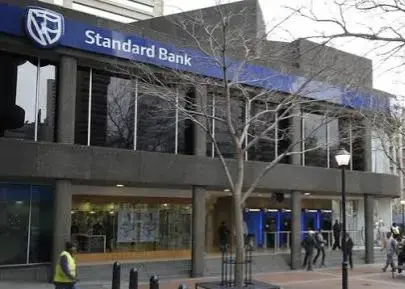
Fossil Free South Africa (FFSA) and the StopEACOP Coalition have lodged a greenwashing complaint against Standard Bank with the Advertising Regulatory Board (ARB), arguing that the bank’s public claims about its sustainability credentials and climate commitments are misleading in light of its financing of the East African Crude Oil Pipeline (EACOP).
The complaint was filed on Tuesday by FFSA, represented by Lawyers for Human Rights, with the StopEACOP Coalition joining the challenge.
It asks the ARB to scrutinise the bank’s 2025 Report to Society, its Climate-Related Financial Disclosures report and its commercial advertising for energy finance, infrastructure finance and sustainable finance services.
Standard Bank states in its 2025 Report to Society that it is one of the lenders to EACOP through Standard Bank South Africa and Stanbic Uganda.
The report states the bank undertook extensive due diligence over several years before committing to finance the project, including environmental and social impact studies, human rights due diligence, climate risk assessments and stakeholder engagement.
The bank notes that the project has also undergone several audits and environmental and social monitoring reviews, including health and safety inspections and third-party evaluations.
The complaint argues that Standard Bank’s repeated claims about its climate leadership, sustainable finance, renewable-energy investment, reduced exposure to fossil fuels and target of achieving net-zero financed emissions by 2050, together with the environmental imagery used in its advertising, create “a broad and unqualified impression” of its environmental performance.
It points to the bank’s description of itself as “a leading provider of sustainable finance solutions” and “a leading enabler of Africa’s just energy transition”. Its reports also state that it intends to substantially grow lending and investment in renewable energy and reduce its exposure to thermal coal and oil.
“These claims, however, are misleading and/or unqualified and/or untruthful in light of the fact that Standard Bank has provided operational funding to the East African Crude Oil Pipeline project,” the complaint states.
EACOP is a 1 443km heated pipeline designed to transport crude oil from Lake Albert in western Uganda to the port of Tanga in Tanzania for export.
The complaint cites estimates that the pipeline could emit up to 34 million tonnes of carbon dioxide equivalent a year at peak production, with total emissions of 379 million tonnes over its 25-year lifespan. It argues that the carbon-intensive infrastructure risks locking Uganda and Tanzania into decades of oil extraction to recover the project’s capital costs.
The complaint also raises concerns about the pipeline’s route through the Lake Albert and Lake Victoria basins. It says the project affects 158 wetlands in Uganda alone, as well as 11 rivers and 44 protected ecological areas.
It argues that the bank’s environmental representations, including its use of clean-energy imagery and statements about its transition to net-zero financed emissions, are “factually inconsistent” with its involvement in financing EACOP.
The complaint describes the content and images in the bank’s advertising as “misleading, hyperbolic” and “an untruthful presentation” of its commitment to sustainability. It argues that the ARB Code requires environmental claims to be truthful, capable of substantiation and presented in a way that does not mislead consumers, including through omissions.
It also challenges Standard Bank’s assertion in its Report to Society that,after an independent environmental and social due diligence assessment, it is satisfied that EACOP continues to meet the requirements of the Equator Principles and the International Finance Corporation’s Performance Standards.
The complaint argues that the bank’s general assurances about environmental and social assessments, stakeholder engagement and risk controls do not adequately substantiate this position.
Standard Bank’s involvement in EACOP sets it apart from other major lenders, the complaint states, describing how four of South Africa’s largest banks — Absa, FirstRand, Nedbank and Investec — have confirmed they will not finance the pipeline, while more than 40 international banks and 30 insurers have refused to fund it.

Citing EACOP Ltd’s 2025 review of the first financing tranche, the complaint says Standard Bank is one of only four financial institutions globally that agreed to finance the project.
The others are Stanbic Bank Uganda, a Standard Bank subsidiary, Afreximbank, KCB Bank Uganda and Saudi Arabia’s Islamic Corporation for the Development of the Private Sector.
In its 2025 Report to Society, Standard Bank states that appropriate stakeholder engagement has taken place and that robust environmental and social risk controls are in place. The bank also points to the project’s economic benefits, saying more than 8 000 Ugandan and Tanzanian citizens are employed on it and that more than 400 000 hours of training has been provided.
The complaint further questions the bank’s presentation of its renewable-energy partnerships. It challenges the prominent wind-turbine image on the cover of the 2025 Report to Society, which features the Ummbila Emoyeni project developed in partnership with Seriti Green.
It argues that the report omits the fact that Seriti Green is a wholly owned subsidiary of Seriti Holdings, which the complaint describes as a major coal producer.
Other parts of the complaint address the bank’s statements about reducing its exposure to oil and fossil fuels, its commitments to water conservation and wastewater management and its support for wildlife and ecosystems. It argues that the claims do not adequately account for the environmental risks associated with EACOP, including potential impacts on freshwater resources and biodiversity.
The complaint identifies nine areas in which it believes the bank’s advertising may contravene the ARB Code: sustainability leadership, net-zero commitments, renewable-energy financing, compliance with environmental standards, fossil fuel exposure, water conservation and biodiversity.
It asks the ARB to require the bank to provide documentary evidence substantiating its claims about climate alignment, fossil fuel reduction, environmental risk management and sustainable finance.
It also asks the regulator to require the withdrawal, amendment or qualification of any representations found to be misleading or insufficiently substantiated.
Standard Bank said it was aware of reports that FFSA might have lodged a complaint with the ARB, but had not received or seen it and was therefore not in a position to comment at this stage.
“Standard Bank remains firmly committed to supporting Africa's transition to a lower-carbon economy and to meeting its publicly stated sustainability commitments and targets.
“We do not believe that supporting renewable energy and sustainable finance is incompatible with responsibly supporting Africa's broader energy and economic development needs as part of a Just Transition.
“Our approach recognises that Africa's decarbonisation pathway must be inclusive, balanced and responsive to the realities of the continent's development requirements. We are one of Africa's leading financiers of renewable energy and sustainable infrastructure, and continue to grow our support for projects that advance the continent's transition to a more sustainable future.
“All financing decisions are subject to rigorous governance processes and comprehensive environmental, social and governance assessments.
“We apply recognised international frameworks and standards when evaluating projects and consider a range of factors, including environmental impacts, social considerations, human rights, governance requirements and economic development objectives. Our approach is further guided by our publicly available Climate Policy.”
The complaint states that the issue is not whether Standard Bank can finance fossil fuel projects while supporting sustainable finance initiatives, but whether its environmental claims accurately reflect the full scope of its financing activities.
“Any consumer exposed to the Report to Society and Climate Report will perceive Standard Bank as a bank that, at a minimum, is moving away from any financing of fossil fuels and is driving sustainable and climate conscious financing on the continent.”
It concludes that the advertisements constitute greenwashing because they omit material facts, lack sufficient substantiation and exaggerate the bank’s position as a leader in sustainable finance.