


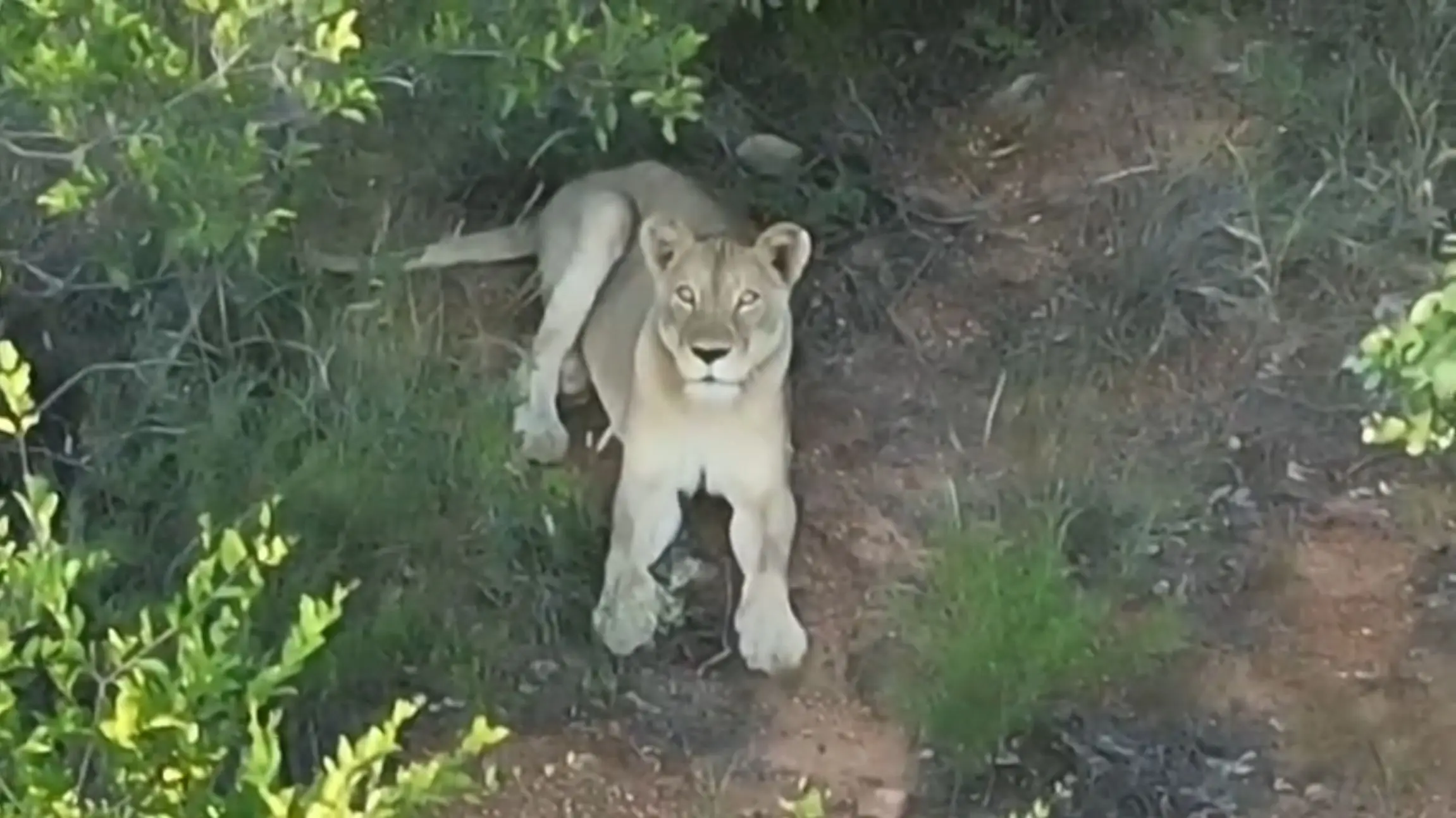
She crossed the flooded Limpopo River twice, wandered through Zimbabwe’s Sengwe Corridor and eventually found her way back to South Africa.
Now, after an extraordinary journey that took her across international borders and brought her into conflict with people more than once, a lioness has settled in the Kruger National Park and given birth to a litter of cubs.
But hers is not an entirely happy story. A young male lion that travelled alongside her was later killed by poachers in Mozambique, while the fate of two older cubs remains unknown.
The lioness, estimated to be between seven and eight years old, was originally captured on Mthimkhulu Game Reserve in Limpopo after coming into conflict with communities and killing donkeys.
The Endangered Wildlife Trust (EWT) said that lions that preyed on livestock could be regarded as problem animals, exposing them to threats including snaring, poisoning and euthanasia.
With the safety of the lioness and surrounding communities in mind, the EWT worked with the Limpopo department of economic development, environment and tourism (Ledet), SANParks, Mthimkhulu Game Reserve, Letaba Ranch and Wildscapes Veterinary Services to relocate her pride to the relative safety of the northern Kruger National Park.
The group comprised the lioness, her two older cubs and a subadult male. But in 2025, the lioness crossed the Limpopo River into Zimbabwe, spending several weeks moving through the Sengwe Corridor before eventually returning to South Africa.
Her movements brought her back south towards the Musina area, where her presence raised further concerns about human-wildlife conflict on the Zimbabwean side of the border.
She crossed the flooded Limpopo River again, this time making her way towards Maremani Game Reserve. However, she was on community-owned land outside the reserve where her presence raised concerns among surrounding communities about living close to such a large predator.
“We were aware of a few livestock losses but surprisingly not many livestock losses or incidents were reported during her time in Zimbabwe, as we have limited communication with the relevant authorities and communities on that side of the border,” said Derek van der Merwe, the manager of the EWT’s carnivore conservation unit. “Similarly, we cannot confirm whether there were any livestock losses during her time close to Maremani.”
After discussions between SANParks and Ledet, it was agreed that returning her to Kruger would offer the most suitable solution.
Van der Merwe said there were two main considerations: available space and the risk of her causing conflict or a risk to human lives in the communities close to Maremani.
“We needed to find a solution that offered her the best chance of establishing a stable territory while also minimising the potential for further human-wildlife conflict. Returning her to Kruger was considered the most suitable option.”
Through the collaboration of veterinarians, landowners, government authorities and field teams, the EWT successfully darted the lioness and returned her to Kruger.
The intervention appears to have paid off. The lioness has successfully settled in her new home, established a territory and the area is suitable for long-term breeding.
“The confirmation of her new litter is particularly encouraging. We have deliberately avoided approaching or disturbing her den site. At this stage, we are allowing her the space and privacy she needs to raise her cubs successfully.”
The fate of the young subadult male lion that was also fitted with a GPS collar and originally relocated with her has been less fortunate.
Van der Merwe said he had one well for several months and followed the lioness into the Sengwe Corridor in Zimbabwe. He had eventually returned to Kruger National Park before moving further north into Limpopo National Park in Mozambique.
“Sadly, shortly after entering Limpopo National Park, he was poached. His body parts were removed, and he was another victim of the targeted poaching that continues to threaten lion populations across this landscape.
“We unfortunately don’t know what happened to the two older cubs. They were not collared at the time and we subsequently lost track of their movements.
“It is a sobering reminder that, while we celebrate the survival of this lioness, not every animal has been as fortunate. Her story has a happy chapter, but it also reflects the very real threats facing lions across the Greater Kruger landscape,” he said.
The lioness’s movements across the landscape would have been difficult to follow without the GPS collar fitted by the EWT, which allowed field staff to monitor her movements across reserve boundaries and an international border.
Van der Merwe said the collar helped coordinate the interventions needed to give her another chance. “It is a powerful example of why investing in collars and monitoring technology is so important to carnivore conservation.”
Her journey illustrated the importance of transboundary conservation, particularly in a landscape where large carnivores moved freely across protected areas, private reserves, community land and international borders, he said.
“It also demonstrates that transboundary relocation and conservation interventions are possible, but they require careful planning and consideration. There are several important factors to consider when relocating lions.
“Perhaps most importantly, we need to understand what will anchor an animal to a new area. Are there other established lion prides or competing coalitions? Is there sufficient space and suitable habitat? Are there livestock or communities nearby and what is the potential for future human–wildlife conflict?”
Simply moving a lion from one area to another did not necessarily solve the problem. “We need to understand the wider landscape, the resident lion population and the potential challenges the animal may encounter once released.”
Lions play an important role as apex predators, helping to maintain healthy and balanced ecosystems. For the EWT, the birth of the new cubs is an encouraging development for the lioness and the future of the population in the landscape.
Van der Merwe said the lioness’s remarkable passage across the region was also a reminder that conservation was rarely straightforward. It took patience, perseverance, difficult decisions and, above all, people willing to work together across political, geographical, social and organisational boundaries to give wildlife a chance.
The lioness’s journey, he added, was a wonderful example of how collaboration between conservation organisations, government authorities, private landowners and communities can make a difference.
“The contrast between her survival and the loss of the young male is particularly important. It shows both what is possible when we work together and how much work remains to secure the future of lions across this landscape.”
The intervention was supported by the EWT’s donors, the Lion Recovery Fund and the Kevin Richardson Foundation, alongside conservation partners and government authorities.