


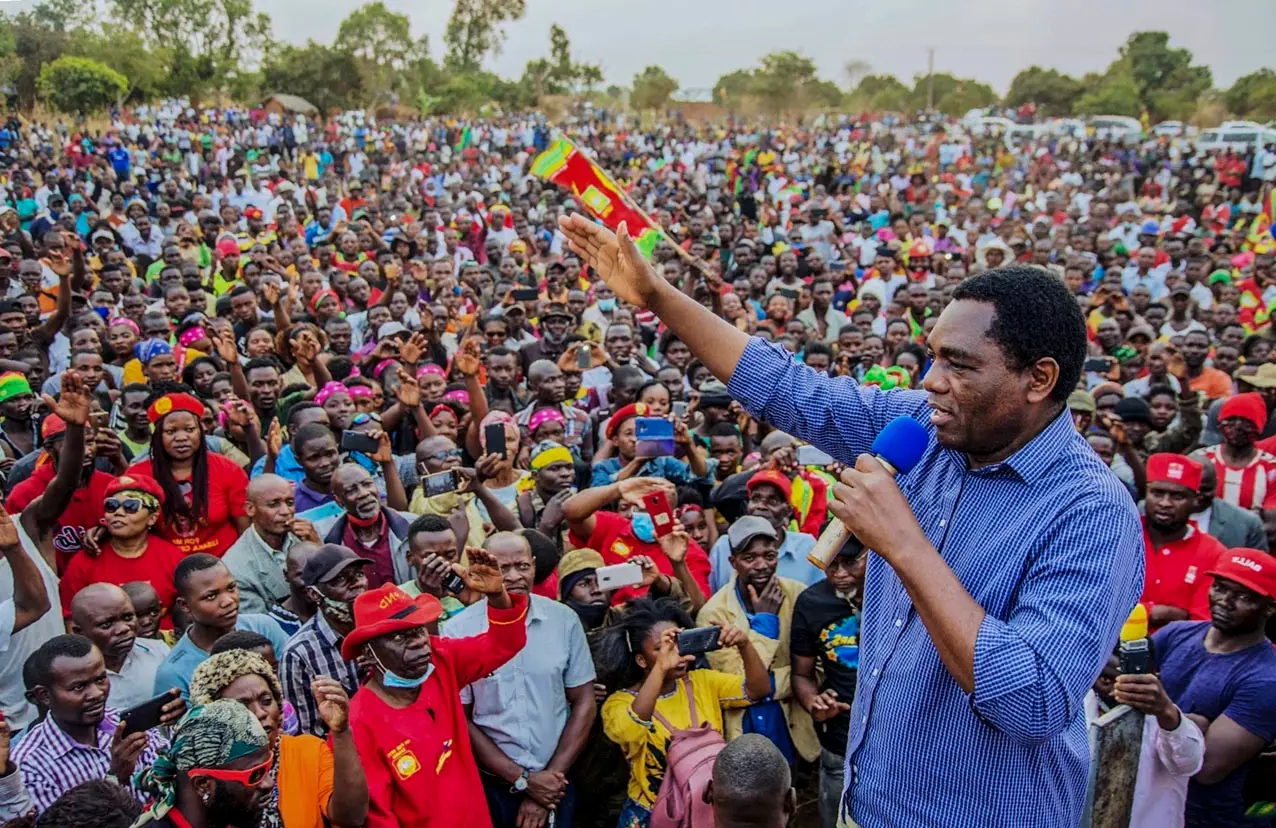
Zambians heads to the polls on 13 August 2026. Among the 14 contenders in the election, President Hakainde Hichilema is seeking another mandate from the people.
The big question analysts, pundits and ordinary Zambians have to ask themselves is whether the president has done enough or met the expectations of the people in order for them to contemplate giving him another term of office.
It doesn't matter what others think of the Hichilema administration, including the broader international community — at this point, it's only the views, opinions and conclusions of registered voters that will be of consequence. Therefore, let us examine whether a strong case can be made either for or against another five more years of the Hichilema administration.
On many occasions, Hichilema has argued that his administration and himself are the best things that happened to Zambia. In fact, he has even gone so far as to suggest that he has achieved more for the country than any of his predecessors. This is certainly subjective and can be self-deceptive if not put in proper context or at least explained well to the people.
Some of the things the governing United Party for National Development (UPND) and its leader, Hichilema, have done and according to them, makes the case for re-elections by the Zambians people:
1. Free education from primary to secondary school. This alone has seen more than 2.5 million children returned to school. There have been teething problems with the implementation of this, such as the increased pupil-to-teacher ratio, with some teachers having more than 180 pupils in a classroom. This is something the government has vowed to work on. Nonetheless, this is generally accepted by most people as a good initiative.
2. An increase for the Constituency Development Fund — a fund to develop various constituencies. Under the previous government, the CDF was at K1.6 million (Zambian kwachas). Hichilema has increased it to almost K40, enabling the government to localise development and decentralise certain projects.
3. Partial withdrawal for pensioners under the National Pension Scheme Authority. The partial withdrawal allows pensioners to withdraw 20% to 30% of their savings before maturity or retirement, so that they can start their investments early.
4. Meal allowances for students. This applies to all government institutions of higher learning, colleges and universities. To be fair to the UPND, this was a promise it kept when it formed the new government. The previous administration, under the Patriotic Fund (PF), had removed the meal allowances.
5. Restructured debt. This is an old song but something the government is proud of as it has worked with the International Monetary Fund and World Bank to get this far. But the question remains: What has this restructuring of the debt done for the people in more practical terms?
6. Single-digit inflation. The UPND government says the PF, under president Edgar Lungu, left the inflation rate at 21% but managed to bring it down to single digits. The figure varies, depending on whom you talk to.
7. Increased activities in the mining sector as the country prepares for what the government says will be the largest mining investment on the continent with the soon-to-be opened Minkomba Mine in CopperBelt Province. However, the greatest score for the administration has been its ability to ensure that it passes and implements laws that will increase the participation of Zambians partnering with foreigners in the mining sector via the local content doctrine. A provision states that if foreign nationals want to get a mining licence, a Zambian has to be a partner or shareholder.
8. GDP growth of 4% to 6%. At the height of Covid-19 and during the transition from the PF rule to the UPND in 2021, the Zambian economy was growing at -2% (which was not usual, because most of the world economies were growing in the negatives). Fast forward to the present, under the leadership of Hichilema, the Zambian economy is growing at somewhere between 4% to 6% — an achievement most people are proud to point out.
9. School feeding programmes. The government has introduced free meals in government primary schools. This has attracted great appreciation and publicity among the population.
10. Zambia's image abroad is a plus for the administration. It is no secret that Hichilema and his administration continue to enjoy favourable international headlines. Whether this is based on reality or purely public relations can be hard to determine because sometimes the line between the two are blurred.
The case against a second term for Hichilema is as compelling as the opposite because of the disconnect between the realities facing the people and the economic fundamentals being reported. Zambians are alert to such things and have even demonstrated that they favour trickle-down economics as opposed to good indicators only on paper.
In 2011, Zambians voted the Movement for Multiparty Democracy (MMD) out of power and ushered in the PF — despite the fact that all economic indicators were impressive under the MMD. This could be history repeating itself if the UPND does not do the right thing by addressing the effects of trickle-down economics.
Some of the reasons why some people think Hichilema should not have another five years:
1. The high cost of living remains a serious challenge the administration needs to address. Despite the fact that economic indicators paint a great picture of life in Zambia. The truth is that most people cannot feel the effects of the positive numbers. The question that most people are left to wrestle with is whether life is better for them now compared with five years ago. The answer can be subjective but it's difficult to find many people on the streets of Lusaka or across the country who answer in the affirmative.
2. For the longest time, the UPND championed the notion that for the past four to five years "there was no opposition in Zambia, because they were doing so well in government". Well, come 2026, we quickly went from no opposition to where we are now — 13 other presidential candidates of which at least two appear to be serious contenders.
3. Proposed and rushed constitutional amendments (Bill 7, now Act 13 of 2025 and 70-plus bills parliament passed just days before it was dissolved).
4. Load shedding lasted for just over four years when the UPND was in power. Now there is even talk that this will happen again after elections.
5. Internal intraparty challenges after nominations. Hichilema has gone unopposed in the party, for reasons only known to the governing party.
6. Political violence, including intimidation and harassment, by UPND cadres. Mazabuka Central and Lusaka’s Chawama constituencies are cases in point.
7. Allegations of corruption have been ramped under the Hichilema administration, according to the Financial Intelligence Centre reports in the past five years, with figures for illicit financial flows quoted in billions of kwacha and dollars too. The $80 million the government accidentally sent to China was shocking. Also, the issues surrounding the Ndola-Lusaka dual carriageway and Mopani Copper mines, which were essentially public assets, were transferred into private hands without the approval or ratification of parliament under article 210 of the Republican Constitution.
8. The blowback that will emerge from the recycled politicians of the previous regime who have joined the UPND
9. A lack of cash or liquidity in the country and high interest rates. The economy looks good on paper but without any trickle-down effects to citizens.
10. Allegations of regionalism and tribalism in government. For any objective thinker or well-meaning Zambian, the line between the case for Hichilema to be voted in for another five more years is blurry, with strong arguments against his second term bid. This is what makes this election unpredictable and consequential.
The newly passed Act 13, 2025, together with the Electoral Process Act, provides dynamics that will produce shocking and unexpected results at all levels. Therefore, all serious political players taking part in the process must be vigilant and examine their prospects with much thought and deep reflection.
The idea that Hichilema will win the elections with a landslide of five million votes — almost double of what he got in 2021 — is nothing but a fuss. It's like the days of the PF led by Lungu just before the 2021 elections where some pundits and trusted voices in his circle pronounced that he would win the elections with more than 500 000 votes. That turned out to be a joke. As fate would have it and because men learn nothing from history, we have people close to Hichilema misleading him by saying he will obtain five million votes.
For all practical purposes, only Brian Mundubile and Makebi Zulu opposition presidential ticket seems to be poised for a good outcome, which will significantly take a huge chunk of the votes in the urban areas and along the line of rail. In other words, the CopperBelt Province and Lusaka Province will still remain the battleground for this election as well.
It would be naive for anyone to think that the UPND will command a wide margin in these two provinces. Unlike the 2021 elections, which had a two-race horse, there is a high probability that this year, the race will produce a third or even fourth force to be reckoned with. Just as it was during the Movement for Multi-Party Democracy era, the PF was the main opposition leading up to the 2011 general elections but the second-largest opposition party, the UPND, was strong then.
Therefore, as an example, it is possible that the likes of the Kalaba-Mawere as presidential ticket will presumably do really well if all things being equal.
Furthermore, in the 2021 general elections, which was largely a race between the UPND, then in opposition, and the government PF, the rest of the opposition political parties, 14 or so, got less than 1.5% of the total vote.
This will not be the case in this year’s general elections because the mood in the country favours an opposition poised to score far better percentage-wise, than what we have seen. This implies that even a 50+1 majority, as required by the constitution, will not be a walk in the park for Hichilema. Obviously, the political strategists and advisers surrounding the president seem to have a different view and have been telling him otherwise.
Evidently, there are significant reasons why the opposition will work even harder in this election — the most rational one is what came out of Bill 7, now Act 13 of 2025 — the idea of propositional representation or a quarter system that will allocate certain seats of youth, women and other vulnerable groups based on the performance of political parties in the election. The new constitutional provision is a game-changer and will force opposition political parties to deploy tactics we have not seen before, just to win seats in parliament and thereby get a piece of the cake from the propositional representation scheme.
In the final analysis, the vote could swing either way for Hichilema in August 2026 general elections, according to all predictive indices, but it is more probable that the victory will be achieved in a presidential run-off. The idea of parading famous people, opposition politicians and even old-timers to endorse the president cannot be used as a tactic for guaranteeing a certain outcome.
In the US’s 2024 elections between Donald Trump and Kamala Harris, Harris received all sorts of endorsement from prominent people but at the end of the day, that did not translate to the tangible victory she needed to make history.
Those around Hichilema should sober-up and give the head of state the accurate and correct picture of what is attainable and what is most likely to happen at the polls.