


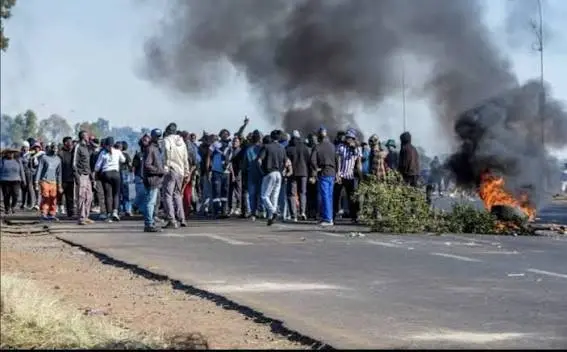
There are deaths that should not happen in a democratic dispensation. A week ago, two deaths occurred in Ratanda, a township south of Heidelburg, that should make every South African reflect on the depths to which our country has descended. Katleho Mokoena was just 23 years old when he was struck multiple times by rubber bullets while participating in a service delivery protest. Sipho Motaung, aged 39, died after being hit by a bullet while sitting with friends outside a home. Though he was not taking part in the protest, he still became a casualty of police clashes with community members who were demanding a fundamental human right – water. Ratanda residents had taken to the streets demanding reliable water after weeks of constrained water supply in the area. The water supply crisis in Ratanda began in mid-June 2026 when Rand Water reduced bulk water supply to the Lesedi Local Municipality. The horrific deaths sparked outraged and calls for the mayor, Mluleki Nkosi, to step down. Protesters blocked water tankers with burning tyres and rocks, then went on to burn down the mayor’s home. The home suffered damage, but the mayor was able to escape unharmed.
Rand Water took the decision to reduce water supply to the municipality by 20% owing to mounting and unpaid debt. The municipality owes the bulk water utility just over R27 million, and had repeatedly failed to honour payment arrangements. Municipalities in Gauteng alone owe roughly R9 billion to Rand Water. According to recent National Treasury figures South African municipalities owe more than R15.7 billion to various water boards combined. The overall multi-billion rand debt is driven by several repeat-offending councils. Significantly, the same municipalities who owe water boards are also those with poor audit outcomes. The recently released consolidated report of the Auditor-General revealed that her consolidated report that only 39 out of 257 of municipalities in the country achieved clean audits while 39 actively regressed. A total of 145 municipalities have shown zero improvement since 2021. The most common audit outcome for municipalities is an unqualified audit opinion with findings, indicating systemic failure to comply with basic legal frameworks. At the core of poor audit outcomes is massive irregular and wasteful expenditure, institutional decay owing to political instability, collapsing budget facilities evidenced in over 40% of the municipalities adopting unfunded budgets, and a chronic lack of consequence management. Municipal leadership routinely fails to investigate financial misconduct or hold officials accountable, creating a culture where non-compliance is normalised.
The Lesedi Local Municipality is one of the 69 municipalities whose equitable share grant allocation has recently been temporarily withheld by the National Treasury. This corrective measure aims to enforce fiscal discipline, address massive unauthorised and wasteful expenditure, and ensure that municipalities pay their mounting debts to bulk suppliers, mainly Eskom and water boards. The municipality had committed to use part of its July equitable share allocation to begin settling its debt to Rand Water – debt that is threatening the financial survival of an entity that receives no government funding and relies solely on payments from municipalities and other corporate customers. When local councils fail to pay, the bulk water utility risks running out of cash, which halts vital pipeline maintenance and infrastructure construction at a time when water security should be a key priority in the country. Non-payment to water boards poses the very real risk of systematic collapse. If the debt is not paid, or the crisis gets worse, it threatens the entire water supply of the nerve-centre of the national economy. This will worsen unemployment and a cost-of-living crisis that is already tearing the country asunder.
The deaths of Mokoena and Motaung are not simply an unfortunate tragedy, they are a direct result of systemic municipal failure. Poor water governance, the failure of overall framework and processes for decision-making and implementation of policies related to the use and management of water resources, does not happen in isolation to broader poor governance. What happened in Ratanda was not just about water access – it was about widespread deficiencies stemming primarily from deep-rooted financial mismanagement, systemic corruption, infrastructure neglect, and a critical lack of skilled management. I understand and respect the decision by Rand Water to suspended the reduction in the Lesedi Local Municipality to help restore normal water services and prevent more tragedies. It is a moral stance. But we must recognise that the problem is much bigger than water supply, and that water access in this case is a symbol of broader service delivery challenges that are devastating the national economy and eroding fundamental democratic principles and violating the constitutional mandate of the state. Until we have municipalities that work, it is a mathematical certainty that what happened in Ratanda will happen again.
Malaika is a geographer and researcher at the Centre for Women and Gender Studies, specialising in water governance and urban spatialities. She is a PhD in Geography candidate at the University of Bayreuth in Germany.