


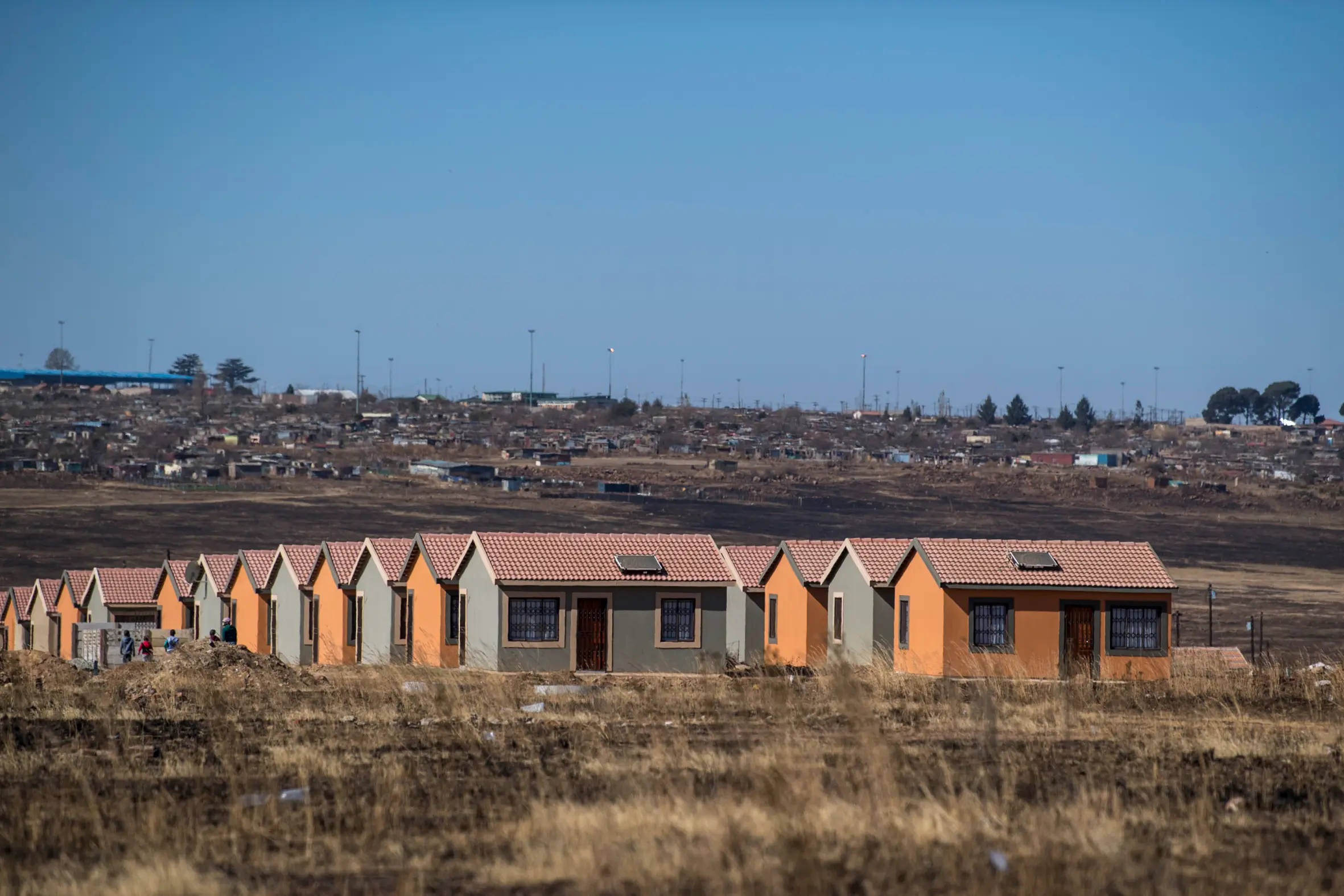
Ahead of the local government elections on 4 November, campaigns will be fought in the familiar language of delivery, focusing on the number of houses completed, taps installed, roads tarred, lights connected and settlements upgraded. Although these numbers matter, they are also dangerously incomplete. A municipality can build many houses and still make a city less just.
Consider the country's main housing statistics. The government reports that it has provided about 5.2 million "housing opportunities" since 1994. This number includes serviced sites and over 3.2 million RDP/BNG (Breaking New Ground) houses.
Under the RDP programme, qualifying beneficiaries get a fully built house for free, though they still must pay for municipal rates and service charges.
That is an extraordinary achievement. Measured by units, it looks like a success story. Measured by location, the story changes.
The government built too many subsidised houses where land was cheap and delivery was easiest, on the urban edge, far from jobs, schools, reliable transport and social infrastructure. That made the spreadsheet look good. It also made the apartheid map harder to undo. Apartheid planners designed cities to keep black South Africans physically distant from land, work, and political power, admitting them to the urban economy mainly as a source of labour.
Research on South African settlement patterns shows that colonial and apartheid planning created the spatial injustice and exclusion that still shape towns and cities today. Democracy promised to change this by offering more than shelter. It promised the right to live in the city as a full citizen. However, many poor households received formal houses in places that still separated them from opportunity.
The 2025 White Paper for Human Settlements acknowledges the problem bluntly. It confirms that apartheid spatial development remains entrenched and that, in many cases, state interventions have exacerbated spatial inequality patterns.
The result is a painful paradox, as a policy created to repair apartheid has often extended one of its central spatial logics.
This did not happen through malice. It was driven by incentives, land markets, political pressure and a delivery culture that counts units more easily than it measures access.
New burden
A house on the city's edge is not truly free. Households pay for it every month through taxi fares, wasted hours and lost opportunities. Transport costs are the hidden bill for living on the periphery.
In Gauteng, almost 60% of households spent more than the 10% policy target on public transport in 2019/20. A City of Cape Town transport plan reported that the lowest income households spent as much as 43% of their income on public transport, although a later plan questioned that estimate.
While the exact numbers vary between datasets, the evidence is consistent. The further poor households are pushed from jobs, the more the city taxes them.
The International Monetary Fund's 2026 analysis of spatial inequality in South Africa found that transport alone uses about 17% of wages. This figure rises to 30-40% when lost time is included. In areas where the average commute is over an hour, unemployment is more than 20 percentage points higher than in areas with commutes under 15 minutes.
A house two hours from work is shelter, not integration.
Drifted outward
Social housing was created to solve this problem. The government subsidises affordable rental homes for working families in well-located areas. This policy is one of the few tools South Africa has to place lower-income households near jobs and public transport.
However, this solution has become less effective. Research by Andreas Scheba, Ivan Turok and Justin Visagie identified a "spatial drift" in social housing.
Projects have moved away from inner cities to the outskirts of South Africa's seven largest cities. While early projects often repurposed inner-city buildings, later ones were increasingly built in outer suburbs, townships and new mega-projects on undeveloped land.
The programme has produced only tens of thousands of units, not millions. Its geography is what matters most. It reveals the struggle to make location, not just the number of units, the true measure of housing policy. The old map persists because building where poor people already live is administratively easier, politically safer and cheaper in the short term.
Lack of will
South Africa does not lack planning instruments.
The Constitution protects the right of access to adequate housing. The Spatial Planning and Land Use Management Act aims to correct past spatial and regulatory imbalances, promote inclusive planning and create municipal planning tribunals. Municipalities use tools like integrated development plans and spatial development frameworks. The Constitutional Court has confirmed that rezoning and establishing townships fall within these municipal planning powers.
The new Expropriation Act is now law but the government has not set a date for its implementation. If the state uses it carefully and within the bounds of the Constitution, the Act can help acquire well-located land for a public purpose or in the public interest.
The problem is not the absence of tools. It is that tools without consequences become ornaments. Spatial frameworks are too often disconnected from budgets. Planning tribunals are thinly resourced and exposed to pressure from developers and ratepayers. Inclusionary-housing policies are delayed, diluted, or fought suburb by suburb. While national departments can fund programmes, many daily land-use decisions are local. These decisions determine what gets approved, where densities are allowed, who gets excluded and whose objections carry weight.
Local elections are important for this reason. Councils determine whether well-located land becomes mixed-income housing or another exclusive enclave. They determine whether 'densification' means only luxury apartments or also includes homes affordable to nurses, cleaners, security guards, students and municipal workers. They also determine whether public land is treated as a balance-sheet item or as a democratic asset.
The upcoming local elections should not be another contest over delivery totals alone. Voters should judge councils on the location of new houses as much as the number built. They should ask three spatial questions:
First, where are houses, serviced sites and social housing being built in relation to jobs, schools, clinics and public transport?
Second, is the municipality using its land, zoning powers and infrastructure budget to integrate the city or to push the need further outward?
Third, who is allowed to say no? Middle-class resistance to affordable housing is often dressed up as concern about traffic, parking, 'neighbourhood character' or property values. The effect is to keep poor people away from the opportunities their labour sustains.
South Africa needs annual spatial-justice audits for municipalities. These should show how many units were delivered and also measure the average distance of subsidised housing from employment nodes, transit corridors, schools and health facilities.
Grants for housing and infrastructure should incentivise well-located, mixed-income delivery. They should not be used for projects on the cheapest land at the urban edge. Inclusionary housing must become a standard condition for private development in good locations. It cannot be a favour negotiated project by project.
The map is the policy
Social justice is impossible without spatial justice and on 2 July 2026, the ConCourt gave that principle legal force.
In Adonisi (the Tafelberg case), the Court held that location is a legal component of adequate housing and equitable access to land and found the Western Cape Government and the City of Cape Town had breached their duty to redress apartheid era spatial inequality.
While title deeds, water connections and electricity meters are important, their value decreases significantly if they are delivered within the same geography of exclusion that apartheid created.
South Africa's housing programme is a great material achievement of its democracy. It is also one of its starkest warnings. Injustice can be hidden by numbers when the focus is only on how many units are built, while the distances people must travel are ignored.
On 4 November, the real question is not simply how many houses a party promises to build. It is whether it is prepared to change where opportunity lives.
The country has spent three decades proving that it can build at scale. The next test is whether it can build in the right places.
Dr Lungelwa Kaywood is affiliated with the School of Public Leadership at Stellenbosch University.