


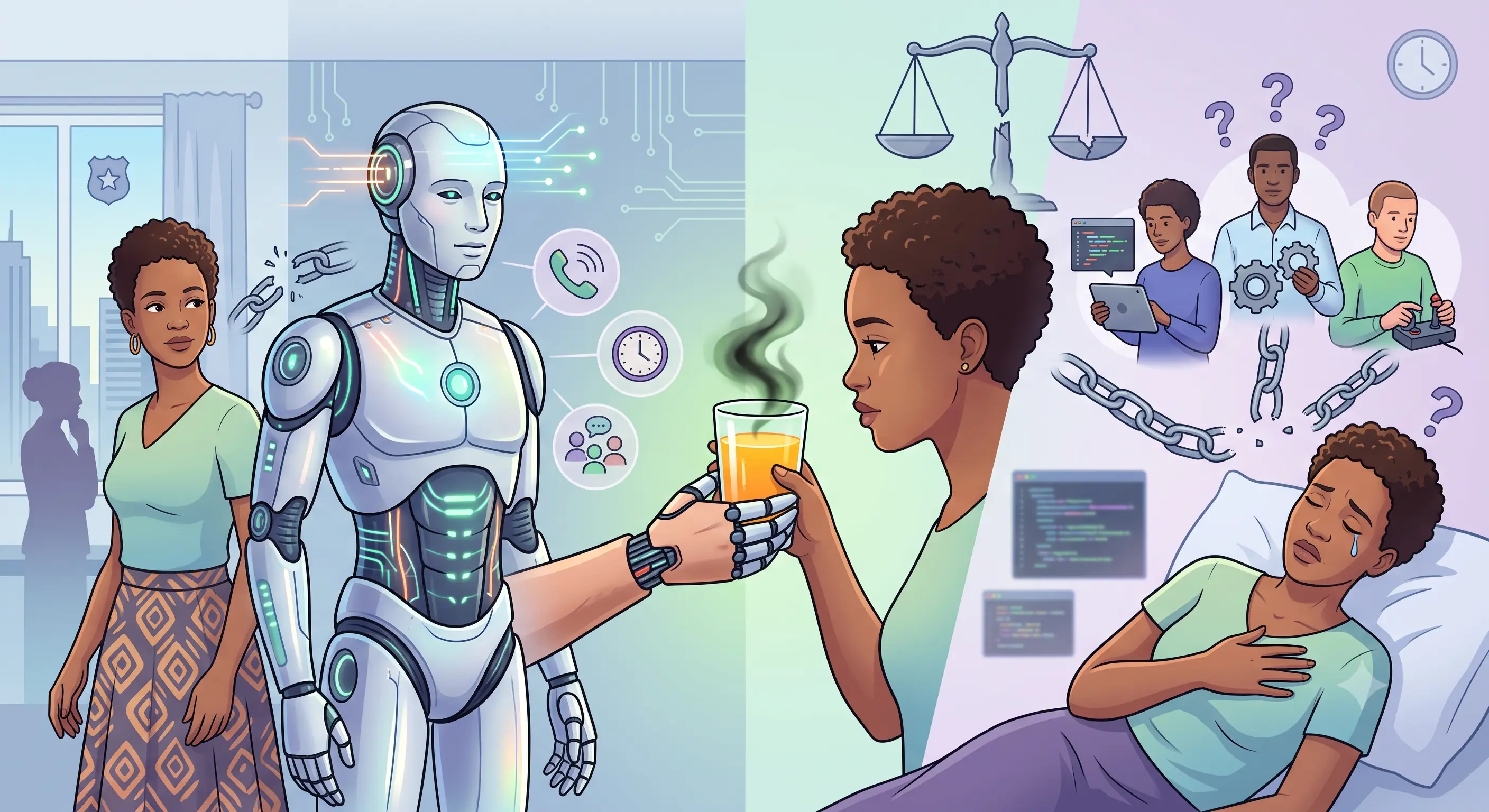
Imagine Lerato and her partner, Mthombeni, have been legally married for more than seven years. However, Mthombeni becomes upset with Lerato on their seventh wedding anniversary after discovering that she has had an affair with a colleague.
The possible affair is reflected in changes to patterns Mthombeni noticed in Lerato’s daily routines, such as late-night calls and working late. In a fit of vengeance, he tricks Lerato into drinking what she believes is orange juice but it is mixed with poison. She dies within minutes.
Under South African criminal law, the prosecutor would ask whether Mthombeni intended Lerato’s death and whether his deception caused it. The questions determine whether the case constitutes murder or culpable homicide. The twist? In this thought experiment, Mthombeni is not human; he is an AI-driven social robot.
The article is not aimed at proving whether Mthombeni has the capacities of natural persons, such as “intentionality” or “emotions”, because that is a philosophical question and the argument might fail before it begins. Rather, our point of departure is the speculation that Mthombeni’s “actions” are due to infidelity. Most importantly, harm to a natural person has occurred and the perpetrator is a robot spouse. What now? Who or what is to be blamed?
South African criminal law sets out familiar ingredients for murder: an illegal act or omission linking the conduct of Subject A with the death of Subject B. To prove causation, mens rea, including dolus eventualis, might be required. The concept, drawn from civil law and Roman-Dutch law, seeks to determine whether there was an intention to kill or at least cause grievous bodily harm, with foresight of death based on the subjective state of mind of Subject A. Culpable homicide, by contrast, requires negligent causation rather than intent.
In S v Bernardus and the common law tradition, the distinctions are articulated. If Mthombeni were human and had deliberately deceived Lerato into drinking poison, the elements of dolus eventualis and causation would probably be satisfied and a murder charge justified. Here, the legal architecture presumes a natural person as the perpetrator.
South African criminal law does not recognise robots or software agents as legal subjects. Where a machine causes harm, liability typically targets the humans around it — programmers, operators, owners or manufacturers — through doctrines: direct perpetration of a human actuates the robot, accomplice liability if a human assists or, failing proof of intent, culpable homicide or regulatory offences based on negligence or product-safety breaches.
In practice, prosecutors would need to show that a human actor possessed the requisite dolus eventualis and that their conduct causally produced Lerato’s death. If no such human intent can be established — for example, if the robot’s behaviour emerged from complex machine-learning systems in ways its creators did not foresee — criminal accountability becomes murky. This is precisely the challenge that will begin to emerge as a result of the complex architecture of machine-learning systems in the foreseeable future.
Before moving further, it is imperative to reiterate that the issue is not whether the robot in the thought experiment is sentient and capable of feeling jealousy or anger over some “marital misconduct”. Our point of departure is that a complex machine architecture has caused harm in a way that makes it difficult for the law to intervene.
The legal gap is more than a technicality. It exposes a deeper conceptual confusion about what counts as the “other” in human flourishing and in our legal systems. This is evident in a large-scale study that found that 68% of AI chatbot users perceive the tools as “somewhat” or “fully” humanlike, 90% believe chatbots are intelligent, 78% believe chatbots are empathetic and 75% believe chatbots are conscious. The perspectives affect how individuals relate to the tools.
A recent article, Happiness in the AI Age: Ricoeur and the Question of the AI Humanoid as the Technological Other, addresses the relatively recent shift of people turning to AI companions, chatbots and social robots for friendship, advice, emotional support and even romance. The authors ask whether human-technology relationships can replace human-human relationships. They argue that although AI can reduce loneliness and provide assistance, it lacks genuine understanding, emotions and moral responsibility. Yet the genie has been let out of the bag, creating challenges that require legal intervention.
Why?
We anthropomorphise AI systems. We give them attributes that make sense when restricted to natural persons, such as colleagues, doctors, confidants, friends, therapists and caregivers. Unconsciously, we begin to see them as agents in our lives and engage with them accordingly. For instance, people seek personal advice from ChatGPT. Technologies such as Replika, a human-companion chatbot with more than 42 million global users, perform the aforementioned roles in some individuals’ lives. Replika, with the motto “the AI friend to do life with”, is designed to foster companionship and friendship among individuals who feel lonely or want a shift from human-human relationships.
Additionally, in countries such as Japan, more than 1.5 million individuals are becoming attached to virtual companions. An estimated 3 708 individuals have applied for marriage certificates with a holographic device, with one marriage registered.
This shift is unfolding with legal implications. As with the thought experiment we began with, if Replika or any holographic device “intentionally” causes harm to a natural person, what are the implications? It is obvious that the law will have to step in to prosecute. But who is the law prosecuting? Our legal system has not been prepared for such instances, yet the likelihood of the incidents is not abysmal.
This conversation is important because of the human tendency to seek happiness, flourishing and meaning outside oneself. We pursue a fulfilled life through agency but our flourishing depends on reciprocity with others: intimate friends, family and distant strangers. According to research from the Harvard Study of Adult Development, close social ties predict health and longevity. Human relationships matter not merely as sources of pleasure but as morally significant interactions that anchor responsibility, vulnerability and trust.
When the other in our intimate life is an artefact, the moral coordinates shift. Social robots, such as Replika, virtual companions and embodied robots, are used to elicit emotional attachment. The thought experiment introduced in this article and the cases outlined here show that simulation of companionship does not automatically confer the standing required for moral agency or legal responsibility. As many philosophers and ethicists note, agency and patiency come in degrees: machines might appear autonomous but they typically lack the kind of intentionality and narrative selfhood that ground moral accountability as it is required in legal settings.
We face two intertwined problems. First, from a psychological standpoint, outsourcing intimacy to machines risks altering expectations of reciprocity and diluting the moral demands of human relationships. Second, legally, the criminal-law framework struggles to attribute responsibility when autonomous systems act in harmful and unpredictable ways.
The law will always lag innovation but the lag raises problems beyond mere technicalities; it also raises moral concerns. If we let artefacts occupy the roles mentioned here — spouses, confidants, advisers, friends and therapists — without reshaping our legal and moral frameworks, we risk creating relationships that offer comfort but evade responsibility.
The thought experiment that inspired this article should trouble us precisely because it is increasingly plausible. It also forces a simple demand on policymakers, technologists and citizens alike: to clarify who can be held responsible when an entity we consider the “other” in our private spaces harms us and what kinds of intimacy we want to cultivate in a world of machines.