

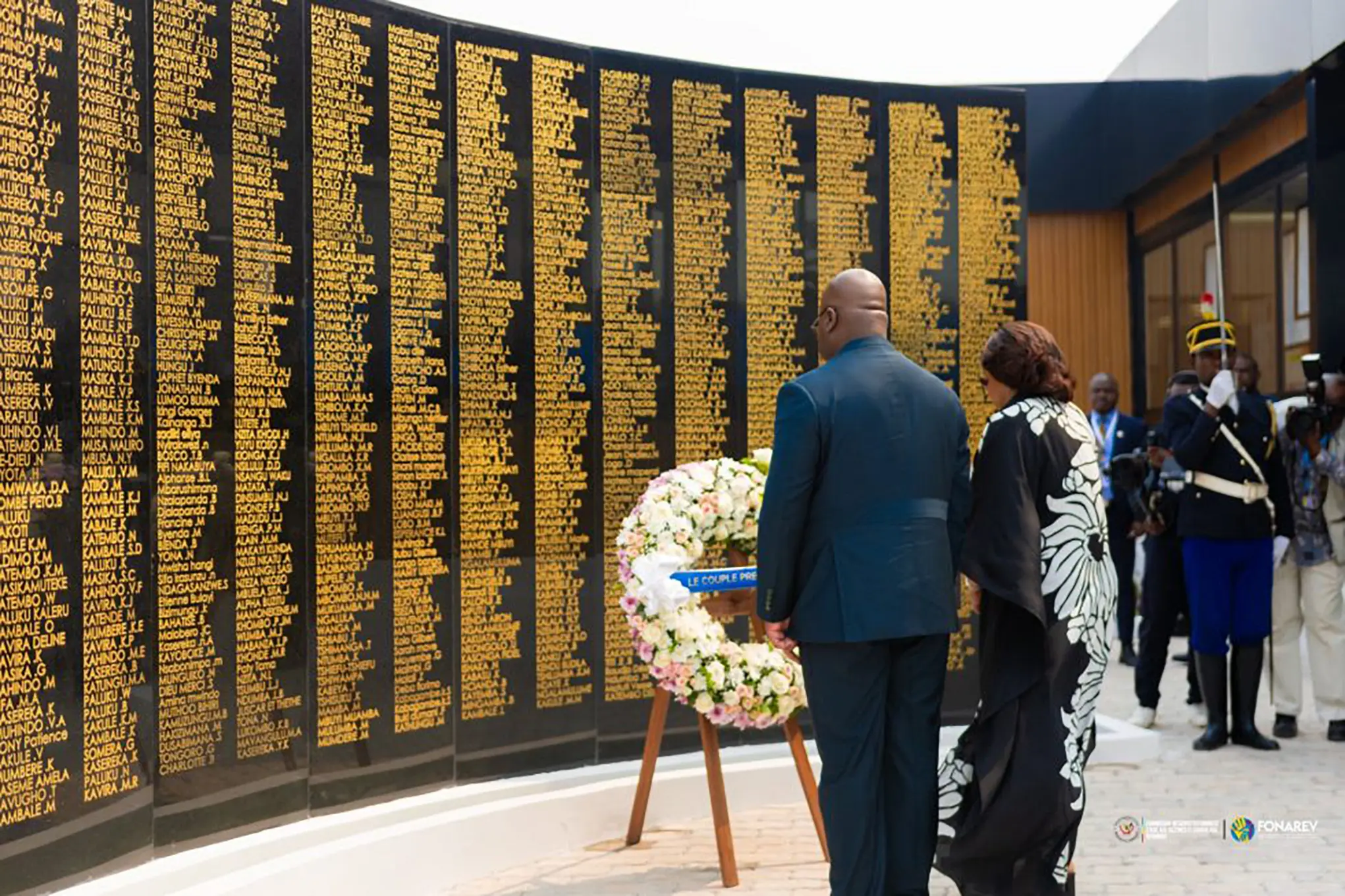
This is the time of the year when the Congolese remember the millions of victims killed in the decades of war in eastern Congo. To many in Congo, 2 August is known as Genocost Day and marks the day in August 1998 when the Second Congo War broke out.
That long conflict claimed around four million lives and sucked in seven African nations.
An orgy of killing and rape spread through eastern Congo. It brought disease, hunger and devastation that largely destroyed many villages and livelihoods.
The day fails to get much attention outside the Democratic Republic of Congo (DRC) — some even deny the description of the killing as a genocide.
The world has moved on to other conflicts and concerns, leaving the misery of the Congo largely forgotten. Those who've lived through these years of war, however, can never forget. That includes doctors like Jo Lusi whom I first met when I returned to eastern Congo in 2003 to make a documentary for the BBC about the conflict.
By this time, Jo and his wife Lyn had endured almost a decade of war after the genocide that I'd witnessed and reported on in Rwanda in 1994.
The war unleashed a poison that crossed borders and has endured to this day. Since 1994, Jo has treated thousands of patients caught up in the conflict at his hospital in Goma in eastern Congo. Between 1994 and 2003 the United Nations had documented some 617 incidents of human rights violations and violent atrocities in eastern Congo.
"What happened here is what we call hell," he told me as he showed me around the wards. "Sometimes we cry and sometimes we understand that life is a terrible thing. For us it's been the most terrible depression".
Through all those years of war Jo and Lyn managed to keep their hospital open. It has been attacked countless times by various militias and armed raiders.
Together they have witnessed violence, cruel attacks on civilians and an epidemic of rape.
They treated thousands of rape victims, many of them were so badly injured in the rapes that they suffered fistula and needed reconstructive surgery.
Our BBC documentary team were devastated to see rows of women in line at the hospital.
All of them needed surgery. Some had walked miles to reach the safety of the hospital.
I'll never forget one young woman who described to me what had happened to her: "I was 16 when I was chased into the bush and taken by four soldiers. They took all my belongings, then they all had sex with me even though I was pregnant. That's why my baby was born dead and how I was made incontinent."
She was just one of thousands of young women raped as the epidemic of violence swept through eastern Congo.
At its height, Lyn told us that the hospital had treated 2 133 rape victims in six months and that was only scratching the surface of the scale of the violence.
"We've seen the total breakdown of law and order," she said.
"For the last 10 years it's been this way. The militias came to understand that there would be no consequences whatever crime they committed. When people realise there is no control, no recourse for any offence, then some will enjoy being violent to the most helpless."
A study in the American Journal of Public Health found that at the height of the violence an average of 48 women and girls were raped every hour in the DRC. It found that in one year some 400 000 were raped.
From the Lusis' hospital in Goma we travelled into the remote villages around Katanga Province where some of the most brutal attacks had happened.
We met Mama Jeanne Banyere. Her Protestant Women's Association works with the rape survivors: "We have many similar stories that make us shed our tears. Children as young as nine or even four have been raped. I've had counselling myself to help me cope. We've had so many years of conflict and we've been living through all this."
Little did Mama Jeanne realise when we spoke that day in 2003 that the nightmare was destined to continue for another 20 years. She's supporting and caring for victims and has twice been nominated for the Nobel Peace Prize.
In the past year, some 900 people were killed and at least 572 women were raped, according to the United Nations, when heavily armed soldiers returned to the village where she worked.
Mama Jeanne has few resources to offer the women. Her international funding has largely run out as the world turns its attention to other conflicts.
The Christian Science Monitor caught up with her at the Women's Shelter in the aftermath of another attack. She described how she's left to pick up the pieces of destroyed lives the best she can, helping each young woman one at a time.
"I wipe her tears. I show her love and affection. She feels broken, as if she no longer matters, so I must restore her sense of worth."
Mama Jeanne also runs an orphanage for 285 children whose parents have died or been killed in the war. The orphanage is also running out of money as the world forgets.
As for Jo, he's now over 80 years old and his hospital is still operating. Unfortunately, Lyn died some years ago but before she died they founded an organisation together called HEAL Africa. It offers medical care, Aida education, family planning and counselling to bring healing to a ravaged population. Jo's ground-breaking work on fistulas and reconstructive surgery continues.
"Some women walk miles in order to find the most basic medical help. Some arrive without shoes or clothes. They come from villages with no electricity or running water. When we fix them after surgery, they feel like they have come back to life."
After more than 30 years of war Doctor Jo is hungry for justice.
"My wife used to say how can we allow human beings to be so victimised and mistreated by men. These women are lacking justice, lacking human rights, lacking everything."
That's why some senior war crimes lawyers have joined a new advisory council called the Council for the Examination of Atrocities in the DRC to push for accountability for the atrocities that have been committed.
Perhaps one day an international commission of inquiry will be set up to break the impunity and help heal the wounds that people like Jo and Mama Jeanne have been doing their best to heal for so long.
Peter Burdin is a former BBC Bureau chief for Africa.