

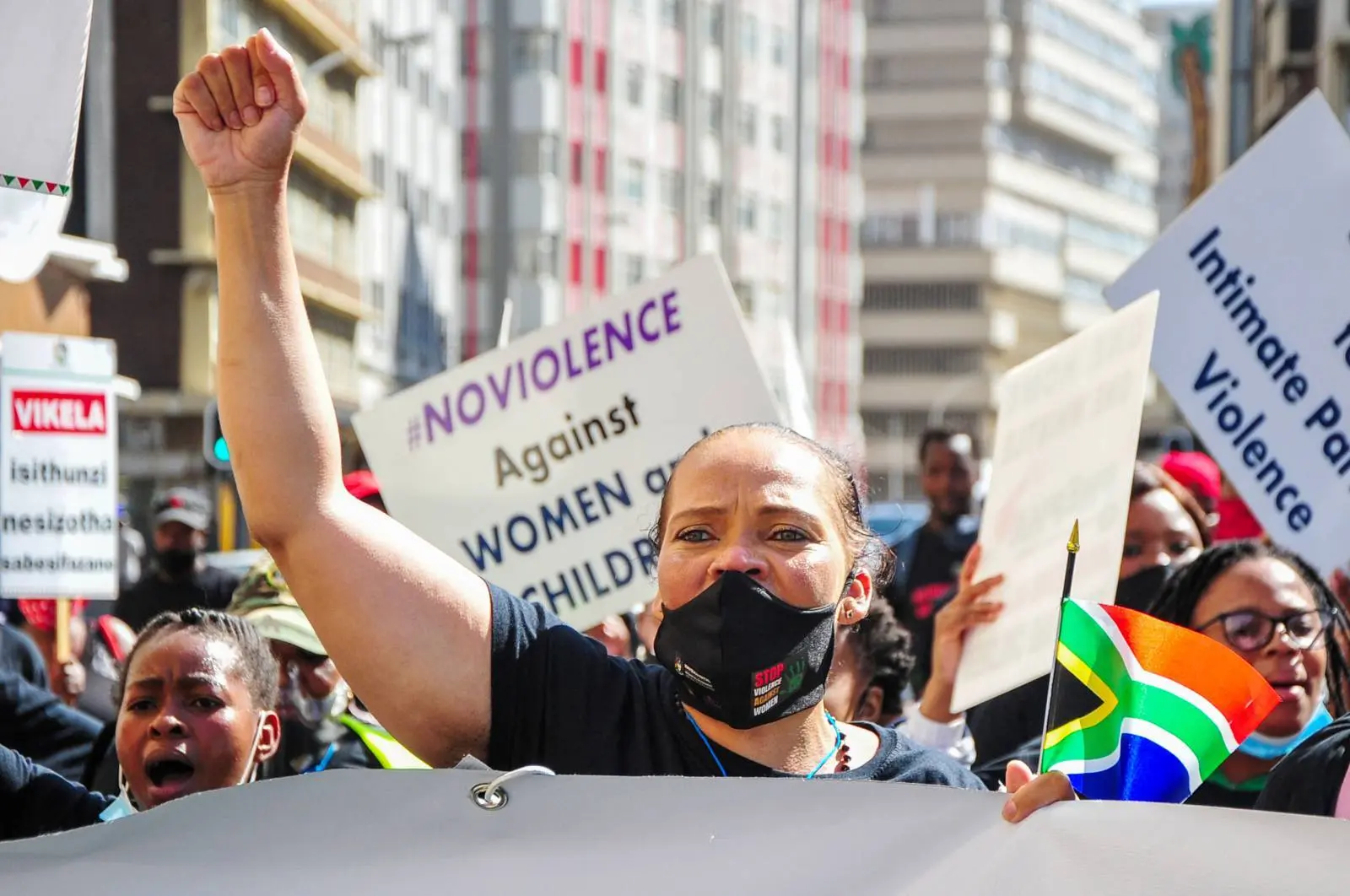
Every Women's Month, we talk about the safety of women.
We talk about gender-based violence. We talk about femicide. We condemn another horrific murder, another rape, another assault. We march. We campaign. We call for justice.
And then another woman dies.
We have to ask ourselves an uncomfortable question: Why?
It is because we remain in denial about the root cause of gender-based violence.
That root cause is gender inequality.
We spend enormous amounts of energy responding to what happens after inequality has manifested itself as violence. We react when women and girls are beaten. We react when they are raped. We react when they are killed.
Of course we must respond. We need an effective criminal justice system. We need perpetrators to be prosecuted. We need appropriate sentences and support for survivors and their families.
But these are downstream interventions.
There is far too little happening upstream.
A tree grows from its roots. If you want to get rid of the tree, you do not keep pruning its branches. You uproot it.
Yet in South Africa, we keep pruning.
Gender inequality does not suddenly appear when a man raises his hand to a woman.
It begins much earlier.
It exists in our homes. It exists in our schools, workplaces, sporting environments, religious institutions, traditions and relationships.
It exists in the seemingly harmless things we tell children about what it means to be a boy and what it means to be a girl.
We tell boys that men are the heads of households. But what exactly qualifies a man to be the head of a family simply because he is male? What has he done to deserve that authority?
A woman may be better educated. She may earn more. She may be the person keeping the family together. She may be carrying the household financially and emotionally.
Yet the default social position remains: I am the man, therefore I am in charge.
Then we are surprised when men grow up believing that authority over women belongs to them.
We tell men from childhood that they are providers and protectors. We tell women, sometimes subtly, that being provided for is something they should aspire to.
Then, years later, we run campaigns telling men to respect women.
There is a contradiction here.
If a boy has been socialised to believe that being a man automatically gives him authority, we cannot be surprised when the belief follows him into his adult relationships.
Being a man does not give you the right to control the person you love. But we have built social constructs that repeatedly suggest otherwise.
Sometimes the constructs reveal themselves in the smallest moments.
I remember standing outside our home with my wife when one of my sons was younger than 10. He looked at the house and spontaneously said something along the lines of: When you two die, this house is mine.
I have never forgotten it. Why would a boy automatically assume that? What about his sister? More importantly, neither my wife nor I immediately corrected him. Because somewhere within us, too, that assumption had been normalised. That is how deeply the ideas sit.
Nobody needed to formally teach the boy a lesson about inheritance and male privilege. He had absorbed enough from the society around him to understand what he believed his place was.
And we, his parents, had absorbed enough not to immediately question it.
That is where the work must begin.
It is in the way estates are divided and inheritances considered. It is in families where the eldest son is automatically deferred to, even when a daughter may be the person supporting everyone and holding the family together. It is in the chores we give our children.
There should be no task that belongs to a girl simply because she is a girl. Children should share responsibilities equally. These things may seem far removed from gender-based violence. They are not. They teach children where power lies.
This cannot simply become another conversation in which men point fingers at other men.
I have had to examine these things in my own life. I have had to reflect on the way I have treated my own wife and recognise situations in which I have not been fair because of that default position: I am the man.
That is inequality too.
We cannot change a social construct if we are unwilling to acknowledge that we are part of it. This is not about finding somebody to blame. Society collectively created the norms, and society has to collectively dismantle them.
This is not an academic debate for me.

My daughter was murdered by a man who was supposed to love her. That experience inevitably informs the way I think about gender-based violence.
When I look back, I have to ask what kind of society fashions a man who cannot see the woman he loves as a fully equal human being, someone with the right to disagree with him, to make her own decisions and ultimately to exist independently of him.
The question does not excuse a perpetrator. Adults remain responsible for their actions. But if we are serious about preventing the next murder rather than simply punishing it afterwards, we must be willing to ask how the attitudes are formed in the first place.
Equality does not diminish men. It frees men and women from roles that no longer make sense. That is why we need to stop treating gender equality as something we do for women and start understanding it as something necessary for society.
There is important work being done downstream.
We need functioning police stations. We need better investigations. We need prosecutors and courts that deal effectively with gender-based violence. We need shelters and support for survivors. We need justice.
None of that should stop. But it cannot be the beginning and end of our response.
My emphasis is on prevention. We need to identify the beliefs and behaviours that promote inequality long before they become violence.
That means interrogating attitudes in schools, workplaces, families, churches, traditional structures, sport and social life.
Changing the social construct also requires institutions that are properly equipped to do the work.
Parliament needs to ensure that the institutions responsible for advancing gender equality are properly resourced and fit for the mission that lies ahead.
The Commission for Gender Equality (CGE) is a constitutional institution with an important role to play in addressing the issues. It needs to be properly and independently funded, directly by the National Treasury, so that it can fulfil its mandate effectively.
We should also question the tendency to create new structures when constitutional institutions have responsibilities in this space. We have seen the creation of structures such as the GBV Council while the CGE remains inadequately resourced.
When an institution underperforms because it does not have the resources to fulfil its mandate, the answer cannot always be to create another structure. We need to ask who is responsible, what they are required to deliver, whether they have the resources to do so and who will hold them accountable.
The time for unfunded mandates is over.
We need to raise boys who do not believe women are their responsibility or their possessions, and raise girls who do not believe their security depends upon finding a man who will provide it. It means recognising all the small things we dismiss as harmless because “this is how it has always been”.
Those small things matter. They form the roots.
South Africa cannot campaign its way out of gender-based violence. Campaigns create awareness. Outrage can mobilise society. The criminal justice system can punish perpetrators. But none of those things, on their own, change the conditions that keep producing the problem.
We need to go upstream. We need to change the default settings of society. And we need to be willing to admit that some of the things we have accepted as culture, tradition, masculinity and femininity are simply inequality by another name.
The Constitution gives us the principle: men and women are equal.
Our task is to make that equality real: in parliament and policy but also around the dinner table, in our wills, in our relationships and in what we teach our children.
If we keep pruning the branches while protecting the roots, we should not be surprised when the tree keeps growing.
Dr Kgosi Letlape is an ActionSA member of parliament and a member of the portfolio committee on women, youth and persons with disabilities and the portfolio committee on health.