

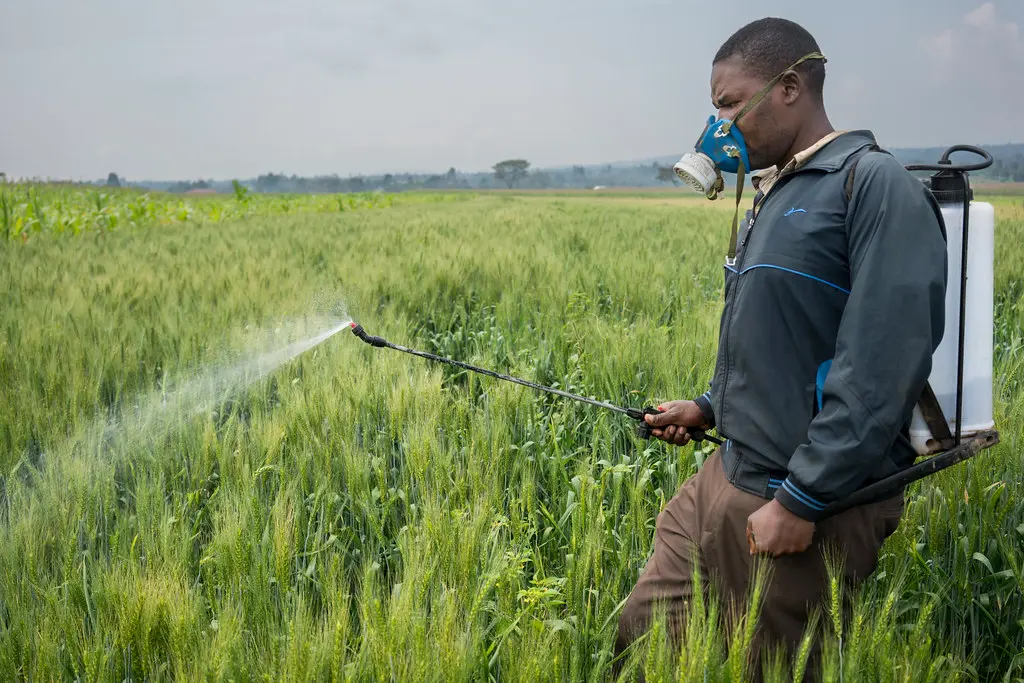
I arrived at the International Society for Environmental Epidemiology conference in Munich last month expecting technical debates about pesticide science. There was plenty of new evidence, much of it troubling. But what stood out to me most was a deeper disconnect: researchers have become good at documenting harm, at naming the problem but we are much less practised at proposing solutions and engaging with policy processes.
That thought stayed with me at the World Congress on Public Health in Cape Town last week, not far from where I have spent years researching how pesticide exposure affects children’s neurodevelopment. Research from my PhD found that children with greater chronic pesticide exposure performed worse on tests of attention, planning and problem-solving.
The evidence is growing. But evidence alone does not change policy.
Europe offers South Africa a warning and an opening.
Europe is retreating
Just as South Africa considers modernising its pesticide laws, the European Union is reconsidering some of the safeguards that have made its regulatory system comparatively precautionary.
In December 2025, the European Commission proposed a Food and Feed Safety Simplification Package that would replace systematic, time-bound renewal of many pesticide active substances with unlimited approvals by default, alongside targeted reassessments when new evidence or concerns emerge. The commission describes this as a way to reduce administrative delays while maintaining health and environmental protection.
But there is a deeper question here than administrative efficiency.
Periodic risk reassessment exists because scientific knowledge changes. Chemicals once considered safe to use can look very different when new evidence emerges. Chlorpyrifos and several neonicotinoids, for example, lost EU approval after evidence accumulated about their risks.
Removing routine risk reassessment changes the regulatory logic. Instead of regularly asking whether a chemical remains safe enough to justify continued use, the system increasingly relies on identifying particular chemicals for review when there is a reason to suspect their risk profile has changed.
That might be presented as smarter regulation. But it also risks shifting the burden of proof away from the precautionary principle.
And this matters beyond Europe. In March, the European Parliament’s human rights subcommittee heard testimony from the South African People’s Tribunal on Agrotoxins on the human-rights implications of pesticides banned in the EU but exported to countries such as South Africa. Judge Navi Pillay, the tribunal’s chair and a former UN High Commissioner for Human Rights, urged the EU to end the practice.
South Africa should be paying attention.
South Africa can choose differently
South Africa’s core pesticide legislation, the Fertilisers, Farm Feeds, Agricultural Remedies and Stock Remedies Act of 1947, is nearly 80 years old. It was drafted for a world with a different understanding of agricultural production, environmental exposure and public health.
Now, reform is no longer a distant possibility.
In March 2026, the department of forestry, fisheries and the environment held a stakeholder engagement session on a draft National Implementation Plan for phasing out highly hazardous pesticides. This means the debate is not simply about whether South Africa should modernise its pesticide governance. It is about what that modernisation will look like and whose interests it will serve.
Being decades behind has real costs. But it also gives us an opportunity that Europe does not have in the same way: we can watch what is happening there and choose not to repeat it.
South Africa does not need to ask how quickly it can catch up with Europe. We should ask what we are trying to catch up to.

Whose evidence counts?
There is another reason we should be cautious about simply importing regulatory models wholesale from elsewhere.
My systematic review of research on chronic postnatal pesticide exposure and child neurodevelopment identified 66 relevant studies worldwide. Only one was conducted in sub-Saharan Africa.
That is not just a gap in the literature. It is a gap in whose children, whose farms and whose exposures shape the evidence that regulators rely on.
When evidence from our own communities is scarce, regulatory decisions inevitably depend more heavily on research generated elsewhere: in different agricultural systems, climates, regulatory environments and populations.
This is what is meant by epistemic injustice: whose knowledge counts, who gets to produce it and whose realities remain invisible in the evidence base.
But producing more local scientific evidence is only half the job. A study that sits in a journal but never reaches the people it concerns or the policymakers who could act on it, has not finished its work.
South Africa needs research that is not only about South African communities but reaches South African policy processes. Communities affected by pesticide exposure should not simply be subjects of research. Their experiences should help shape which questions we ask, what risks we prioritise and what solutions we consider acceptable.
Local, contextually relevant evidence matters. But importantly, evidence is most useful when it becomes part of democratic decision-making.
What the Constitution asks of us
Section 24 of South Africa’s Constitution requires that the environment be protected for the “health and well-being” of present and future generations.
Those words are not merely decorative.
They mean that the costs of today’s regulatory choices cannot simply be exported to children who had no say in making them.
The current policy moment gives us an opportunity to make that constitutional promise concrete: phase out the most highly hazardous pesticides on a clear timeline; ensure that risk assessment is genuinely independent from industry interests; strengthen environmental and biological monitoring; and invest in safer alternatives so that reducing pesticide reliance is practical rather than merely aspirational.
This is not an argument against farming, food security or development. Farmers need effective ways to manage pests. Transitions cannot happen without viable alternatives.
It is an argument for asking a more basic question: What should pesticide regulation be designed to protect?
The answer cannot simply be the continued availability of chemicals for convenience or the profits of their producers. Regulation exists to decide, in the public interest, which risks are acceptable and which are not.
What we choose next
Europe’s retreat should not be South Africa’s excuse. It should be our warning and our opening.
We have a live policy process, a constitutional mandate and enough global and local evidence to know that pesticide exposure can carry consequences for human health and the environment.
We also have an opportunity to build something suited to our own circumstances: a regulatory system that treats reassessment as a safeguard rather than a burden; that puts precaution ahead of commercial convenience, especially when the consequences of being wrong are borne by vulnerable communities; and that values the health of people and ecosystems alongside the productivity of agriculture.
European regulation should be a point of comparison, not a template. We can learn from what Europe got right, recognise where it is now retreating, and build a system grounded in South Africa’s own evidence, realities and constitutional obligations.
The question is no longer whether we know enough to act; it is whether we are willing to act on what we know.
South Africa should choose better.
Paola Gabriela Viglietti is a public health researcher at the University of Cape Town, with an interdisciplinary background in psychology, neuropsychology, epidemiology and social anthropology. Their research focuses on pesticide exposure, child neurodevelopment and environmental justice, particularly among communities living in South Africa’s intensively farmed regions.