

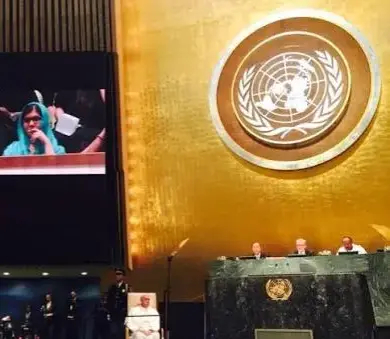
When the 81st session of the United Nations General Assembly (UNGA) opened this month under the banner “Silence the guns, amplify the voices: Peace, security and justice for all,” the irony was difficult to miss. The last time the UN Security Council authorised a new peacekeeping mission was in 2014, when it approved MINUSCA in the Central African Republic. That was 12 years ago. Since then, wars have erupted or escalated in almost every quarter of the globe. Not a single new blue-helmet mission has been deployed to any of them.
This is not a simple coincidence. It is a choice made by the permanent five members of the United Nations Security Council (UNSC), who have quietly decided that the UN's signature conflict-management tool is no longer worth the political cost. While a conflict prone host state consent has become an increasingly fragile foundation. Peacekeeping requires the consent of the host government, but that consent is now more conditional and more easily withdrawn. Mali's military junta ordered MINUSMA to leave in 2023, forcing the Security Council to terminate the mission. The Democratic Republic of the Congo has pushed for MONUSCO's accelerated drawdown. Sudan expelled UNAMID.
At the end of 2025, personnel deployed in multilateral peace operations fell to 78,633, the lowest level in at least 25 years and a 49 percent drop from 2016. The UN's peacekeeping budget faced a $2 billion shortfall, more than 35 percent of its total alone in July of 2025.
The irony is that the conflicts most in need of neutral, multilateral intervention are precisely the ones where it has become impossible.
The UN Security Council is essentially paralysed. Russia has cast more than 20 vetoes since 2014, blocking action on Syria, Sudan and beyond. China has joined in on several of those votes and the United States has followed suit. Even when a veto is not formally cast, the threat of one is often enough to kill a mission before it reaches a vote.
This is the uncomfortable truth that UNGA 81's peace and security theme must contend with. The General Assembly can pass resolutions. It can hold high-level meetings. It can issue communiqués affirming the importance of peace. But it cannot deploy a single blue helmet to a new conflict without the UN Security Council's consent. And the Security Council has made clear that its consent is no longer available for the conflicts that matter most.
The consequences are not merely bureaucratic. They are measured in lives. When the UN cannot deploy peacekeepers, regional organisations try to fill the gap but they often lack the legitimacy, scale and funding that only a UN-mandated mission can provide.
As SIPRI's 2026 report concluded, "regional organisations lack key capabilities when it comes to successful, integrated peacebuilding, while they are also plagued by funding shortfalls and inability to reach agreement like the UN." The result, in the words of SIPRI's director, is likely to be "more conflicts and these conflicts are likely to have even graver impacts on civilians as states abandon long-established norms.
Part of the problem runs deeper than the Security Council's paralysis. As Cedric de Coning argues in his work on the stabilisation dilemma, the contemporary peacekeeping operations that do exist, are themselves suffering from a significant trust deficit. The reason is not that peacekeeping has failed historically; two-thirds of UN peacekeeping operations since the Cold War have successfully ended and withdrawn. The reason is that these stabilisation missions have been deployed in contexts where there is no viable political or peace process to support. When security is not directed to serve a peace process, it produces a perverse effect. The more effectively a peace operation protects civilians and achieves stability, the less incentive there is for ruling political elites to find long-term political solutions.
This is the stabilisation dilemma. It prolongs conflicts, traps operations in place with no exit options, increases the resilience of armed groups and embeds peacekeeping in the local political economy. The Security Council is losing trust in these operations when it is the Council itself that deployed and tasked them with protection and stabilisation mandates despite the absence of a peace process, and when it is the Council that determines the mandated tasks, the overall size, the use of force posture, and the scope of the capabilities of these operations.
The absence of new missions since 2014 is thus not simply a matter of great-power obstruction. It also reflects a deeper loss of confidence in the instrument itself, a confidence that the Security Council helped erode by repeatedly deploying peacekeepers into situations where, as the Brahimi Report warned in 2000, there was "no peace to keep."
UNGA 81's theme asks the world to "silence the guns." But the institution built to do precisely that has been silenced, not by its enemies, but by its most powerful members. The peace and security agenda on display in New York this month should present a renowned blueprint as to how to grapple with this dilemma.
Shaun Kinnes is a 2026 Mail & Guardian Top 200 Young South African awardee and researcher with special interest in climate induced conflict, geo-politics and regional integration.