


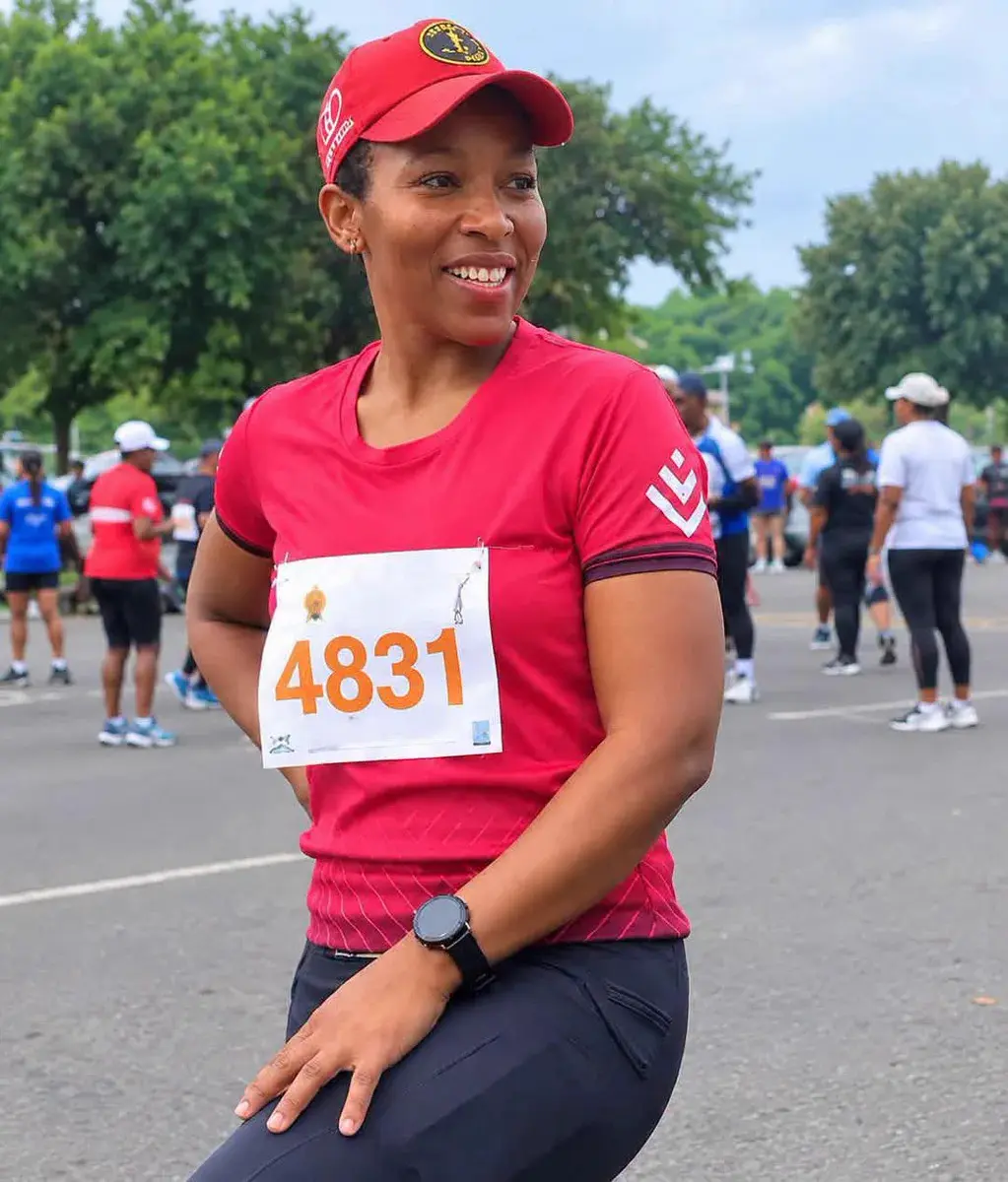
You pull on your bright pink tee and black shorts, lace up your running shoes and sweep your hair up under a cap. You plan your route, weaving through the familiar suburb so you pass the maximum number of security guards.
You silently debate whether to take your phone. It’s useful for letting someone follow your live location but does it also make you more of a target carrying that telltale rectangle on your body?
You take the phone. You turn on the tracking and safety features. You show your husband which way you’re planning to go on the map — no, not Roos Street, the next one. You feel less alone with him in your pocket.
You also carry some water, your keys. The last time you went shopping to buy a new water bottle, they were hanging on a display next to keyrings attached to small cans of pepper spray. You remember thinking: “Only in South Africa.”
You brush past your medals on the way out the door. The Two Oceans half marathon. The Soweto 10 kay. This should be easy, just a 5km loop around the block.
Outside, you stop just before reaching the gate and wait for an unfamiliar man to walk past before opening it and slipping out.
You stretch, warm up, start running at a light pace. Around the corner, a man sits alone in a blue sedan with the window down. You cross to the other side of the road.
It is not entirely new, this feeling of wariness. You have experienced your fair share of catcalls and veiled threats. White men in white bakkies yelling at you to “Run, b****!” Men near the finish of your Parkrun announcing loudly how it makes them sick to see women running alone, how they are “asking for it”. The man who has screamed at you across a busy intersection that he will “shoot you in your p***” before walking into traffic to follow you down the road.
You have imagined sprinting straight to the police station to report this more than once but you have never followed through.
It is not entirely new but it is sharper now. Now that you know the name Elizabeth “Tsontso” Moselakgomo.
She was 38 years old, as you are. She was out for a regular afternoon run, something you do a few times a week. She was running alone, like you often do. And she is only one of 10 or 11, or will it be 12 or more by the end of the week?
It is not entirely new, this feeling of outrage.
The country is on its feet, calling for action. Calling for harsher penalties for gender-based violence or new laws recognising femicide as a crime. Organising marches, trending hashtags. It is a cycle we have seen before.
For Uyinene Mrwetyana, raped and strangled and beaten to death at a post office in Claremont in the middle of the afternoon.
For Anene Booysen, gang-raped and disembowelled and left for dead at a construction site near her house by men she knew.
For Reeva Steenkamp, shot and killed by her partner while hiding in a bathroom at home.
For Leighandre Jegels, murdered by a police officer despite having a protection order against him.
For Karabo Mokoena, stabbed, burnt and buried in a shallow grave by her currency trader boyfriend.
#AmINext #MenAreTrash #MeToo #WhatNow.
You want to take action but feel helpless in the face of overwhelming odds.
In a span of nine months, police record upwards of 40 000 reports of sexual offences and 75 000 crimes involving domestic violence in the country.
But then only around 10% of women tend to report the violations committed against them, so those numbers are probably 10 times higher. The femicide rate here is said to be six times the world average.
Over the course of a lifetime, one in three women in South Africa is expected to face physical or sexual violence.
What can you do? You dutifully sign the petition being circulated. You donate your Discovery Miles to Team Vitality’s fundraiser for Tsontso’s family and her daughter’s future.
You plan to join a march, think about signing up for the run being organised in her honour in November. You continue to ask your friends to let you know when they arrive home after going out.
You keep your location turned on and visible to your emergency contact. You remain wary of strangers, even though you know the most likely scenario for women is that they are attacked by men they know.
On your way back home, you pass a group of three men in high-visibility jackets fixing a water pipe that must have burst weeks or months ago and then another group in blue overalls rebuilding a wall. They are friendly, too occupied with their jobs to pay much attention. Like most people out on the street, they are not interested in you. Nearing the last stretch, you run alongside a park where there are no children playing on the swings or jungle gyms, no one to greet you but the birds. You listen to the common calls of the Cape Sparrow and the Masked Weaver and even two Black-Collared Barbets.
Is this what the police mean when they urge us not to exercise alone in isolated areas? Would anyone hear if you screamed? Would you remember to scream?
You think about Tsontso as you run. How she might have felt while training for a half marathon. Free, strong, proud. What she must have felt on her last run. Terror, panic, desperation.
You have heard of prayer runs undertaken by Native American women to honour their missing and murdered sisters. Spiritual and physical acts of resistance and remembrance. A moving prayer which offers up their strength and breath to those who are no longer able to move or breathe. A way to turn grief into action. You meditate on the women who have been killed in South Africa. Runners, mothers, sisters, friends. Lost, killed, gone but not forgotten. As your run comes to an end, you start to walk.
You pass another woman in a matching pink top and hat running in the opposite direction. She is a mirror that matches your wave with her own. Your run remembers the women like Tsontso who have come before and lost their lives. And the women who continue to go out despite the fear and brutality and loss.

Lee-Anne Gaertner is a writer and editor who works at the intersection of human rights and communications at the Centre for Applied Legal Studies based at Wits University