


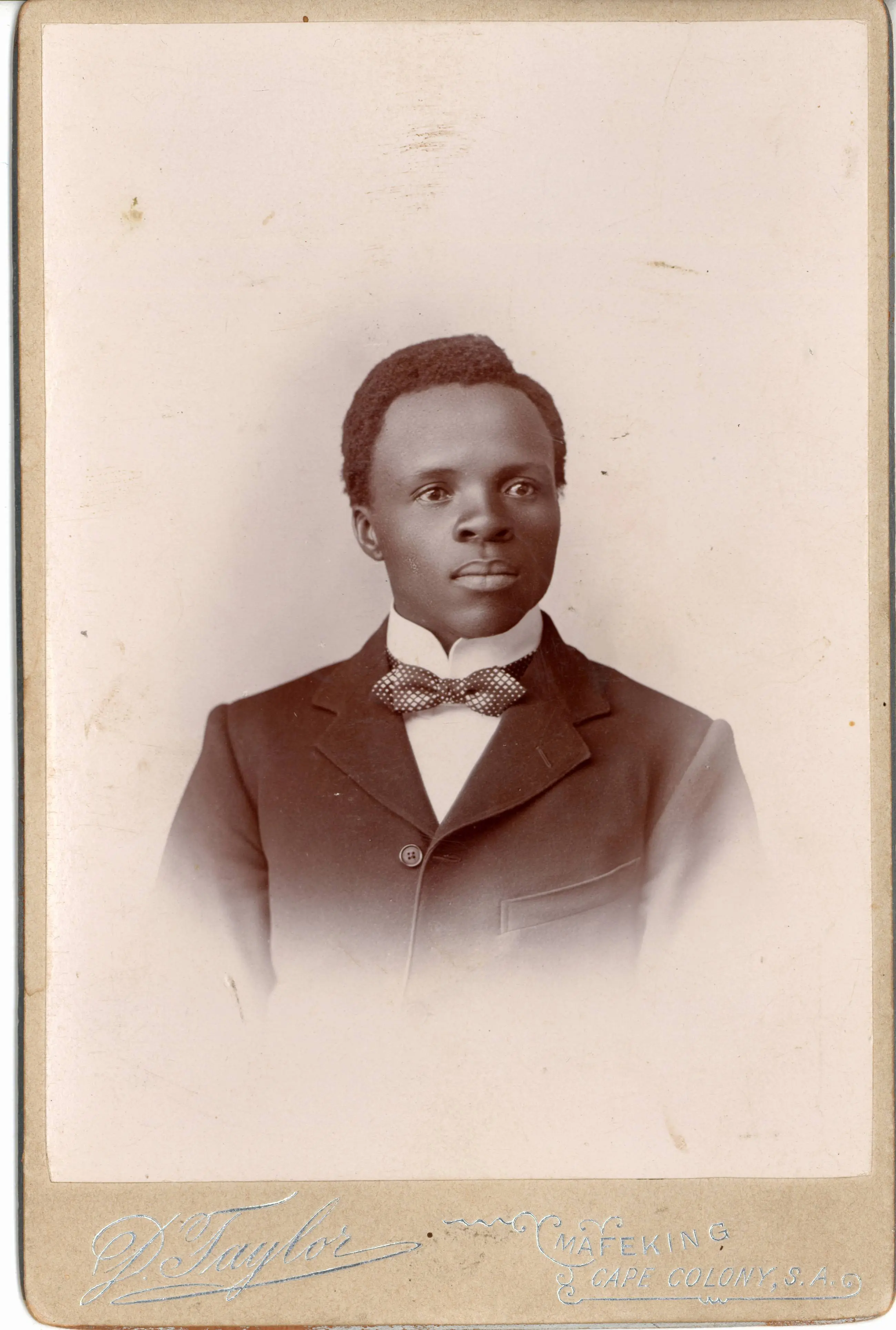
South Africa’s first book length biography of Solomon Plaatje was written by historian, medical doctor and politician, Dr Modiri Molema, in 1965. It was published in Sechuana and titled, Sol Plaatje: Morata Wabo, meaning, lover of his own.
The biography is an affecting reconstruction of the life of a man the author knew well and one that he greatly admired, even as a boy growing up in Mafikeng. Plaatje had become a member of the Molema household shortly before the South African War (1899-1902), and never truly left their home. He remained intimately woven into the personal and political affairs of the family even after he was established in his own home, first in Mafikeng and later in Kimberley.
Mqorata Wabo relays all the extraordinary gifts of Plaatje’s intellect and political acumen, the generosity and warmth of his personality and his unwavering commitment to serve both the mixed settlements of the Sechuana-speaking peoples of the northern hinterlands, some black and others not, and the larger populations of black people in today’s South Africa and Botswana against whom the colour bar was strengthening and deepening their longer history of dispossession.
This attention to Plaatje’s genius and devotion to others is not what sets Morata Wabo apart from the scholarship on Plaatje’s life and times that would later follow. Neither is it that this was the first biography of Plaatje and in Sechuana. Rather, it is how Morata Wabo is infused with mourning for a life that the author feels could have been lived differently, could have more fully achieved its ambitions and could not have been lost, unnecessarily, too soon.
Molema writes about Plaatje as a tragic hero and as a man enfeebled by the challenges of leadership. “He would grow weary of reprimanding, opposing, fighting and advocating for the rights, liberation and advancement of his people.” He wrote of Plaatje as a Moses of his own time, “a soldier and valiant man”, but just the Old Testament liberator, Plaatje never entered the promised land of his own personal destiny. He spent his life squeezed hard by deep indebtedness and lack and limited success of his writings, only some of which survive today.
There were other failures and disappointments too, as the joint archive of the Molema and Plaatje families. Plaatje wanted those who had come to an understanding of themselves as “Bechuana” to have a vernacular newspaper of their own. He had dedicated his life as journalist and editor mostly to this project, even giving up opportunities to hold a secure form of employment.
The first newspaper he had edited was Koranta ea Becoana, which remained in circulation for only seven years, from 1901 to 1907. For most of those years, he and his staff worked without pay, rewarded only by the personal esteem of carrying out a particular kind of work, tiro, meaning the work of persons, or batho. At the beginning of the 20th century, having a regional newspaper in a vernacular language belonged to the set of everyday routines that confirmed that one was a person, motho, and not a wild thing of nature, ntho feela, just an animal standing or walking on two feet but otherwise no different than the beasts of the field.
Personhood is that which enables us to dominate nature as agents with freedom. Human beings can pursue their own designs on the world, dream of possibilities and mould their circumstances towards the architectures of their imaginations.
These conversations about what makes us quintessentially human were part of the late 19th and early 20th centuries, particularly in response to the dizzying rate of social change that was taking place across the world, albeit in different ways.
Sociologist, Emile Durkheim’s Suicide, first published in 1897, was a scientific analysis exploring this question. It is interesting that Plaatje, writing from the far-flung colonial outpost of the north of the Cape Colony had come to the same conclusion as Durkheim. For both thinkers, connectedness, that is the proficiency in the strategies of collaboration that emboldened our freedom over nature, was the key existential quality that set us apart from nature. Without it, human beings become like other animals, slaves to the whims of circumstance — hibernating in the winter, awakening in the spring, prowling in the night in search of prey. We adapt but we are locked in the cycles of events we cannot control.
The argument is that untethered to one another, our ambitions quickly outstrip our capacities. We unravel into the disaffection and demoralisation that precipitate anxiety. We roam about without a collective purpose, and uninspired, we settle into the routines of everyday life as an inescapable ennui.
The expiry of the human body is inevitable. As Plaatje once wrote, death folds into the helm of one’s garments, such that “in the midst of life we are in death”. The death of personhood is always threatening but can be avoided through work, tiro, the works that confirmed our attachment to one another precisely in ways that bolstered our freedom. Work makes us free and hence, work makes a human being.
Plaatje’s personal pain was that the black educated classes of the early 20th century barely lifted a finger to work. Their ambition was directed solely towards their self-interest, rather than in activities that strengthened solidarity, like vernacular newspapers and social clubs and literary undertakings and infrastructural developments. He criticised the array of Edwardian dresses and topcoats that coloured the pews on Sundays in Mafikeng when too many children were out of school and the printing press of their newspaper was struggling to continue making Koranta.
His commitment to public service cost him and his family deeply. Not only were there long absences from home but his work placed considerable pressure on the family purse. He was plagued by many years of debt.
“I work day and night just to have something at the end of every month to pay up these things,” he wrote in 1911, when he was trying to get going with Koranta’s successor, Tsala ea Becoana.
It caused him considerable pain that the educated Sechuana-speaking public seemed not to have any intention to support the work of their own newspaper. “There are many things that disappoint me,” he wrote again a year later when this second newspaper continued to struggle. “It makes one sometimes feel that there is no good in all this striving for the rights of the Becoana people.”
Once he spent three months away from home, again working, and he felt ashamed to return without a penny in hand. “I have heard very little from home and it is so hard to go and arrive there after three months without a penny. It would not be so hard if the train money had been paid.” These complaints about the newspaper was only one of many disappointments in his many roles, including as secretary-general of the then-South African Native National Congress.
The reality is that educated African stratums of the early 20th century often had far less means that the studio photographs of their respectable existence. They were the leading families of the countryside, slowly trickling into urban centres like Johannesburg and Kimberley and Bloemfontein.
More families were taking their children to school at the beginning of the 20th century but white collar employment towards which many aspired were becoming scarce. Missionary schools, like Lovedale and Healdtown, were struggling to collect tuition and boarding fees. The journey towards pedigree qualifications in medicine and law that families like Molemas’ acquired was immensely difficult, causing deep rifts in families, as fathers struggled to finance their children’s aspirations.
Educated families were under severe pressure, certainly in the northern hinterlands. Education did not yield the return on investment that it promised. Fathers could not support sons into the transition to manhood.
After the promulgation of the Natives Land Act of 1914, as historian Timothy Keegan observes, not only were the educated classes in the then-Transvaal and Orange Free State stripped of their access to land. They lost the relationships on the land through which they funded their ambitions. The loss of solidarity, this time between black and white in the countryside, bruised their confidence and whittled down at their ambition. They retreated into the repertoires of survival, merely getting by, adapting to their new circumstances like wanderers looking to shelter in a cave overnight.
Not only were there limited opportunities, but there were also new vices that claimed the time and talents of young, educated men, like Plaatje’s sons, particularly drink and the display of things that money can buy. Young people were displaying symbols of wealth that their families did not have, no different from what the new anthropologies of urban youth and unemployment in South Africa are revealing today. Conspicuous consumption and generational indebtedness can coincide. Perhaps Plaatje underestimated the material requirement of solidarity as families like his transferred debt and insecure property rights and not the institutional memory to work, that is to build thriving public institutions like the schools and nursing homes, concert halls and sanitation houses, of the early 20th century.
By the time that Plaatje died in 1932, Modiri Molema thought Plaatje’s life had been snuffed out by dreams that were not realised, both personal and political. Plaatje needed, and never benefitted, from the buoyancy that our connectedness affords our individual efforts. It means that he did not successfully reproduce himself into the institutional practices of today’s educated, now ruling classes. His first biographer believes he could have achieved more, left a mark on the world more equal to his genius and certainly lived longer. Instead, he spent himself in a one man show, and the curtain fell before the final act.
As Molema writes: “It might be said that he [Plaatje] died of overwork and anxieties over his publishing and finances. He died just as he had lived — in the midst of worries over publishing his work and lack of finances. And again, as one can say of many others, he died of overwork. Plaatje was born in October 1876 and died on 19 June 1932. He lived a life of fifty-five years, eight months and ten days.”
Dr Khumisho Moguerane is the author of the award-winning ‘Morafe’. She is with the Wits Southern Centre for Inequality Studies