


It is the reality of opening a tap and finding nothing. It is families having to search for water, communities waiting for water trucks and residents repeatedly being told that another technical problem has disrupted supply.
But during the recent Komani Water Crisis Speak-Outs, residents raised a more uncomfortable question: What if the water crisis is not only being allowed to continue because of failing infrastructure, but is also creating opportunities for private businesses to make money from the failure of the public water system?
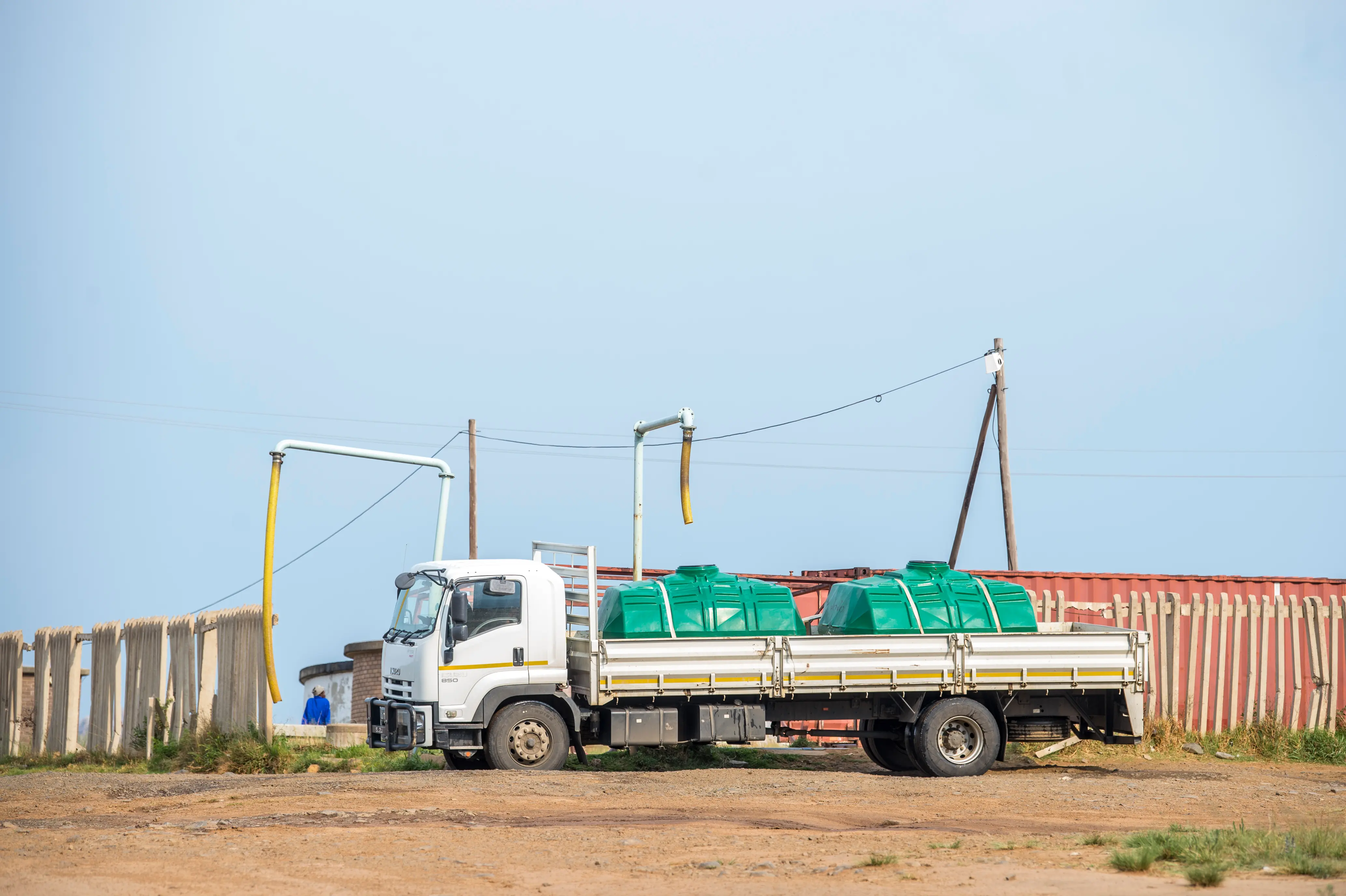
This question came directly from communities themselves. Residents spoke about what they described as a “water mafia” system — an ecosystem in which the continuing failure of municipal water infrastructure creates a market for water tankers, emergency procurement and tenders.
The allegation is serious. It must be investigated, not simply dismissed.
The residents’ argument is straightforward: if public water infrastructure is allowed to deteriorate, communities become dependent on emergency water supplies.
Every prolonged interruption creates another demand for tankers. Every crisis creates another emergency procurement process. And where procurement is not transparent, residents fear that politically connected businesses can benefit from a crisis that ordinary people are paying the price for.
The fieldwork conducted in Komani between 15 and 17 September 2026 provides important context for understanding why these concerns have gained such force.
Emergency water provision has a legitimate role during genuine emergencies. When a major pipe breaks, a pump fails or a disaster interrupts supply, water tankers can provide essential temporary relief. The problem begins when the emergency becomes permanent.
In Komani, residents questioned why communities continue to depend on water tankers and JoJo tanks without the underlying infrastructure problems being resolved. They asked whether the repeated need for emergency water creates an incentive for a procurement system that profits from failure rather than investing in fixing the public system. This is the heart of the community’s concern.
The residents did not present an independent forensic investigation proving that a coordinated “water mafia” controls water procurement in Komani. Nor did the fieldwork establish individual criminal responsibility. But the allegations themselves reveal something important about the collapse of public trust.
When residents see their taps repeatedly running dry while private tanker companies repeatedly receive business from the resulting emergency, they begin to ask who benefits from the crisis. That question deserves an answer. And the answer cannot simply be another promise that the municipality is “working on the problem”.
There must be transparency about who receives emergency water contracts, how much is being paid, how long contracts last, what services are actually delivered and why emergency procurement continues instead of being replaced by sustainable infrastructure investment. There is a fundamental difference between responding to a crisis and governing through a crisis. A tanker sent after an unexpected infrastructure failure is emergency relief. A community depending on tankers month after month is a sign of systemic failure. And if that systemic failure becomes an established source of contracts and revenue, the distinction becomes even more troubling.
The community’s concern is therefore not simply about corruption in the narrow sense. It is about the political economy of water. Who owns the infrastructure? Who controls procurement? Who gets contracts? Who carries the costs when infrastructure fails? Who has to wait for water? And who makes money when the taps run dry?
These questions must be asked because water is not an ordinary commodity. For working-class communities, water is essential to life. When supply fails, the costs are transferred from the municipality to households. People must find alternative sources, buy water, queue for deliveries and reorganise their lives around the absence of a basic public service. The poorest residents are often the ones who pay the highest price.
The fieldwork is important pre-cisely because it does not require us to choose between a technical explanation and a political explanation. Both matters. Our field-work visit identified genuine technical problems that relate to infrastructural problems: electricity failures, damaged control panels, faulty generators and interruptions affecting pumping operations.
But technical failures do not explain why a crisis continues indefinitely. That requires us to ask questions about maintenance, budgets, planning, procurement and accountability.
For example: According to Salga (2014/15) and Cogta(2014/15), the increasing evidence of water supply and sanitation backlogs in South Africa is ascribed to, amongst others, the following: lack of capacity and institutional weakness in governance resulting in weak monitoring and evaluation, a disjuncture or disconnect between national budgets and requirements for water and sanitation financing, a flawed municipal financing model, questionable financing and pricing arrangements, slow pace of decentralisation, particularly in relation to empowering local governments financially, in implementing water and sanitation interventions and finally lack of better accountability and responsiveness to communities These explanations point to the structural and institutional problems and policy choices by the government which, in turn, have an effect on the technical problems.
In other words, aging and decaying infrastructure does not decide whether it will be maintained: a damaged electrical panel does not decide whether it will be repaired; a generator does not decide whether it will receive proper maintenance.
Institutions make those decisions. And institutions must therefore be held accountable for them. This is why the residents’ concerns about tenders cannot be separated from the infrastructure crisis.
If, on the one hand Salga has identified the problems then the question is why do those problems persist? Why have they not yet been addressed? On the other hand, if a municipality repeatedly pays for emergency water but fails to adequately maintain the infrastructure needed to deliver permanent water, are residents not entitled to ask whether public money is being spent in the public interest?
The anger expressed at the 16 September community meeting did not remain simply anger. Residents decided to act. On 17 September, more than 150 people marched to the Chris Hani District Municipality, despite rainy conditions and submitted a petition demanding reliable water, improved electricity, urgent infrastructure intervention, accountability for recurring service failures, an end to outsourcing of municipal workers and the protection of water and electricity as essential public services.
This mobilisation matters. It shows that communities are beginning to move beyond the question of “When will the water come back?”
They are asking: Why do these problems persist? Who is responsible? Where is the money going? Why are emergency solutions becoming permanent? Who benefits from the crisis? And perhaps most importantly: Why should a public water crisis become a private business opportunity? These are legitimate democratic questions.
The answer cannot be to simply increase the number of tankers. Nor can it be to normalise the idea that communities will permanently live between JoJo tanks and dry taps. The solution must be to rebuild the capacity of the public water system. That means repairing and maintaining treatment plants, pumping stations and reservoirs. It means ensuring reliable electricity and backup power for critical water infrastructure. It means publishing information about reservoir levels, infrastructure failures and restoration timelines. It also means an alignment between national budgets, municipal financing models and the requirement for water and sanitation financing.
It also means opening up the pro-curement system. If emergency water contracts are necessary, communities should be able to see who receives them, what they are paid and what they are contracted to provide. If residents are raising allegations of corruption or politically connected businesses benefiting from the water crisis, those allegations should be independently investigated. Transparency is not an optional extra. It is essential for rebuilding public trust. The community has also made clear that it wants to participate in decisions about the water system rather than simply receiving decisions from above. The fieldwork demonstrated the value of bringing community representatives together with water engineers and technical personnel to understand how the system works.
This should become a permanent feature of water governance. Communities should not have to wait for a crisis march to obtain information about the infrastructure on which their lives depend.
The central question facing Komani is not whether the municipality can find another tanker. It is whether the municipality can restore a public water system that makes the tanker unnecessary. That distinction is crucial. A tanker treats the symptom. Infrastructural and capacity investment addresses the cause. And where a water crisis persists for years, communities have every right to ask whether the political and economic incentives surrounding emergency procurement are undermining the long-term public interest.
The phrase “water mafia” should therefore not be casually thrown around as though it were already an established criminal finding. But neither should it be dismissed as the irrational anger of frustrated residents.
It is a political expression of a deeper loss of trust. In his state-ment to the Madlanga Commission, Professor Somadoda Fikeni has used the concept of “Political economy of inefficiency” to address the link between systematic failure and corruption: these systematic failures and dysfunctionality are deliberately created.
The systematic failures create opportunities. Complexity obscures accountability. Lack of institutional capacity often means that decisionmakers lack the necessary skills and incentive to act decisively.
People are therefore correct to ask why their public water system continues to fail while private actors appear to find business opportunities in that failure. That question deserves investigation.
It deserves transparency. And above all, it deserves an answer. The Komani water crisis has shown that technical knowledge and community knowledge must come together. Residents need to understand how their water system works, while authorities need to listen to the people who experience its failures every day.
But knowledge alone is not enough. There must be accountability. The events of September demonstrated that communities are prepared to organise for it. The march through the rain was not simply a demand for water. It was a demand that public infrastructure serve the public. It was a demand that emergency procurement never become a substitute for a functioning government. And it was a warning that when taps remain dry for long enough, communities will inevitably begin asking a much bigger question: Who benefits when the water does not flow?
That is the question Komani’s political leadership can no longer afford to ignore.
Siyabulela Mama is a member of the Amandla! Magazine editorial collective and the NMB Water Crisis Committee. Thulani Bukani is with the IKomani Residence Association. Mzwandile Mokhuane is a leader of Abahlali Base Freedom Park and member of the Gauteng Housing Crisis Committee. Ntsika Dapo is a researcher and activist based in the Eastern Cape.