

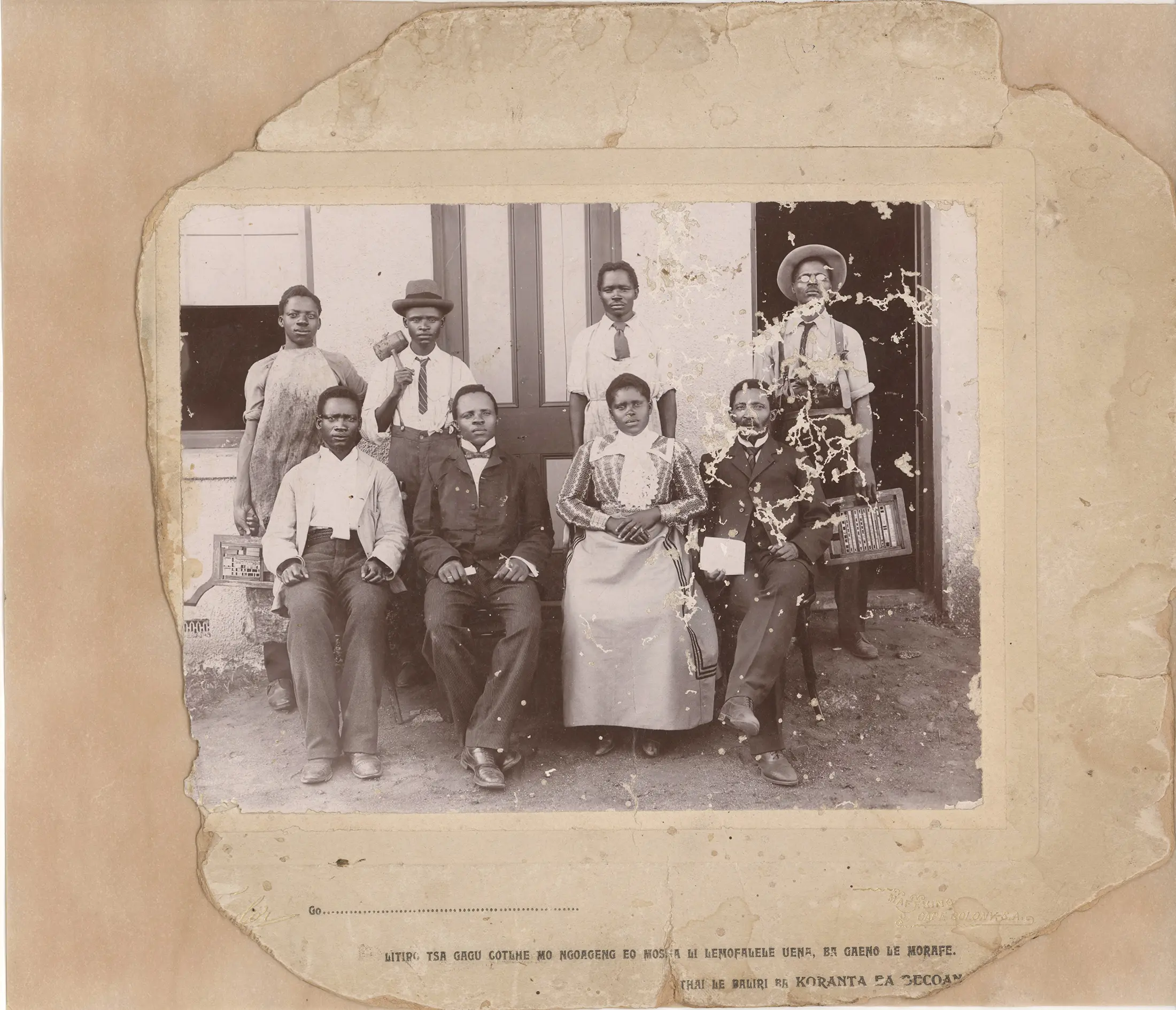
South Africa has produced many giants but few stand as luminously as Solomon Tshekisho Plaatje.
Linguist, journalist, novelist, translator, political organiser, he was one of the earliest architects of Black intellectual modernity.
His life, stretching from 1876 to 1932, is a testament to what brilliance looks like when forged under conditions designed to extinguish it. Plaatje was not merely ahead of his time; he was ahead of the country that birthed him.
To understand Plaatje is to understand the buried inheritance of black excellence, the ingenuity, discipline, and creative fire that existed long before conquest tried to erase it.
His life is proof that black South Africans were never waiting for civilisation to arrive. They were already building it.
Origins: A mind formed in motion
Sol Plaatje was born on 9 October 1876 on the farm Doornfontein, near present-day Boshof in the Free State. His parents, Johannes and Martha Plaatje, were part of a generation navigating the shifting frontier between African polities and expanding colonial rule.
His childhood unfolded across mission stations in Pniel, Mafeking and Kimberley, places where African intellectual life was quietly flourishing.
From an early age, Plaatje displayed a gift that would define his life: language. He mastered Setswana, English, Dutch, German, and later seSotho, IsiZulu and IsiXhosa. In a country where language was used as a weapon of exclusion, Plaatje turned it into a tool of liberation.
Brian Willan notes that Plaatje’s teachers recognised him as ‘‘exceptionally bright,” a young man whose mind absorbed and synthesised with unusual speed.
His early work as a court inter-preter in Mafeking was not a small administrative role; it was a crucible. He became the bridge between worlds, translating not only words but worldviews.
By the early 1900s, Plaatje had become one of the most important Black journalists in South Africa. He edited Koranta ea Becoana and later Tsala ea Batho, newspapers that served as intellectual lifelines for black readers.
He wrote with clarity, courage, and a refusal to accept the lie that black people were incapable of political thought. His journalism was not commentary; it was resistance.
During the Siege of Mafeking (1899–1900), Plaatje kept a diary documenting the experiences of Black residents trapped in the conflict.
His writing captured what official accounts ignored: the humanity and suffering of African people. Plaatje’s Mafeking diary revealed ‘‘a sharp, observant mind, unafraid to confront injustice”.
This was the beginning of a lifelong pattern: Plaatje writing black people back into the story.
In 1912, Plaatje became one of the founding members of the South African Native National Congress, later the ANC. He served as its first general corresponding secretary, shaping the organisation’s early intellectual and diplomatic strategy. He travelled to Britain in 1914 as part of a delegation protesting the 1913 Natives Land Act, a law that violently dispossessed black South Africans of land and economic autonomy. Plaatje’s mission was simple: force the British government to confront what its South African dominion was doing in its name.
His book, Native Life in South Africa (1916), emerged from this struggle. It remains one of the most important political texts ever written in this country, a forensic, heartbreaking account of how the Land Act “turned thousands of people into wanderers”.
Plaatje wrote not only as a witness but as a moral conscience.
He understood something pro-found. Oppression is not only a political condition; it is a psychological one. To break it, you must first name it.
Plaatje’s literary achievements were extraordinary.
He wrote the first English-language novel by a black South African, Mhudi (completed 1920, published 1930), a historical epic blending African oral tradition with modern narrative form. It was a declaration that African stories belonged in the global canon.
He translated Shakespeare into Setswana: The Merchant of Venice, Julius Caesar, Much Ado About Nothing. This was not mimicry. It was a reclamation. Plaatje believed African languages could carry the full weight of global literature. His translations proved it.
Plaatje’s literary work is described as ‘‘a bridge between worlds”, a fusion of African intellectual heritage and European literary forms. He was building a cultural future long before the country was ready for it.
Plaatje’s activism was not abstract. He worked directly with communities, organising relief, advocating for workers, supporting families displaced by the Land Act. He travelled tirelessly, often at great personal cost, to raise funds for schools, missions and civic organisations.He believed in education as a liberation tool. He founded schools, trained teachers and wrote textbooks. His life was a continuous act of service.
The final years: A flame that burned too bright
By the late 1920s, Plaatje’s health was failing. He had spent decades fighting battles that should have been fought by institutions, not individuals. He died on 19 June 1932 in Johannesburg, leaving a country that had not yet caught up to his vision.
His funeral drew thousands. Even those who had opposed him recognised that a giant had fallen.
Plaatje lived ‘‘a life of extraordinary achievement under extraordinary constraint”. He was a man who refused to let the shadows define him.
Legacy: The light that calls us forward
Sol Plaatje’s life is not a chapter in history. It is a mirror. It reflects what black South Africans were capable of before the machinery of conquest tried to erase them.
It reflects what they are still capable of now. • He showed that; • Language is power; • Memory is resistance; and • Institutions matter.
A people who know their past can build their future deliberately, not defensively.
Plaatje left not only books and speeches but a blueprint for intellectual courage.

V Zwelibanzi Mntambo is the chancellor of the Vaal University of Technology.