

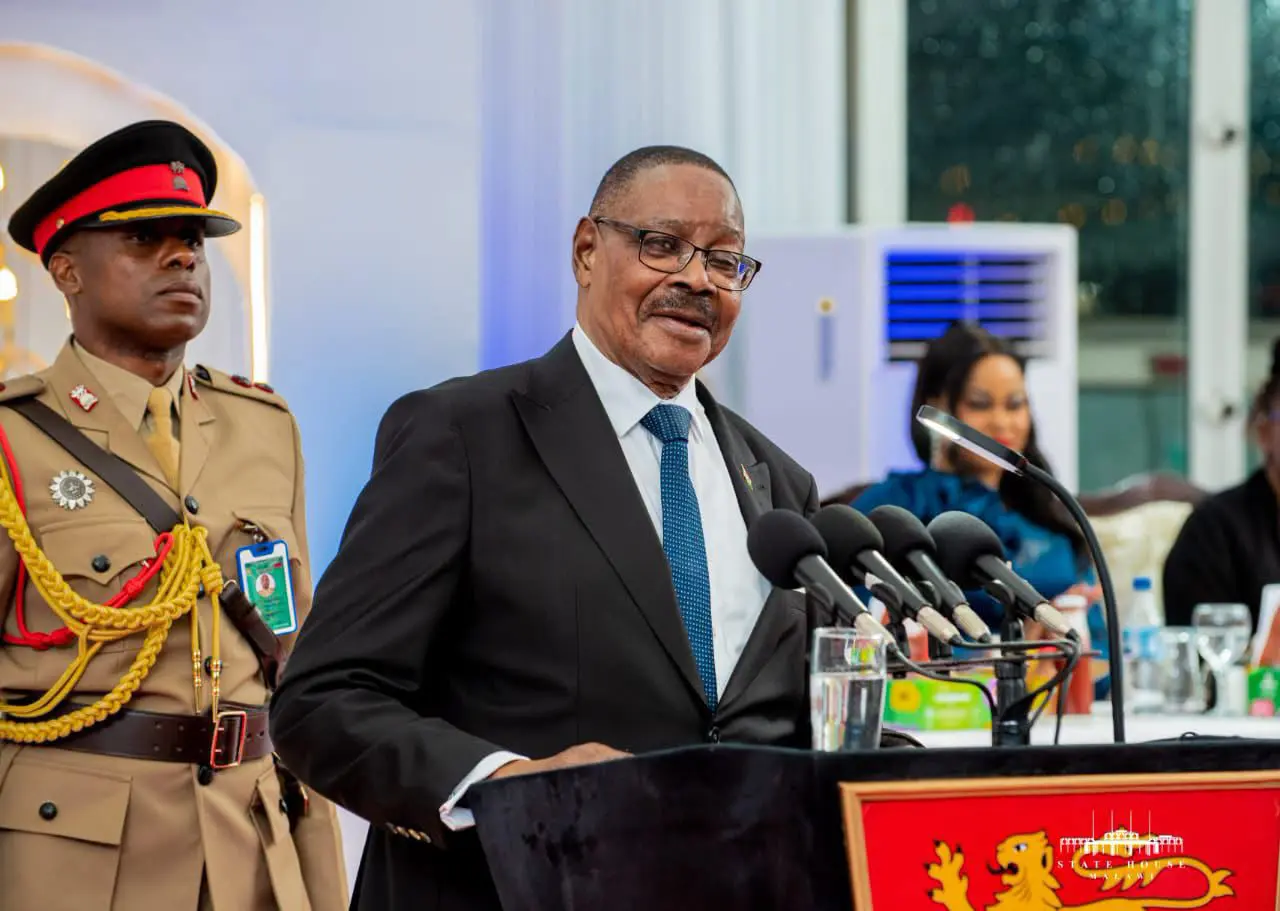
Malawi’s government has declined to say whether public money supported five trips President Peter Mutharika made to South Africa, invoking his privacy while leaving questions about travel expenditure unanswered.
The dispute is not simply about where a president goes. It concerns how a democracy protects an officeholder’s private affairs while accounting for public resources used in support of the presidency.
Mutharika has made five trips described as private since returning to office in October 2025. The government has not disclosed their purposes or funding arrangements.
Chief secretary Justin Saidi put the administration’s position in categorical terms: “Private is private. It is not public.” He said critics were “bent on propaganda” and maintained that the government had no obligation to provide further details.
That position leaves a distinct question unanswered: whether taxpayers paid for any part of the travel. Nyasa Times reported that Mutharika travelled to South Africa from 1 to 15 December 2025; 1 to 12 March 2026; 12 to 29 June; and 5 to 15 August. His fifth trip began on 6 October. Officials announced that journey only after his departure, unlike previous trips for which they gave advance notice.
The reported dates establish the frequency of the trips, not their purposes, costs or any wrongdoing. The local news reports contain no record of invoices, allowance records, security bills or payment authorisations. Reports that the trips were for medical purposes or that Mutharika travelled to India remain unverified. The government denied reports of travel to India for the same alleged purpose.
A president may travel for personal reasons while still requiring official security, communications and arrangements for continuity of government. Whether the government paid for transport, protection, accompanying staff or accommodation remains unknown. That pre-vents a clear distinction between privately financed travel and official support provided for private journeys.
Malawi’s Constitution protects personal privacy under section 21. It also gives every person, under section 37, access to information held by the state when needed to exercise rights.
Section 12 says state authority derives from Malawians and must serve and protect their interests.
These provisions require a distinction between legitimate privacy and the public’s right to scrutinise government spending.
The Access to Information Act provides for access to records held by public bodies, subject to protections that include personal information. Requests for expenditure and authorisation records can therefore be considered separately from requests for sensitive medical or family details.
Saidi’s formulation risks treating the purpose of a private trip and any public expenditure associated with it as the same issue. They are distinct questions.
The absence of financial disclosure is not evidence of misuse. Security and personal-safety considerations may justify withholding some information about presidential movements, particularly while travel is under way.
Once immediate security concerns have passed, disclosure of whether public funds were used, who authorised the spending and which rules applied could provide accountability without disclosing medical or family information. African Commission principles also recognise both access to information about public expenditure and protections for privacy. Responsibility for financial accountability does not rest with State House alone. The Office of the President and Cabinet maintain administrative records; the Treasury oversees public finances; Parliament authorises spending through appropriations; and the auditor general examines public accounts.
Under the Public Finance Management Act of 2022, controlling officers have duties relating to the authorisation, purpose and economical use of public funds.
The Public Audit Act empowers the auditor general to inspect transactions, accounts and records of public institutions and assess whether spending was authorised and resources managed economically and efficiently.
The Constitution requires the auditor general to report on public accounts to the National Assembly. Limits on public disclosure therefore need not prevent examination by institutions with statutory oversight powers.
The current information imbalance can sustain the dispute. State House holds the relevant information, while critics cannot independently assess expenditure without records. Unverified claims can spread as officials dismiss questions as partisan.
Associate professor Boniface Dulani warned that a lack of information encourages speculation. Michael Kaiyatsa, executive director of the Human Rights Defenders Coalition, argued that the government should at least say whether the trips were publicly or privately funded.
The dispute arises amid fiscal and foreign exchange pressures.
The World Bank reported in September 2026 that Malawi’s fiscal deficit had narrowed to 8.8% of gross domestic product in the 2025- 26 financial year, while high interest payments continued to crowd out investment and social spending.
Official foreign exchange reserves remained below one month of import cover amid pressure from fuel and fertiliser imports.
International travel can involve expenditure in scarce foreign currency, making the source and scale of financing relevant even when spending is lawful. With costs unknown, there is no basis to conclude that these trips materially worsened Malawi’s shortages. The lack of disclosure instead pre-vents an assessment of their financial significance and compliance with public finance rules.
There is a recent precedent for scrutiny of executive travel costs. In November 2023, then-president Lazarus Chakwera suspended publicly funded international travel by himself and government officials amid a currency and cost-ofliving crisis. The decision reflected the fiscal and political significance attached to official travel, not a finding that all such journeys are wasteful.
The distinction remains straightforward: confirmation that the journeys were privately financed could address one source of speculation. If public resources were used, expenditure and audit requirements remain relevant regardless of the private reason for travel.
Presidential travel also raises questions about who performs official duties during an absence.
Malawi’s Constitution provides for vice presidents to carry out functions assigned by law or the president. Presidential incapacity is a separate constitutional matter, under which the first vice president may act.
Travel abroad does not itself indicate incapacity and the material reviewed contains no evidence that Mutharika was unable to perform his duties.
Records of the Southern African Development Community (SADC) indicate that representation continued. Second Vice President Enoch Chihana represented Malawi at an extraordinary SADC summit on 29 June and at an ordinary summit in Durban on 17 August.
In June, SADC also announced that Chihana would chair an Organ Troika summit on Mutharika’s behalf while Malawi held a regional security role.
Those delegations counter any suggestion that international representation stopped during the president’s absences.
They do not, however, establish what arrangements applied to every presidential duty. For regional part-ners and Malawians alike, clear information about delegated authority matters separately from the reasons for private travel.
Tanzania offers a cautionary example rather than a direct parallel.
Former president John Magufuli’s absence from public view for roughly two weeks in 2021 prompted health speculation that officials initially rejected. His death was announced on 17 March 2021. That episode establishes nothing about Mutharika’s health. It illustrates how limited information about a leader’s availability can also generate questions about continuity of government.
The unanswered questions can be addressed through records rather than speculation. An access-to-information request could seek expenditure and authorisation documents with protected details redacted. Parliament could question the relevant controlling officer and the auditor general could examine whether public resources were spent lawfully, economically and efficiently. Such scrutiny need not expose the president’s private medical or family circumstances.
A consistent approach to post-travel disclosure could identify funding, duration and delegation arrangements while withholding details that remain security sensitive. The frequency of the trips alone establishes neither financial wrongdoing nor presidential incapacity.
Whether the relevant institutions disclose or examine the financial records will determine how far the government can justify withholding information in the name of privacy. The president’s personal reasons for travel may remain private; any use of public money remains a question of public accountability. Collins Mtika is a veteran journalist and the Mail & Guardian’s special correspondent in Mzuzu, Malawi. This article was made possible by a partnership with the Centre for Investigative Journalism Malawi (www.investigative-malawi.org).