


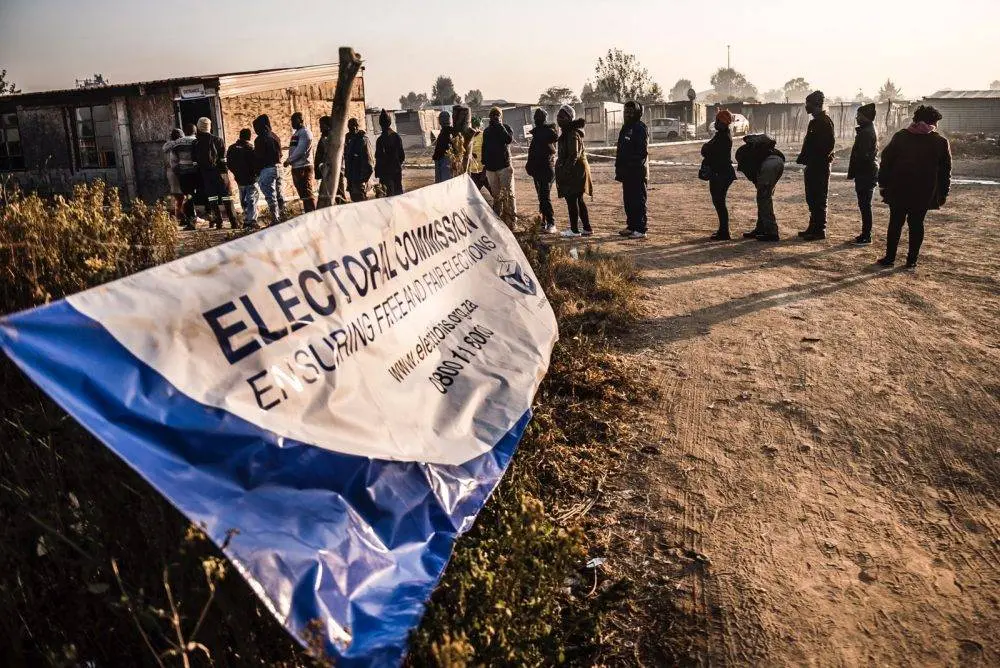
On 29 May 2024, 16.29 million South Africans voted. That was 58.64% of the 27.78 million registered voters, the lowest turnout of any general election since 1994. But registration is itself a filter. Measured against the voting-age population, turnout was about 41%, down from 86% in 1994, and the number of eligible adults who never registered has grown from roughly 7 million in 2014 to roughly 11 million today.
Estimates of the voting-age population range from 39.7 million to 41.4 million. Between 23 million and 25 million adults did not vote in 2014. The ANC, still the largest party, won 6.46 million votes, roughly one in six eligible adults. Those who stayed away outnumbered the ANC's voters by more than three to one. Local government, supposedly the sphere closest to the people, is worse: in 2021, turnout was 45.79% of registered voters, fewer than 30% of those eligible, and only 35% of registered 20- to 29-year-olds bothered to show up.
Not every empty queue is a protest. The IEC itself admitted that its new voting-station rule turned people away in 2024, and people move, work far from home and fall off the roll. But logistics cannot explain a slide from 76.7% in 2004 to 58.6% in 2024, nor the millions of adults who made their decision before election day by never registering at all. This is a pattern, and it has a direction.
They know what the ballot has delivered
Official unemployment stands at 33.6%, and 47.4% among young people. Count those who have given up looking, and the figure rises to 43.8%. The World Bank ranks South Africa first among 164 countries for inequality. Every party that has won local or national elections during this period has maintained structural inequality. Ask ordinary people why they stopped voting, and you will rarely hear indifference. You will hear a verdict: “they come when they want votes only, and they disappear afterwards”.
That verdict is an anarchist analysis
Anarchism is usually presented as an insult, a synonym for chaos. In fact, it is a body of argument about power, and its central claims are ones millions of South Africans already make without the label. First, the state is not a neutral machine waiting for the right hands; it is an institution built to concentrate power, protect property and manage the people below it, and those who run it develop interests of their own. Second, those who enter government find their choices narrowed by debt, investors and treasury rules, and call it realism. As Lucien van der Walt put it to a Khayelitsha audience before the 2019 election, “We never voted for privatisation in 1994, but we got it.” Third, real power lies in what people build themselves, and this is most observable when their politics are outside and against the state. Since the 1980s, and even earlier, the South African working class has argued that workers should build their own organisations rather than hand their hopes to parliament. The person who says “they only come when they want our votes” is making Bakunin's argument without having read him. I have made this case before, and it is the long-standing view of the anarchist tradition.
But abstention is not resistance.
Here the anarchist tradition parts company with the stay-at-home. Silence is not a strategy. A government elected by 16 million governs just as comfortably as one elected by 40 million, and a boycott that ends on the couch costs the powerful nothing. The tradition's answer to disillusionment was never “do nothing”. It was to organise, now, where we live and work, and to build counter-power: the collective strength of working-class and poor communities, independent of parties and the state.
This is not an abstraction; it is the most reliable record South Africa has. In 1917, African workers in Johannesburg, shut out of the franchise, formed the Industrial Workers of Africa, the country's first union for African workers, with the slogan Sifuna Zonke: “We want everything.” In 1973, close to 100 000 workers went on strike in Durban without a union or a vote, and the state conceded that black unions were here to stay. The Treatment Action Campaign forced a reluctant government to provide HIV treatment, backing court action with the threat of mass civil disobedience. The Anti-Privatisation Forum and the Soweto Electricity Crisis Committee reconnected power by hand when prepaid meters cut families off. Abahlali baseMjondolo organised shack dwellers under the slogan “No Land! No House! No Vote!” and paid a heavy price, including the murder of its leaders.
In each case, people won something an election had not delivered, and the ballot box, where it appeared at all, came afterwards to ratify it. Governments move when they are frightened, not when they are flattered.
“But surely the vote is better than nothing?”
This is the strongest objection, and it deserves a straight answer. The right to vote was won through immense sacrifice. The right to vote, especially in the South African context, is an incredible gain for all, and the fact that it exists under a constitutional order securing civil liberties is fundamentally far superior to the apartheid regime. However, elections will not advance the working class. A vote takes minutes; a movement takes years. If we pour our hope into the first and neglect the second, we should not be surprised when nothing changes. The ballot has never been where change begins.
The deeper problem is not only that elections fail to deliver. It is what they do to us. Elections ask us to be spectators. They teach us that politics is something done on our behalf by professionals, and that our task is to pick a leader and then wait. Between elections, we are expected to be quiet. If the leader disappoints us, the remedy offered is another election, another leader, another cycle of hope and betrayal. Elections also divide us. They turn neighbours into rival camps, sharpen ethnic and regional loyalties, and give opportunists a stage on which to blame foreigners, whether through vigilante campaigns against migrants or through the politics of scapegoating dressed up as service delivery. We are told to fight one another for scraps instead of asking why there are so few.
The upcoming elections are municipal, and municipal government is supposed to be the sphere closest to the people. Yet this is exactly where the collapse is most visible. Municipalities across the country are broke, captured by tenderpreneurs or hollowed out by factional appointments. Sewage runs through the streets; residents go days without water. Potholes become craters, and refuse piles up while contracts are awarded to the politically connected.
Party after party promises to fix this. Coalition after coalition forms, collapses and reforms, as councils become marketplaces where seats are traded for positions. The technical language changes from administration to administration, but ordinary residents keep paying rates and tariffs for services that do not arrive. Where does the pressure to repair a water pipe actually come from? Rarely from a manifesto. More often, it comes from residents who block a road, occupy an office or organise a community committee that refuses to be ignored.
Whether your vote is a personal decision or not, do not mistake it for the main event. The 23 million already understand the first half of the argument: the ballot box is not where power lives. The second half is harder and better. Power is something people build.
Leroy Maisiri is a researcher and history lecturer at the University of Fort Hare and a PhD candidate. He writes in his personal capacity.