

South Africa is heading into an exciting week. This weekend, the nation’s attention will turn to one of the country’s biggest football fixtures: the Soweto derby, as Orlando Pirates take on Kaizer Chiefs at FNB Stadium.
Just four days later, on 4 November, another kind of contest will unfold across more than 23 000 voting stations in the country. This time, the contest will not be decided on the football pitch, but at the ballot box, as South Africans choose those who will lead municipal councils.
In several respects, the Local Government Elections (LGE) share similarities with the derby. Both invite people to make choices about whom they support. Both also demand extensive preparation, coordination and the participation of multiple stakeholders.
While the derby lasts 90 minutes, its preparation begins long before the teams take to the field. The same is true of elections. Preparation for an election begins almost as soon as the previous one concludes. In this sense, preparations for the 2026 Local Government Elections began immediately after the general elections in 2024.
Both events require careful planning and execution. In the case of elections, the stakes extend far beyond the outcome of a contest. Elections shape the leadership, governance and future of our communities.
A natural question for both football fans and voters is: Are the organisers ready?
The short answer is that the Electoral Commission is ready.
We are ready because we have undertaken extensive work to create the conditions for elections that are transparent, credible and worthy of public confidence.
Among the measures we have put in place are:
Robust election systems: The rigorous development, testing, auditing and performance evaluation of the systems and applications that will support the elections;
Electoral staff recruitment: A review of Recruitment and Selection Criteria, particularly for Presiding Officers and Deputy Presiding Officers, to strengthen the quality and competence of electoral personnel. Management and supervisory experience is now a requirement;
Voting station efficiency: Measures designed to improve the flow of voters and minimise unnecessarily long queues at voting stations; Transparency and oversight: The accreditation of election observers and party agents, whose presence at voting, counting and results determination processes helps promote transparency and enables irregularities to be identified and addressed;
Results capturing and verification: The double capture of election results into the Results System, together with an audit of each captured result slip against the finalised result declared by the Presiding Officer and witnessed by observers and party agents. As a novel aspect, enabling party agents to take photographs of original result slips;
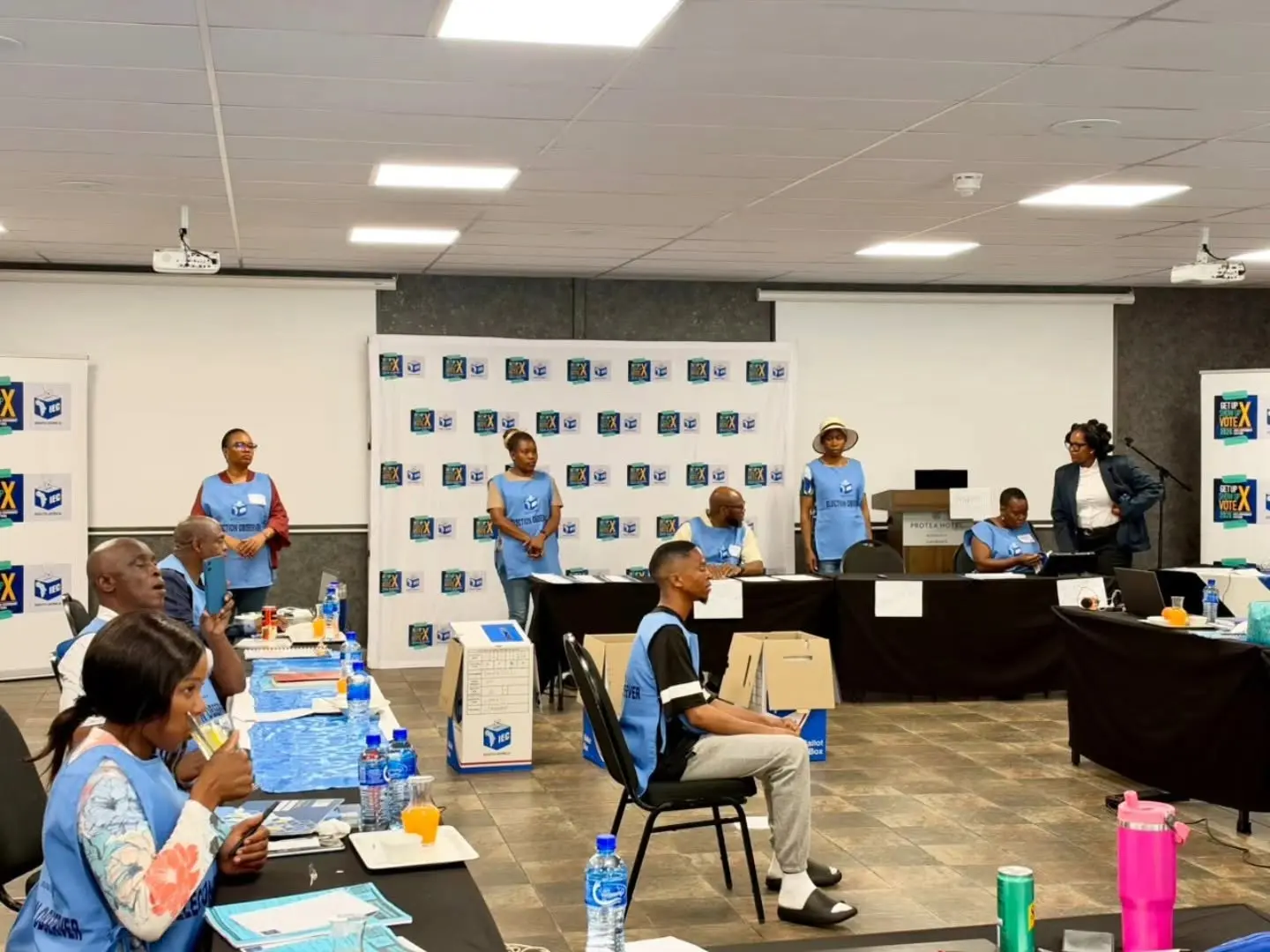
Readiness simulations: Dry runs conducted in simulated election environments to test the readiness of our staff, processes and systems; and Exception management: Integrity checks built into the Results System, supported by an exception management process, to ensure that discrepancies and exceptions are resolved in accordance with prescribed pro-cedures before results are published on the mobile APP and website as well as displayed on the leaderboards at our Results Operations Centres (ROCs).
These measures are not merely technical requirements. They are essential safeguards for the integrity of the electoral process and the credibility of its outcomes.
Beyond operational readiness, our preparations have also focused on ensuring that eligible South Africans are registered, informed and able to participate.
There are just over 29.2 million voters on the voters’ roll, including many first-time voters. The roll continues to change, with approximately 34 000 voters removed each month due to deaths. Against this background, we are encouraged by the growth in registration, while recognising that more eligible young people still need to register and participate.
The growth in youth registration is not accidental. The Commission has been deliberate in its efforts to encourage young people to see themselves not merely as observers of democracy, but as active participants in shaping their future.
Among our initiatives is Beats for My Peeps, a 10-episode youth-focused series combining music, culture and digital creators to address voter apathy, counter misinformation and encourage participation. The series was broadcast on SABC 1 at 18:00 from 3 June.
We also produced a television reality documentary, Let Your Voice Be Heard, which follows the stories of citizens alongside constitutional experts to explore what makes democracy work and to emphasise the importance of active citizenship. Our television campaign to mobilise registered voters focused on encouraging turnout on Election Day, while reminding voters of the required documentation and the voting process. The campaign deliberately incorporated a strong youth focus.
We complemented these initiatives with an animation series covering important electoral topics, including democracy, special votes, election dos and don’ts, voting and counting processes and the allocation of seats. These animations are already being flighted across multimedia platforms, including community media. A further innovation was the launch of a podcast to make accessible election information available through mobile and digital platforms, alongside a newly introduced media app.
Our contact centre has been expanded into a multichannel service offering voice, live chat, email and social media support, making it easier for voters to obtain information through channels that are convenient to them.
As political parties and candidates increasingly use digital platforms and media networks for campaigning, we must also contend with the risks associated with misinformation and disinformation. The rapid development and widespread availability of artificial intelligence capabilities have made voice cloning, deepfakes and digital impersonation easier to produce and distribute.
The growing sophistication of these technologies makes false election information increasingly difficult to detect, verify and rebut. This creates the risk that voters may make decisions based on false or manipulated information. Therefore, protecting integrity of election information is an integral part of ensuring free and fair elections.
It is for this reason that we have pursued a multistakeholder approach, working with civil society organisations that share our concern about disinformation, as well as with digital platforms. This collaboration culminated in the signing of a framework of cooperation with Meta, Google, TikTok and Microsoft on 20 October 2026.
Alongside the established Electoral Code of Conduct, which political parties subscribe to upon submitting nominations for candidates, we have introduced a further Code of Conduct on Countering Disinformation, or the Disinformation Code.
Internally, we have expanded our digital communications capacity to enable us to monitor disinformation as it emerges. We have also strengthened our content team to ensure that accurate, authoritative and official election information remains accessible to South Africans.
Voters can reach us directly through our well-staffed contact centre, which is operating extended hours and providing support in all 11 official languages, as well as through our social media channels.
Our objective is not simply to respond to falsehoods after they have spread. It is also to ensure that reliable information is available, accessible and timely enough to help voters make informed choices.
As an election management body, we are conscious that the Commission is not the main act in an election. Political parties and candidates are. Football fans do not fill stadiums or tune in to watch matches simply because they admire the organisational capabilities of the Premier Soccer League or stadium management. They come because they care about the teams, the players and the contest. In much the same way, voters ultimately make their way to voting stations because of what they make of the political choices before them. Just as the two clubs in the derby have a responsibility to build enthusiasm among their supporters, political parties and candidates have a responsibility to present compelling ideas, credible programmes and leadership that inspire citizens to participate.
Turnout at the voting stations will ultimately depend on how voters assess the political alternatives before them. This does not mean that the Commission is absolving itself of its responsibilities towards voters, political parties and candidates.
Quite the contrary. Our responsibility is to ensure that the conditions for meaningful participation exist, that eligible voters can exercise their rights and that political parties and candidates are able to contest elections within a fair, transparent and credible framework.
South Africans are entitled to expect the Electoral Commission to organise elections that provide the best possible conditions for political parties and candidates to contest, and for voters to register, access reliable information and vote for their preferred parties and candidates.
We believe we have been equal to the task.
It is now up to South Africans to Get Up, Show Up and Vote on November 4.

Sy Mamabolo is the chief electoral officer at the Electoral Commission of South Africa (IEC).