

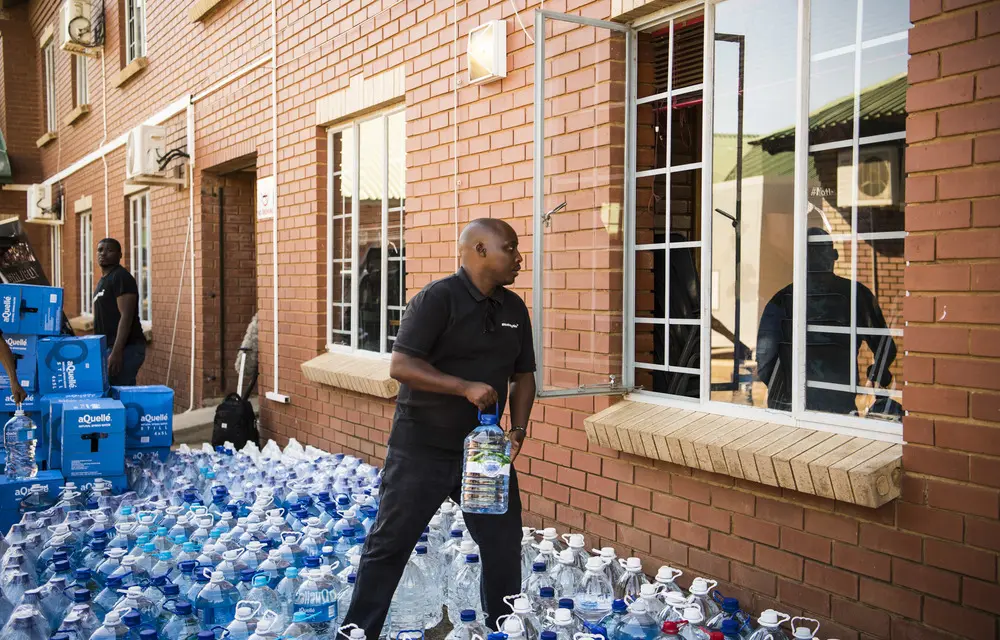
Water is finite. No institution can produce beyond the limits of the available resource. Rand Water has repeatedly engaged the municipalities it supplies on the urgent need to reduce consumption. Yet demand continues to exceed sustainable levels, while the reservoirs that provide the vital buffer between bulk supply and municipal networks remain dangerously low. The immediate task is clear: protect the water already in the system, bring consumption within agreed limits and rebuild storage before the margin for recovery disappears.
Rand Water is doing everything technically possible to sustain supply. But maximum production cannot indefinitely compensate for excessive demand, avoidable losses and delayed interventions.
One system, three distinct responsibilities
Gauteng’s water reaches consumers through an interconnected value chain. The Department of Water and Sanitation manages national raw-water resources and sets abstraction allocations. Rand Water conveys raw water, treats it to drinking-water standards and supplies it in bulk. Municipalities manage local storage, reticulation, distribution, customer services and losses within their networks. Reliable supply depends on all three parts of this chain working effectively and in coordination.
Rand Water is abstracting, treating and supplying water at maximum levels, while its operational teams work continuously to keep the bulk system stable. But this crisis cannot be solved simply by pumping harder. When consumption remains above agreed limits, water leaves the system faster than reservoirs can recover.
A water-use licence sets the maximum amount of raw water Rand Water may abstract from the Integrated Vaal River System. It protects a shared, finite resource for other users and future needs. Rand Water’s permanent allocation is 1.6 billion cubic metres a year – about 4,381 megalitres a day. A temporary allocation of 1.803 billion cubic metres a year permits about 4,936 megalitres a day until 30 September 2027. Municipalities and direct users supplied by Rand Water consumed about 4,702 megalitres a day in September 2026 – 95.3% of the temporary limit and only about 234 megalitres a day below it. That remaining difference is not unrestricted spare capacity as the licence is a legal and physical ceiling, and strategic reservoirs still need sufficient water to maintain pressure and absorb disruptions.
Future supply will not remove today’s responsibility
Long-term water security depends on continued augmentation of the Integrated Vaal River System. Planned allocations rise from 1,600 million cubic metres a year for 2024–2028 to 1,840 million cubic metres for 2028–2032, and to 2,065 million cubic metres from 2032. That augmentation is essential, but it cannot replace sustained municipal conservation and demand management. Additional supply will be secure only if local networks are efficient and consumption is responsible.
The present figures show why action cannot wait. At 15:00 on 26 October 2026, total Rand Water reservoir storage stood at 28.9% against a 60% target. From January to September, Johannesburg Water used about 1,722 megalitres a day – 194 megalitres a day, or 13%, above its temporary water-use-efficiency target. Sustained consumption above target erodes the system’s buffer, destabilises pressure and increases the risk of restrictions and unplanned interruptions.
The demand picture
Figures reported for 27 October 2026 show how consumption across the three major metros compared with their temporary targets:
Three metros: monthly consumption against permanent and temporary targets
All figures are in ML/day. Permanent and temporary targets remain constant across the period.
The monthly data from January to September 2026 shows a consistent regional imbalance. Johannesburg Water exceeded both its permanent target of 1,356 ML/day and temporary target of 1,528 ML/day in every month, averaging about 1,724 ML/day. City of Tshwane also remained above both targets throughout the period, averaging about 902 ML/day against a temporary target of 752 ML/day. City of Ekurhuleni remained below its temporary target of 1,152 ML/day in every month, but its average of about 1,063 ML/day was still above the permanent target of 1,022 ML/day.
Over the nine-month period from January to September 2026, the three Gauteng metros consumed an average of about 3,690 ML/day. Had they remained within the combined temporary target, average consumption would have been no more than 3,432 ML/day; actual demand was therefore about 258 ML/day, or 7.5%, above that limit. Against the combined permanent target of 3,045 ML/day, the excess was about 645 ML/day, or 21.2%.
Across the 273 days from January to September, the monthly averages represent estimated consumption of about 1,007,287 ML. This was approximately 70,351 ML—70.4 billion litres—more than the temporary target would have allowed, and about 176,002 ML—176.0 billion litres—more than the permanent target. Every month exceeded both combined targets. The figures show that temporary allocations provide short-term relief but have not brought overall metro demand to a sustainable level. Johannesburg and Tshwane require the largest reductions, while Ekurhuleni’s performance below its temporary target demonstrates that demand can be moderated. Continued overconsumption limits reservoir recovery and reduces the system’s ability to absorb outages and peak demand.
Put differently, if the three metros had kept consumption within their combined temporary target from January to September 2026, approximately 70.4 billion litres of water could have been saved. If consumption had remained within the lower permanent target, the saving would have been approximately 176.0 billion litres. The permanent target would therefore have conserved about 105.7 billion litres more than the temporary target over the same nine months. This comparison shows that the temporary allocation provides additional short-term capacity, but returning to the permanent target would make a substantially greater contribution to reservoir recovery and long-term water security.
The pressure extends beyond the metros
The broader municipalities that are supplied by Rand Water requires the same discipline. The table below compares each municipality’s temporary water-use-efficiency target with its reported monthly consumption from January to September 2026, showing whether demand remained within target and how it changed over the nine-month period.
The nine-month pattern shows that overconsumption is concentrated in a some of the municipalities. Emfuleni and Madibeng exceeded their targets in every month, while Mogale City, Rustenburg and Midvaal were above target in most months. By September, Emfuleni remained 47 ML/day above target, Mogale City 1 ML/day above, Rustenburg 4 ML/day above, Midvaal 1 ML/day above and Madibeng 4 ML/day above. Ngwathe was at its target in September after exceeding it in three months, while Royal Bafokeng Nation exceeded its target in July and August but returned below target in September. In contrast, Metsimaholo, Govan Mbeki, Merafong City, Rand West City, Lesedi, Victor Khanye and Thembisile remained within target throughout the period. The data therefore points to the need for focused interventions in persistently over-target municipalities, while maintaining the it is possible to stay within targets.
Rand Water’s response and the reservoir warning
Rand Water has introduced targeted measures across the Mapleton, Palmiet, Eikenhof and Zwartkopjes systems. These include restricting selected municipal meters, reducing or temporarily closing supply at certain points, isolating reservoirs and managing reservoir operating levels to balance flows and stabilise pressure. These interventions support the system, but they cannot create additional water.
At 15:00 on 26 October 2026, total reservoir storage had fallen by 2.9 percentage points—about 35 million litres—to 28.9%, far below the 60% target. Several strategic reservoirs were below target, while demand was increasing at Sandton No. 1, Aeroton Reservoir, Waterval Dall and South Hills Water Tower. Low storage reduces the buffer needed to maintain pressure and respond to outages or demand peaks, reinforcing the need for restrictions, leak repairs and close monitoring of high-consumption points.
The water already produced must reach consumers
Demand reduction must be matched by a determined effort to reduce non-revenue water.
Non-revenue water is treated water that enters a municipal network but does not generate revenue. It includes physical losses from leaks and bursts, inaccurate or missing meters, illegal connections, billing errors and authorised supplies that are not billed. Not all of it is physically lost, but high levels show that a significant share of water purchased from Rand Water either does not reach intended users or is not properly measured and billed.
The scale is severe. Non-revenue water is estimated at about 49% in Gauteng and 49% in Johannesburg. Physical leakage alone is estimated at roughly 20% of treated water supplied in Gauteng – about 431 billion litres a year – and approximately 26% of system input in Johannesburg. Across Gauteng, this lost water is estimated to be worth more than R14 billion at municipal water rates, or about R7 billion at bulk purchase prices.
The effect on availability is direct. When treated water is lost before reaching users, municipalities must request more bulk water to meet the same underlying demand. Reservoir recovery slows, Rand Water’s licensed supply is placed under greater strain, and the risk of low pressure, restrictions and interruptions increases. Lost, inaccurately measured or unbilled water also reduces municipal revenue for repairs and maintenance. Faster leak detection, replacement of ageing pipes and faulty meters, pressure management, accurate flow reconciliation, action against illegal connections and stronger billing can recover an existing source of supply without increasing abstraction.
What municipalities must do now
Rand Water has in various forums requested municipality to assist by:
- bring consumption within allocated water-use-efficiency targets and report progress regularly;
- implement and consistently enforce Level 2 or 3 water restrictions where required;
- coordinate with Rand Water to identify and manage high-consumption meters;
- enforce by-laws against wasteful and non-essential use, including excessive irrigation and sprinkler use;
- accelerate leak detection and repairs, replace ageing infrastructure and improve metering to reduce non-revenue water; and
- install and optimise pressure-reducing valves to manage night flows, reduce bursts and stabilise local networks.
Rand Water will continue to share information, provide technical support and coordinate bulk-system interventions. Municipalities remain responsible for implementation within their networks and for clear, regular communication with residents and businesses.
Rand Water is supplying at maximum. Gauteng’s water security now depends on reducing demand, recovering losses and rebuilding reservoir levels.
This is not a contest over blame. It is a test of coordination, urgency and accountability. Rand Water will continue operating the bulk system safely, responsibly and transparently. Municipalities must reinforce that effort by reducing losses, applying restrictions consistently, maintaining infrastructure and keeping consumption within agreed limits. Progress should be measured and communicated so that interventions can be adjusted quickly. Every drop saved – and every leak repaired – strengthens the system and moves Gauteng towards a more secure water future.
Lydia Radebe is the General Manager for Communications and Stakeholder Management at Rand Water.