


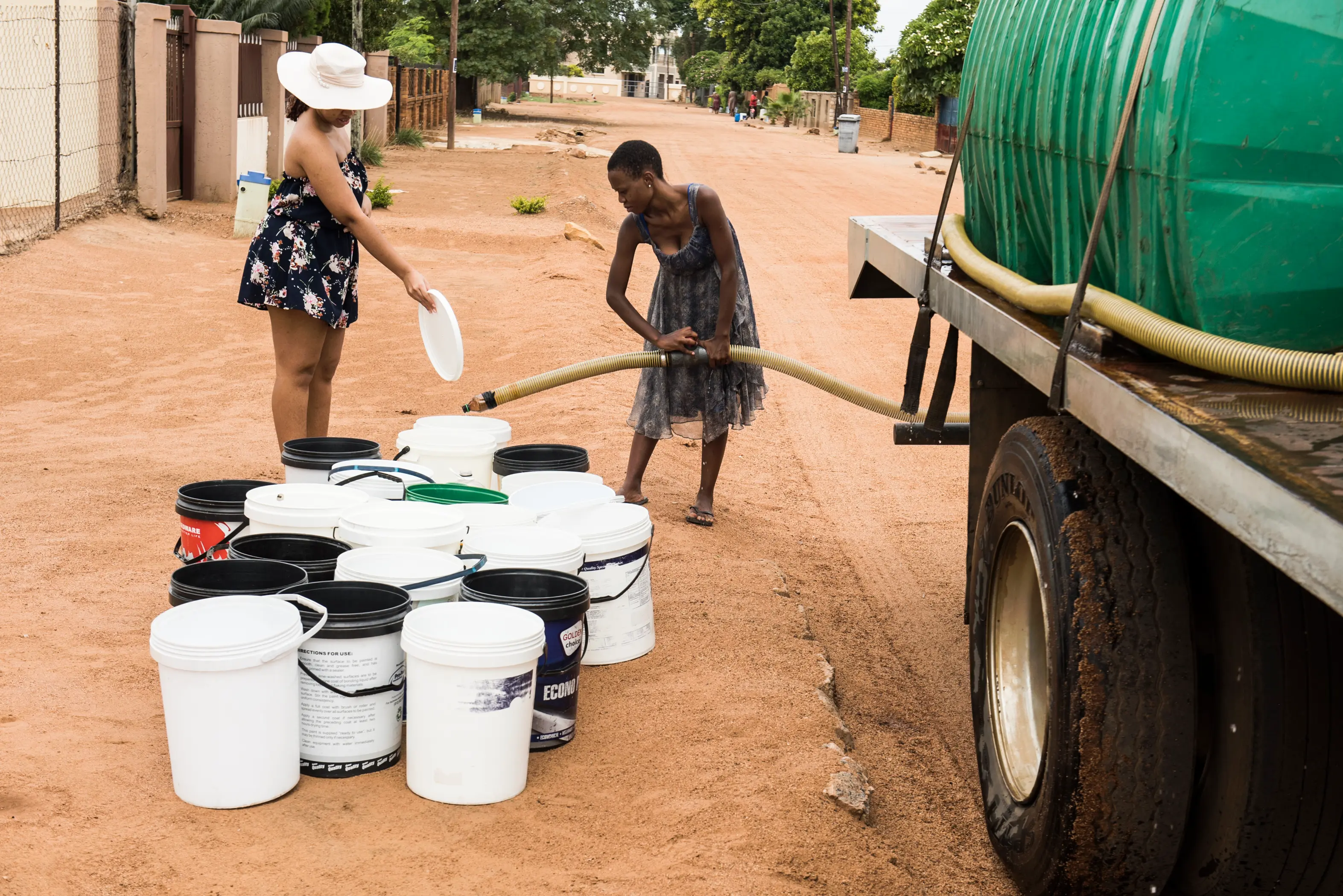
Ask any township or inner-city parent what the local government does for them and the response is almost always water. It is the tank truck that comes too late or not at all; the tap that is just air; the sewage that flows down the street the children play on.
On 4 November, millions of us will stand in line to vote for councillors to run our affairs for the next five years. Yet, for far too many South Africans, the line they are familiar with is the one for water from tankers.
A vote is a badge of dignity
Our Constitution enshrines a democratic state founded on adult universal suffrage, a national common voters’ roll, regular elections and a multiparty system (section 1(d)) and provides every adult citizen with the right to vote (section 19). We should not take that for granted.
For most of the past century, the right to vote was denied to most South Africans based on skin colour. In August versus Electoral Commission 1999 (3) SA 1 (CC), the Constitutional Court held that the right to vote is an “emblem” of dignity and personhood and that the state is obliged to take reasonable steps to enable citizens to participate in elections.
Universal suffrage is not a prize handed down by the ruling class. It is the means by which equals hold power to account. But a vote that does not make your life better is not a right. The ballot determines who rules. But it does not, in itself, pro-vide you with water.
The taps are running dry
Section 27(1)(b) guarantees everyone access to sufficient water. It is bound up with the right to dignity (section 10) and to an environment that is not harmful to health or well-being (section 24). In Mazibuko and Others versus City of Johannesburg and Others 2010 (4) SA 1 (CC), the Constitutional Court ruled that pro-viding six kilolitres (6 000 litres) of water per household per month was a reasonable measure towards the progressive realisation of the constitutional right of access to water.
Crucially, the court made clear that state policies must evolve and remain open to challenge. Can a municipality progressively fulfil this constitutional duty through water tankers?
Absolutely not. Relying on tanker water is an admission of failure, a costly, temporary band-aid that can never deliver the reliable, dignified access the Constitution guarantees. This recent history is unsustainable. Two turns of the broken water pump drive a vicious cycle.
First, municipalities in debt to water boards owe R23 billion (as at 31 March 2026). Bankrupt water boards cannot afford to invest in maintenance and upgrades. The department has cut off equitable-share funding to 62 of the worst white elephants.
Second, neglect: globally, about 30% of water entering municipal systems is lost through leaks (20%) and faulty meter readings (10%). South Africa matches this dismal figure. Worse still, of the country’s municipal wastewater treatment works,996 of 848 are in failure, according to the 2025 Green Drop report. The department’s chief engineer has admitted that a R400-billion maintenance backlog is “one of the contributing factors to the decline in water infrastructure”.
Johannesburg residents do not need statistics to know the water system is failing; they are living it. As I write this article, Johannesburg Water is warning Bezuidenhout Valley residents not to drink from their taps due to suspected contamination. In the Eastern Cape, more than 111 Rhodes University students and community members in Makana have fallen ill in a gastrointestinal outbreak linked to suspected E. coli. What happened in Bronkhorstspruit is not an isolated incident; it is a symptom of widespread municipal failure. Issuing public warnings only after people get sick is not responsible governance; it is neglect disguised as notice, closing the stable door long after the horse has bolted. Behind every statistic lies a household. When water is unavailable, it is the family who suffers most — the women and girls who have to carry it; the children who fall ill; the school and clinic that cannot operate without it. In some of our rural hospitals, patients have to bring water to take their medicine. Every time the tap runs dry, every time you go without water, you are being humiliated, degraded, deprived.
Bronkhorstspruit: when the tap becomes a threat
This is the fallout of management failure and it is playing out in Region 7 in Tshwane. Between 7 and 18 October 2026, 408 people in Bronkhorstspruit, Zithobeni, Dark City, Rethabiseng and Sokhulumi contracted gastrointestinal infections, most of them under five years old.
The Department of Water and Sanitation said: “From 24 September to 14 October, the Bronkhorstspruit Water Treatment Works delivered untreated water to the municipal network after the City experienced challenges with its chlorine supply.
“The tests revealed very high levels of E. coli and total coliforms. The polluted source river was contaminated by wastewater from failing wastewater works and pump stations upstream. The investigation found that the pump and sand filters at the plant were not operational.”
Most damning of all, the minister said the city failed to alert residents as the 2025 Compulsory Standards for Water Services stipulate. For three weeks, families drank, washed and bathed their babies in water that officials now say may only be used to flush toilets.
The investigations continue but the pattern is common: a known weakness, no contingency, no warning. Read through the Bill of Rights; this is not only a failure of plumbing. It is a failure of rights, one after another. The right to sufficient water in section 27(1)(b) means water that is safe to drink; water that sickens a toddler is not “access”. The right to life (section 11) and the right to bodily integrity (section 12) of the residents were impaired whenever a public utility exposed them to preventable disease. This was also a requirement of section 28(1)(c), whereby every child is entitled to basic health care services, and section 28(2), which requires the child’s best interests to be the primary consideration of all actions concerning the child.
The right of access to information (section 32) and the constitutional principle of transparency and accountability in government (section 195) required the residents to be immediately informed that their water was unsafe.
Rights do not fall equally on everyone. A family with financial means can buy bottled water, install a home filtration system or relocate. A family without resources is left waiting for an unreliable water tanker and a hospital bed. When a municipality fails to maintain its water infrastructure, it fails its residents unequally, striking hardest and first at those with the fewest options and the youngest lives to protect. That inequality is a choice of leadership, and on 4 November, the ballot is how we reject it.
Two kinds of leaders
This crisis is not an act of God. It is the product of choices and the choices are made by leaders. Bad leaders exploit systems for themselves; good leaders strengthen systems for the betterment of all. A leader cannot do both. The two approaches are mutually exclusive: one erodes public trust, while the other fosters sustainable growth.
The exploiter looks to the municipality as a ready market for tenders, jobs for friends and favours for allies. The Auditor-General’s 2024-25 report shows how this happens: out of 257 municipalities, only 39 pro-duced clean audits, while irregular expenditure reached R40,14 billion in a year, 87% of it the result of pro-curement and contract-management failures.
Irregular expenditure is not automatically theft but the Auditor- General’s more damning observation is that councils routinely write these amounts off instead of investigating or recovering them. Where consequences are absent, negligence and looting blur into one another, indistinguishable in practice.
Bronkhorstspruit exposes the steep price of negligent leadership: a fixable glitch becomes a three-week poisoning because no one planned, checked or warned. True leadership is about doing the unglamorous work: paying bulk water accounts, safeguarding revenue for maintenance, hiring qualified managers, publishing records and fixing pipes before opening grand new projects. Because nobody cuts a ribbon for a repaired water pipe, maintaining infrastructure remains the ultimate test of character.
Making the vote count
Voters are not powerless between elections. The Local Government: Municipal Systems Amendment Act 3 of 2022 bars municipal managers from holding political party office and prescribes minimum qualifications. Under sections 54A(8) and 56(6) of the Municipal Systems Act 32 of 2000, the MEC for local government must act within 14 days of receiving an appointment report. In Western Cape Provincial Minister of Local Government, Environmental Affairs and Development Planning versus Central Karoo District Municipality and Others [2023] ZAWCHC 66, an acting municipal manager’s appointment was declared null and void. Residents can use the Promotion of Access to Information Act 2 of 2000 to obtain the records and test them against the law.
Courts are the last resort but they have acted. In Unemployed Peoples Movement versus Premier of the Province of the Eastern Cape and Others [2020] ZAECGHC 1, the Makhanda High Court found that Makana Municipality’s failure to deliver basic services breached sections 152 and 153 of the Constitution and ordered the council’s dissolution. In Joseph and Others versus City of Johannesburg and Others 2010 (4) SA 55 (CC), the Constitutional Court held that residents must be given notice and a chance to make representations before an essential service is cut.
Make the campaign work for you. Before you vote, ask each ward candidate in writing to identify the three most serious service failures in your ward and say when they will be fixed; whether the municipality is paying its water board and what proportion of water revenue is spent on maintenance; and whether they will publish the appointments of the municipal manager and the chief financial officer.
After the election, go to ward committee and council meetings and ask the municipal public accounts committee to show you the audit action plan. If there is no answer, report to the MEC, who may intervene under section 139, and to the Public Protector. If the breach is ongoing, write a letter of demand, record the harm and, with a partner organisation, take them to court under sections 24, 27 and 152.
Choose wisely
Every vote is an act of trust. Trust, once eroded, is slow and costly to rebuild. People fought and died for the right to cast it. A child in Bronkhorstspruit should be able to drink from the tap without fear.
We honour the sacrifice of those who won us the vote not by simply turning up on 4 November but by asking what kind of leader we are putting in charge of our water, our budgets and our dignity.
One kind of leader exploits the system for personal gain. The other strengthens it for everyone. Which kind do you strive to vote for? Choose wisely.

Paledi Alfred Sathekge (LLB Unisa) is an advocate of the high court and a human rights proponent.