


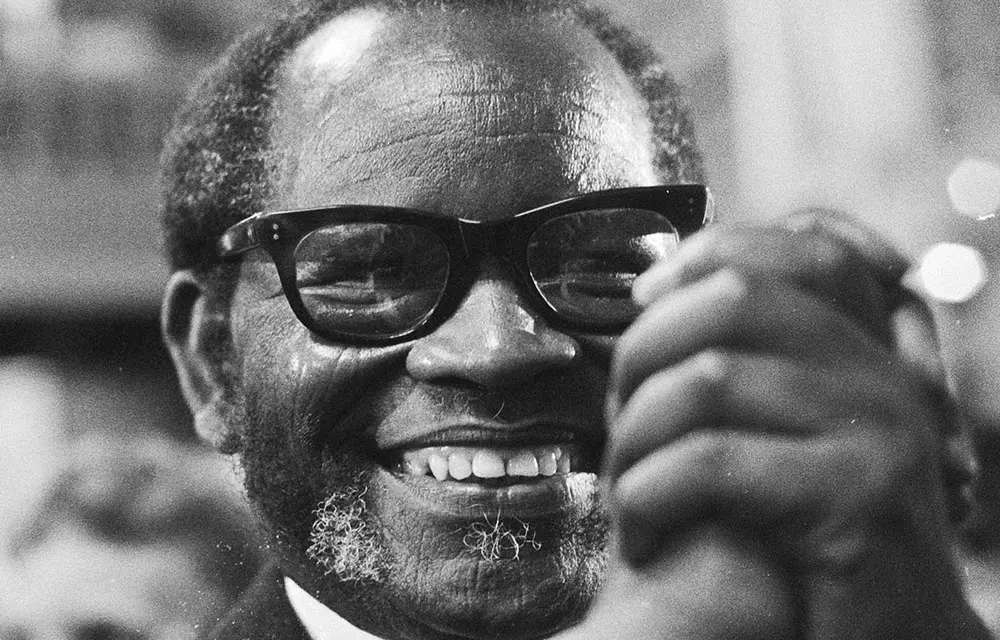
Voters should learn from Oliver Reginald Kaizana Tambo (OR Tambo): a selfless builder, a unifier and a doer
27 October 2026 would have been the 109 birthday of Oliver Tambo, a South African anti-apartheid politician, revolutionary, teacher, lawyer and activist who led the African National Congress (ANC) from 1967 to 1991. He was also a co-founder of the ANC Youth League. Eight days after his birthday, the 2026 South African municipal elections will be held on 4 November 2026 across South Africa, to elect councils for all district, metropolitan and local municipalities in each of the country's nine provinces.
Voter turnout in South Africa has been decreasing since 1994. When you ask ordinary people why they have stopped voting, you will often hear indifference in their tone. You will hear a verdict: “they come when they want votes only and they disappear afterwards”.
The forthcoming municipal elections are particularly significant, as local government constitutes the sphere of governance that is intended to be closest to the people and most responsive to their daily needs. Yet it is at this level that the failures of governance are often most starkly evident. Across the country, numerous municipalities face severe financial distress, have fallen prey to patronage networks, or have been weakened by factional political appointments.
Basic service delivery continues to deteriorate, with sewage flowing through residential areas, communities enduring prolonged water shortages, roads falling into disrepair, and refuse accumulating in public spaces. At the same time, public resources are too often directed towards politically connected individuals through questionable procurement processes, further eroding public trust and undermining effective governance.
Discussions around elections are usually dominated by the steady decline in voter participation and the increasing erosion of public trust in the political system. Declining confidence in democratic institutions, coupled with the perception that the voices of ordinary citizens are not being adequately heard, has been identified as a key factor contributing to voter abstention.
The gradual decrease in voter turnout since 2009 should be regarded as a critical concern, as persistently low participation rates signal not only a growing disillusionment with South Africa’s electoral system but also an escalating distrust of politics in general and of political parties in particular.
One thing is evident: voters need to adopt a different perspective on electoral participation, recognising that voting should not be viewed merely as an endorsement of a particular political party, but rather as a means of exercising their democratic rights and reclaiming their agency in shaping the country's future.
Electoral participation represents the bare minimum of civic engagement and serves as a fundamental mechanism through which citizens collectively contribute to shaping and transforming their communities.
As Frantz Fanon once observed, “Every generation must discover its mission or betray it.” This profound statement serves as a reminder that each generation is confronted with its own distinct challenges and responsibilities, and that history demands vigilance, courage, and action rather than complacency.
In reflecting on these responsibilities, important lessons can be drawn from OR Tambo’s leadership.. During some of the most difficult periods of the liberation struggle, he served as the unifying force that kept the movement intact and focused on its objectives. His leadership extended beyond South Africa’s borders, where he worked tirelessly to build strategic alliances, mobilise diplomatic pressure, and persuade governments across the world that apartheid was not merely an internal South African matter, but an international moral, political, and humanitarian crisis.
Despite the immense challenges and uncertainties of the time, OR Tambo remained steadfast in his commitment to justice and freedom. He demonstrated resilience, determination, and unwavering hope, refusing to succumb to despair even in the darkest moments. His legacy serves as a powerful example to present and future generations that meaningful change requires perseverance, principled leadership, and the courage to fulfil the mission entrusted to them by history.
The only difference between OR Tambo’s generation and ours is that we are not required to take up arms, go underground, or live in exile. Instead, we can exercise the rights enshrined in our Constitution to advocate for and bring about meaningful change.
Recent events have demonstrated that pressure for improved service delivery and meaningful social change seldom arises from political manifestos alone. Rather, it is often driven by active citizen participation, whereby communities organise collectively, engage in peaceful protest, occupy public offices, or establish local committees to ensure that their concerns receive attention.
Such forms of civic engagement serve as important mechanisms for holding public officials accountable and compelling government to respond to the needs and priorities of its citizens. In this context, voting represents the minimum threshold of democratic participation and should not be disregarded. Instead, it should be recognised as a fundamental means through which citizens exercise their agency and contribute to shaping the future of their communities and the nation.
The life and leadership of OR Tambo continue to offer enduring lessons on perseverance, principled leadership, and the pursuit of social justice. His unwavering commitment to the anti-apartheid struggle, despite prolonged exile and significant personal sacrifice, exemplified resilience, courage, and dedication to the ideals of freedom and equality. Drawing inspiration from his legacy, the current generation is called upon to demonstrate a similar commitment to what may be regarded as a second revolution: the pursuit of economic inclusivity, economic freedom, and sustainable development. Achieving these goals requires collective action to address persistent inequalities, expand opportunities for all, and create a more prosperous and equitable future for generations to come.
OR Tambo’s leadership was tested during the 1969 Morogoro Consultative Conference in Tanzania, a pivotal gathering convened to address internal organisational challenges, including growing discontent among members in exile, operational difficulties, and criticism of the ANC leadership. The conference demonstrated the importance of collective leadership, resilience, and constructive engagement, highlighting that times of crisis require active participation in driving positive change rather than despair or inaction.
Perhaps our generation has come to recognise that it was misguided to view South Africa’s 1994 democratic transition solely as a miraculous transformation. While the achievement of democracy was historic and significant, framing it as a miracle may have unintentionally fostered unrealistic expectations regarding the pace and nature of societal change.
In some respects, this narrative contributed to a culture of dependency and entitlement, creating the perception that progress would emerge automatically rather than through sustained collective effort. This occurred despite a clear awareness that the country faced the immense task of dismantling and overcoming more than three and a half centuries of systemic oppression, inequality, and exclusion. Meaningful transformation was never likely to be immediate; rather, it required active citizenship, long-term commitment, and continued engagement in the democratic project.
Indeed, OR Tambo was an exemplary leader whose values of integrity, resilience, and collective leadership remain worthy of emulation. However, South Africa’s political freedom was not secured by a single individual, but through the sacrifices of millions of ordinary men and women whose names may never appear in history books, yet whose contributions were instrumental in the struggle for liberation.
A society can only progress when its citizens actively participate in shaping its future. As such, citizens are encouraged to exercise their democratic right by voting on 4 November. Voting represents the first step towards active citizenship and meaningful participation in the development of the nation. While significant progress has been made, it is evident that much work remains to be done.
Just as OR Tambo dedicated his life to building a free and democratic South Africa, knowing that the full fruits of his labour would be enjoyed by future generations, so too must citizens commit themselves to advancing the nation for the benefit of those who will come after them. The responsibility of building a better society belongs to all, and its success depends on the active engagement of every citizen.
Yolanda Mhlungu is a writer and researcher in academia. She writes in her personal capacity.