

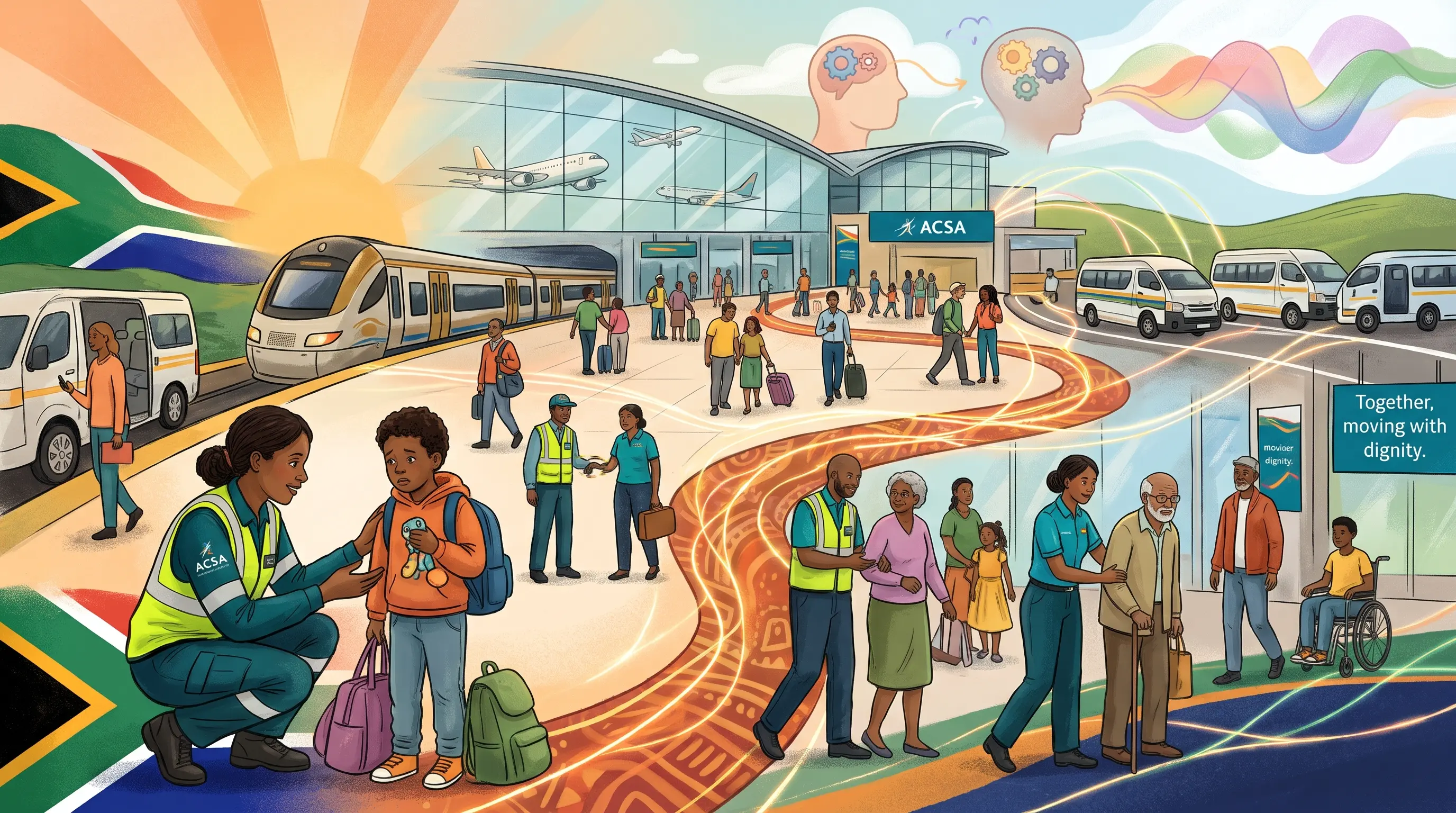
October presents us with an interesting intersection. It is Transport Month, when South Africa reflects on the infrastructure, institutions and people that keep our country moving. It is also Mental Health Awareness Month, a time that challenges us to think more deeply about the people around us, including those whose struggles and differences are not always visible.
These two observances may appear unrelated. I believe they are deeply connected. Transport is about movement. But genuine progress is about ensuring that everyone can make the journey.
At Airports Company South Africa (ACSA), our business is often described in terms of aircraft, terminals, runways and passenger numbers. Those things are important. But behind every statistic is a human being. Every passenger who walks through our terminals carries a story, a destination, a hope and, sometimes, a challenge we cannot see. That is why our understanding of accessibility must continue to evolve.
For many people living with ADHD, dyslexia, dyspraxia and other forms of neurodivergence, navigating spaces that most of us take for granted can be demanding. Reading information quickly may be difficult. Following multiple instructions in a noisy environment can become overwhelming. Crowds, queues, flashing screens, announcements and unfamiliar surroundings can create sensory and emotional pressures.
Public transport areas such as an airport bring many of these experiences together in one place. The question for us as leaders is therefore not simply: How efficiently are people moving through our airports? We must also ask: How are people experiencing our airports? There is a difference.
You can build an efficient institution that is not compassionate. You can design a technically functional system that unintentionally excludes people. You can meet every operational target and still fail the person standing in front of you who simply needs a little more time, clearer information or someone willing to listen.
That is where Ubuntu must become practical. Ubuntu cannot merely be something we invoke in speeches. It must be visible in the way we design our institutions and treat one another. I am because we are means recognising that another person's dignity is connected to my own.
The true test of infrastructure is not only whether it moves people efficiently, but whether it moves them with dignity. For ACSA, this means constantly thinking about the passenger experience beyond physical infrastructure. Accessibility must include people whose disabilities or challenges may not be immediately apparent. It means asking whether our signage is clear enough, whether our digital platforms are accessible enough, whether our processes are simple enough and, critically, whether our people are equipped to respond to passengers with patience and compassion.
Not every solution requires concrete and steel. Sometimes the most important piece of infrastructure is a human being who cares. A staff member who notices that someone is overwhelmed. A security official who patiently repeats an instruction. A colleague who understands that someone may process information differently. A manager who creates an environment in which an employee does not have to hide their difference simply to belong. These things cost very little, yet their impact can be enormous.
The same principle should guide how we think about the workplace. For too long, conditions such as ADHD, dyslexia and dyspraxia have often been discussed primarily in terms of what people cannot do. We need to change that conversation.
Difference is not deficiency. People think differently, learn differently and solve problems differently. Neurodivergent people can bring creativity, imagination, innovation, intense focus and unconventional approaches to problem-solving. In an increasingly complex world, organisations need precisely that diversity of thought. Our responsibility as leaders is not to create workplaces filled with people who think exactly like us. It is to create workplaces in which different people are able to thrive.
Inclusion is not asking people to become more like the system. Inclusion is having the courage to make the system work better for people. That principle extends beyond airports and workplaces.
Think about the child who has been called lazy because reading takes longer. Think about the young person repeatedly told to "concentrate" when their mind processes attention differently. Think about the employee whose spelling becomes the measure of their intelligence. Think about the traveller who appears agitated in a crowded terminal and is immediately labelled difficult.
Sometimes our judgement arrives before our compassion. We must reverse that order. South Africa carries many wounds. We are a society confronting inequality, unemployment, poverty, violence and enormous pressure on families and communities. Building a more compassionate society will not solve all these challenges overnight. But compassion determines how we encounter one another while we work to solve them.
Mental health is therefore not someone else's issue. Neurodiversity is not someone else's issue. Disability is not someone else's issue. They are questions about the kind of society we choose to become.
As we conclude Transport Month, we rightly celebrate the infrastructure connecting South Africa to itself and to the world. Airports are gateways to economic opportunity, tourism, investment and human connection. We must continue investing in modern, efficient, safe and globally competitive infrastructure.
Our ambition must, however, go further. A world-class airport should not only be measured by the quality of its runway or the efficiency of its terminal. It should also be measured by how the elderly passenger is treated, how the anxious traveller is assisted, how the person with a disability is accommodated, how the neurodivergent passenger experiences the journey and how every human being is made to feel that they belong.
That is the society we must build. One where strength does not mean ignoring vulnerability, but protecting it. One where compassion is not mistaken for weakness. One where Ubuntu is not simply inherited from our ancestors, but practised in our boardrooms, airports, schools, workplaces, taxis, trains and homes.
Transport Month asks us: How do we move South Africa forward?
Mental Health Awareness Month adds another question: How do we care for one another along the way?
Our answer must be: together. We must remember that no country can call itself truly connected while some of its people remain excluded. No journey can be called progress if the most vulnerable among us are left behind.
We must build a South Africa that moves at the speed of progress, but never so fast that compassion cannot keep up. Let me repeat, sometimes the most important piece of infrastructure is a human being who cares.
Irvin Phenyana is the Chairman of Airports Company South Africa