


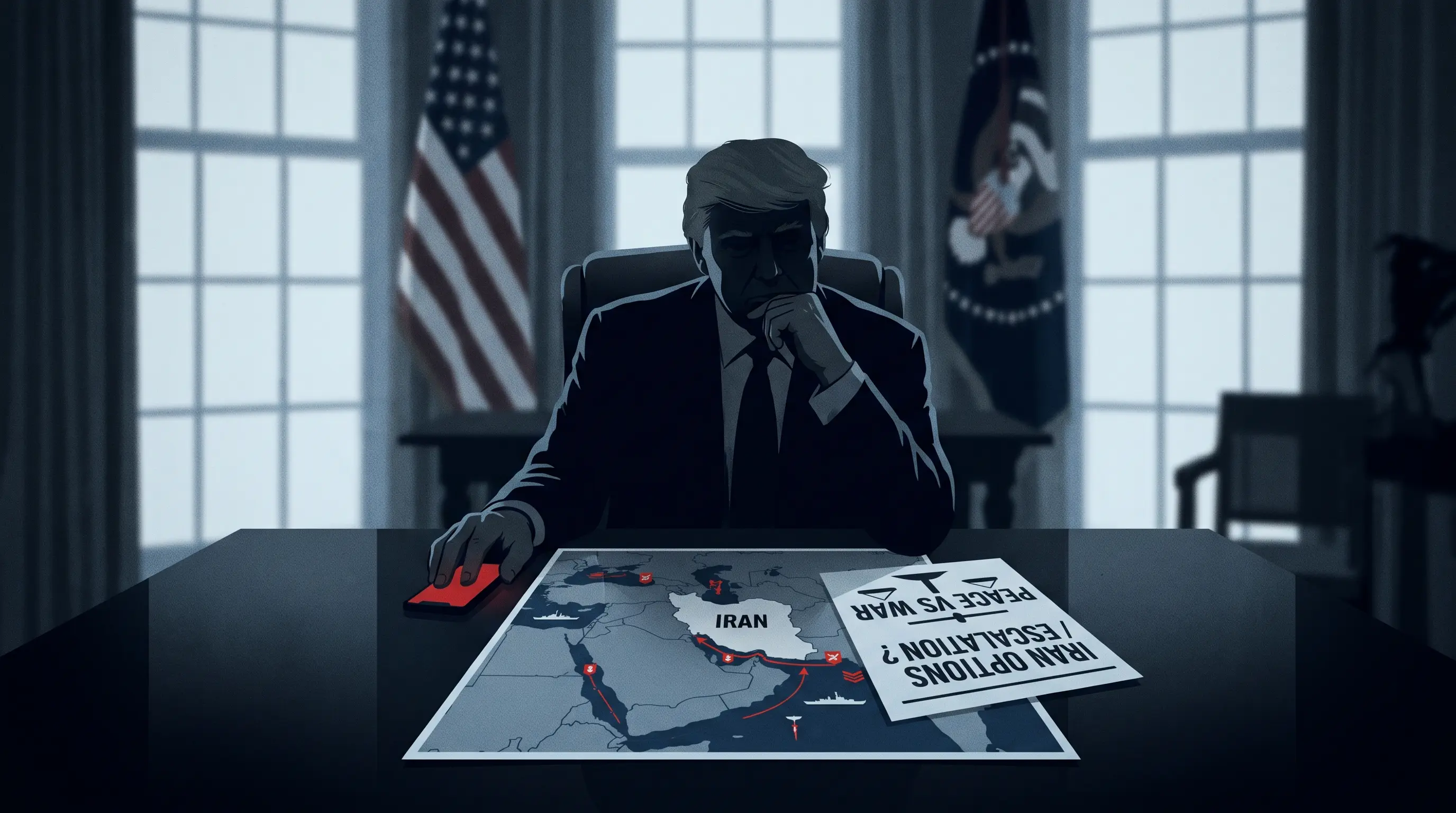
The US midterm Republican defeat has made the Iran war a political liability for Donald Trump, but it has not removed his capacity to escalate it. With voters registering their dissatisfaction with the conflict and its economic costs, Trump faces pressure to find an exit. Yet on 5 November, after meeting his national security team, he said he would decide “soon” whether to resume all-out war. The election has exposed a central contradiction: the war has weakened Trump politically without necessarily limiting his ability to widen it.
The Democrats’ victory, giving them control of both chambers of Congress, will intensify scrutiny of the administration’s conduct of the war and provide greater leverage over its funding. But the new Congress will not take office until January. Until then, Trump retains broad authority over military operations and foreign policy, and the intervening weeks matter. A president chastened by the electorate could choose restraint and pursue an agreement or seek to petulantly reassert authority through military action before congressional opposition becomes consequential.
The political consequences are already visible. Vice-President JD Vance has blamed the Republican defeat in part on the war, and he has also authored the administration’s most senior diplomatic outreach in months: a letter to Iran’s national security chief, Mohsen Rezaei, proposing a resumption of negotiations while insisting that Iran’s nuclear programme be addressed from the outset. Trump, strikingly, described the letter to reporters as being about helping Iran obtain medical supplies; deflecting the impact of the domestic politics on the diplomacy of de-escalation. Other senior figures remain divided. Defence Secretary Pete Hegseth and Israeli Prime Minister Benjamin Netanyahu have pressed for a harder military line; envoy Steve Witkoff has favoured pursuing an agreement; still others advocate maintaining economic pressure rather than immediately resuming combat.
Netanyahu’s position, too, is politically weakened. Israel’s election has left his governing fate uncertain, but he remains prime minister and retains influence over Israel’s security decisions until he is able to form a coalition government. In the interim, and with his political career in the balance, he has continued to press for renewed action against Iran.
US Central Command is completing preparations for a possible return to major combat operations and its commander, Admiral Brad Cooper, joined the White House options briefing, though no new order has been issued. Aides have suggested strikes could come soon after the midterms, with speculation that a nuclear strike on the Iranian Natanz facility not having been ruled out. US Senator Chris Murphy described the US plan for Iran as “insane” after attending a military briefing with other members of Congress in October. He reportedly said: “The plan that they have developed will lead, in my view, to prolongment and an escalation of this war that will be devastating for our security interests.”
The precedent counsels caution: the June agreement brokered by Pakistan and Qatar to reopen the Strait of Hormuz, lift the US blockade and open nuclear negotiations unravelled within weeks when both sides renewed their attacks. Any successor deal must overcome that inherited mistrust.
Diplomacy, meanwhile, has not stopped. Qatar continues to mediate between Washington and Tehran, with the latest proposals seeking a sequence of confidence-building measures that could return the parties to direct negotiations. The earlier expectation that mediators would receive responses within 36 hours passed without a publicly announced breakthrough. Qatar’s Emir held a phone call with Trump, elevating the efforts on % November. Iranian Foreign Minister Abbas Araghchi held calls with counterparts and mediators in Qatar, Saudi Arabia, Türkiye, the United Arab Emirates, Oman and Egypt. Notably, Rezaei — the recipient of Vance’s letter — was the official who hosted the late-October delegation from Riyadh, Islamabad and Ankara in Tehran. Both tracks, in other words, now run through the same interlocutors.
Tehran is demanding an end to the US naval blockade, sanctions relief, the release of frozen assets and arrangements for reopening the Strait of Hormuz. Washington wants verifiable assurances that Iran will not rebuild its nuclear programme. The disagreement is as much about sequencing as substance: neither side will make significant concessions without assurances that the other will follow. A negotiated settlement remains possible, but the gap between the positions is substantial — and both capitals have seen a near-identical framework fail before.
For Gulf governments, the stakes extend far beyond the outcome of negotiations. Their energy infrastructure, maritime routes, financial systems and civilian populations remain exposed to renewed hostilities. Qatar’s Emir, Sheikh Tamim bin Hamad Al Thani, made the point directly in his address to the Shura Council in October: “Our duty is to always strive for the best, but we must also be prepared for the worst-case scenarios, and everyone — institutions and citizens alike — must take responsibility.”
That emphasis on preparedness has been accompanied by practical defence planning. At the Global Security Forum in Doha, Qatar’s Deputy Prime Minister and Minister of State for Defence Affairs, Sheikh Saoud bin Abdulrahman Al Thani, announced plans for a domestic defence-production hub with international partners, with priorities including ballistic-missile defence, counter-drone systems and cybersecurity. His distinction was telling: “Mediation doesn’t mean that we should not be ready for any defensive action from our side.” Qatar continues to regard Iran as a neighbour with which the region must find a way to coexist. But coexistence cannot rest on the assumption that diplomacy alone will protect critical infrastructure.
Saudi Arabia, Pakistan and Türkiye are deepening security cooperation through the Makkah Joint Defence Agreement, signed in August. Türkiye’s parliament approved ratification on 5 November, and Ankara is expected to follow with a mandate allowing the deployment of Turkish personnel to Saudi Arabia. The pact provides for collective defence — an attack on one party is an attack on all — alongside intelligence sharing and closer military and defence-industry ties. Its significance has been underscored by events: Houthi missile and drone attacks on King Khalid and Abha international airports in October killed three people, damaged six aircraft and forced the closure of Riyadh’s main hub for days, with the group warning airlines away from Saudi airspace.
The pact has taken on added diplomatic weight as the same three countries have engaged Tehran directly to prevent renewed escalation. On 26 October, Saudi Defence Minister Prince Khalid bin Salman, Pakistan’s army chief Field Marshal Asim Munir and Türkiye’s intelligence chief Ibrahim Kalın met Iranian President Masoud Pezeshkian and senior officials including Rezaei. The architecture is widening further: Saudi Arabia and Syria signed a military cooperation agreement on 4 November, days after Syrian officials confirmed that entry into the Makkah framework was under evaluation. The emerging arrangements should not be reduced to an anti-Iran military alignment. Gulf states are building self-defence capacity while recognising that prolonged confrontation with Iran would threaten their economic and strategic interests. The question is whether these parallel efforts can produce a regional framework capable of managing insecurity beyond the immediate crisis.
The strategic geography makes that challenge particularly urgent. The Strait of Hormuz is not the only maritime vulnerability. The Bab el-Mandeb, at the southern entrance to the Red Sea, offers another pressure point. The Houthis have captured the port of Mokha and Perim Island at the strait’s centre, carried out at least twelve attacks on commercial vessels since July, and struck Saudi Arabia’s East–West pipeline in September. Red Sea shipping volumes have fallen to less than a third of pre-2023 levels, transit insurance has risen to as much as one per cent of vessel value, and Egypt has lost an estimated 30 to 40 per cent of its Suez Canal revenues. A conflict that closed both waterways would hit energy exports, freight costs and supply chains simultaneously. The October attacks on Saudi airports showed how quickly the consequences spread beyond the immediate theatre of war.
The vulnerabilities are increasingly digital as well as physical. Undersea fibre-optic cables carry most international data, and routes through the Gulf and Red Sea connect Europe, Asia and Africa. The region has already had a rehearsal: in 2024 a Houthi-struck vessel dragged its anchor across three Red Sea cables, cutting roughly a quarter of traffic between Asia, Europe and the Middle East, with repairs taking five months; further cuts to the SMW4, IMEWE and FALCON systems in September 2025 degraded connectivity across the Gulf and South Asia. Repair capacity is thin; only about 63 cable-repair ships exist worldwide, two to four of them in the Middle East, and a single repair takes at least 40 days. New cable projects in both the Gulf and the Red Sea have been halted by the war. Individual cuts can be rerouted; multiple disruptions with repairs delayed could degrade banking, payments, logistics and energy management. Infrastructure resilience must therefore extend beyond pipelines, ports and power facilities to cables, landing stations and data centres.
Iran’s own public messaging reflects the depth of regional anxiety. Iranian state media have circulated civilian guidance on responding to a nuclear explosion. Such advice does not establish that a nuclear strike is imminent, and the sourcing remains thin. It does, however, illustrate how far the prospect of further escalation has entered public consciousness. The possibility of a wider conflict is no longer confined to military and diplomatic calculations; governments are having to consider the protection of civilian populations and essential services.
The Gulf is preparing for war because its governments cannot assume diplomacy will succeed. Qatar’s mediation, Saudi Arabia’s engagement with Tehran and closer security cooperation among regional partners all reflect efforts to contain the conflict. At the same time, defence production, missile protection, civilian preparedness and infrastructure resilience are becoming central to regional policy.
The immediate decision rests with Washington, but the consequences will not be confined to Washington, Tel Aviv or Tehran. Renewed strikes could trigger retaliation across the Gulf, place both maritime chokepoints under pressure and deepen an economic crisis already felt far beyond the region. The midterm defeat has made the war more politically costly for Trump; it has not made it less possible. The question is whether the electoral message will encourage a negotiated exit — or whether the pressure to demonstrate resolve will produce another escalation whose costs the Gulf has already begun preparing to bear.
Zeenat Adam is a former diplomat and political analyst