


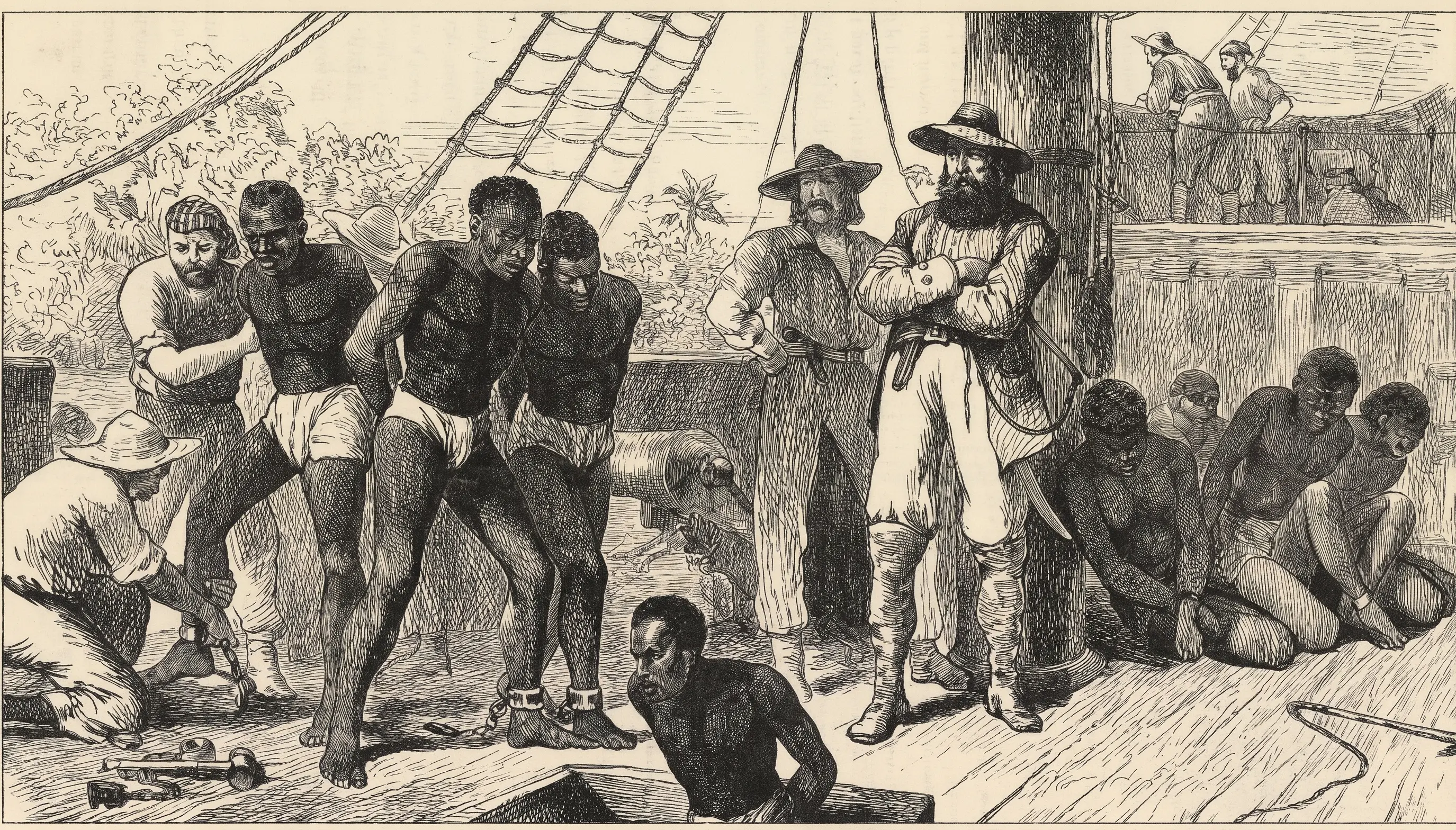
Portugal was by far the biggest single carrier of enslaved Africans, transporting more than 4.5 million in total, mainly to Brazil and various Atlantic island outposts. The British system was very much based on the idea of strict anti-miscegenation and a rigid binary of black and white.
The Portuguese system was different in that it actively encouraged manumission and sexual relationships, which led to massive amounts of miscegenation.
The result was a complex, multilayered system of race based on shade of skin, facial features and hair texture rather than a simple legal system of segregation.
In 20th-century Brazil, this became the democracia racial (racial democracy) myth: because Brazil was so mixed, it did not have racism. It created an insidious situation in which race and class were inextricably linked, making structural racism effectively invisible and extremely difficult to address in a legal sense.
France’s involvement in the transatlantic slave trade was overwhelmingly focused on the sugar-producing Caribbean colonies, particularly Saint-Domingue, Guadeloupe and Martinique.
After the successful Haitian Revolution of 1804, France was obliged to pay a massive indemnity of 150 million francs in 1825, under threat of war, to the former slaveholders.
The weight of this debt locked Haiti into a cycle of international borrowing and economic stagnation, which destroyed its capacity for state-building for the next 190 years. Spain ruled over extensive territories in Central and South America, as well as Caribbean islands including Cuba, Puerto Rico and Santo Domingo. Its system depended on enslaved African labour to top up the decimated indigenous populations in the mines and on the plantations.
Spanish colonial administration was closely aligned with Roman Catholicism. Africans held in slavery were adept at this, simply masking their traditional West African Orisha deities behind the Catholic saints.
This gave rise to a rich and vibrant spiritual and cultural tradition that is very much with us in Cuba, Brazil and throughout the Spanish and Caribbean worlds.
The Dutch West India Company was a company in the classic sense: a profit-maximising enterprise in the slave trade. He was a major slave trader and plantation owner in Suriname, Curaçao and the Guianas. The Dutch approach to the enslaved was almost entirely one of financial accounting, legal contracts and corporate efficiency.
Rights, status and freedom were all contractual. In Suriname and Curaçao in particular, the Dutch did not make a massive push to impose the Dutch language on plantation workers.
As a result, Sranan Tongo and Papiamento developed as robust creole languages. This created a society that was cut off from the Dutch world in terms of access to the centres of power and influence.
Financialisation of bondage
While other European powers participated extensively in the trade, the British Empire turned the practice of human bondage into the engine of global capitalism, scientific racism and the global legal system.
British enslavement was financialised. The profits from West Indian sugar and American cotton funded the Industrial Revolution, the institutionalisation of modern banking, including Barclays and the Bank of England, and the creation of complex insurance derivatives such as Lloyd’s of London to underwrite human cargo.
When slavery was abolished in Britain in 1833, the sum paid was £20 million, some 40% of the national budget, to the 46 000 British slave owners as compensation for their “property”.
The money was not paid to the enslaved. British taxpayers, including the descendants of the enslaved who had migrated to the UK, continued to pay down this national debt for more than 180 years, until 2015. The outcome was a transfer of public wealth to private colonial elites, creating structural and generational wealth inequality that is still with us. Kemi Badenoch, a British Conservative MP, has been clear on the issue of an apology or reparations for the slave trade.
She is of the view that Britain should not issue an apology or pay reparations and has described the call for such redress as a “navel-gazing distraction”. The Commonwealth should be looking “forward, not endlessly backwards”.
Epistemic violence and the politics of imperial nostalgia
Badenoch’s version of the story treats history as a series of isolated events. To tell nations that have been underdeveloped for centuries to “look forward” is to ignore the fact that their position in the world economy at the outset was the product of colonial extraction.
To claim that Britain was the one to end the slave trade while downplaying its 200 years of involvement in the expansion of the trade is what critical scholars would call epistemic violence: the use of knowledge to establish a narrative in which the oppressor is the moral authority.
It uses the West Africa Squadron of the Royal Navy to wipe out two centuries of state-sanctioned human trafficking. It turns a historical crime into a triumph of British morality and tells the victim nations to be grateful that their own oppression has finally come to an end.
The fiction of individualised justice and institutionalised continuity
The argument that modern-day British citizens play no role and therefore should not be liable is predicated on an individualistic notion of justice. British institutions — universities, insurance companies, municipal infrastructure and private estates — have continued to produce value from the wealth generated by the trade.
Caribbean states, on the other hand, are in serious debt, which is attributable to the structures that emerged after emancipation and their extreme climate vulnerability. To dismiss a request for structural repair as simply “asking for cash” is to reduce a legitimate claim for restitution under international law to a matter of political expediency or charitable relief.
The legacy of the British Empire in the transatlantic slave trade was severe in its structural mechanics: it turned racial chattel slavery into the norm for modern industrial capitalism, the institutionalisation of legal dehumanisation and coreperiphery exploitation.
Any argument that apologies or reparations are just “looking back” fails to recognise that the global inequalities we see today are not the result of some random accident. They are the real, living inheritance of those historical legal and economic systems.
The debate in Britain about its role in the slave trade is not simply a debate about history. It is a battle about national identity, moral standing and the nature of the state. Political language constantly turns to the “demand for cash” or “taxpayer burden” to make such a demand sound unreasonable or extortionate to the domestic electorate. The state line is that Britain abolished the slave trade in the 19th century and that the Royal Navy was responsible for the blockades.
It does not acknowledge the 200 years of state-sponsored human trafficking and state-sanctioned chattel slavery or the fact that in 1833 the state paid compensation to the owners of enslaved people rather than to the enslaved themselves.
In modern Conservative politics, opposition to anti-racist movements and postcolonial critique is a strong mechanism for building consensus. Badenoch is signalling to the right of the party that she will defend Britishness from criticism.
She is taking a hard line on an apology and doing so by making the apology and the idea of reparations a form of unfair tax on today’s British workers. “Why should taxpayers today pay?” is a classic populist ploy: it takes a historical issue of state accountability and turns it into an immediate threat to the working man.
The imperative of structural restitution
As a prominent British politician of Nigerian heritage, Badenoch’s positioning is frequently mobilised in nationalist discourse.
Her identity is used by political operators as a tool to provide a racial veneer to imperial nostalgia. The moment you look at her position critically, you can see that it enables conservative institutions to walk away from any claims of institutional racism or the harm of colonialism by saying: “Even a black leader agrees it’s time to move on.”
Trying to put a price on the abductions, torture, sexual violence, forced labour and ontological dehumanisation of millions of African people is an extension of the capitalist logic that created slavery.
Slavery was the attempt to reduce human souls to financial commodities. To suggest that some sum of money, however large or small, can settle the account or buy silence is an endorsement of the idea that the destruction of human beings can be reduced to a simple financial transaction that can be balanced and then closed. Reparatory justice is not a request for a payment or a charitable donation.
Compensation in the form of money, without corresponding structural, moral or institutional changes, leaves the entire racial and economic hierarchy unchallenged.
The “no one alive today owns slaves” argument is a total misreading of how states work.
The British Crown, the British Parliament, the Bank of England and the British state are all continuous corporate and legal entities. They inherited the infrastructure, inter-national standing and capital generated by slavery.
The state is still there, so the state’s moral obligations are still there.
The insistence on a formal apology is what forces the former imperial powers to face up to their history. It is the only way they can acknowledge that their wealth and global influence are built on a foundation of violence.
The demand for an apology remains entirely legitimate. It does not expire, it does not get watered down with time and it does not go away simply because a politician finds it politically inconvenient.
As long as the structural inequalities that were the direct result of the transatlantic slave trade continue to be a reality for the Global South and the African diaspora, the moral imperative to apologise, acknowledge and make amends is enduring.
Lubabalo Cengani has a master’s in political studies from Nelson Mandela University, South Africa. He writes in his personal capacity.