

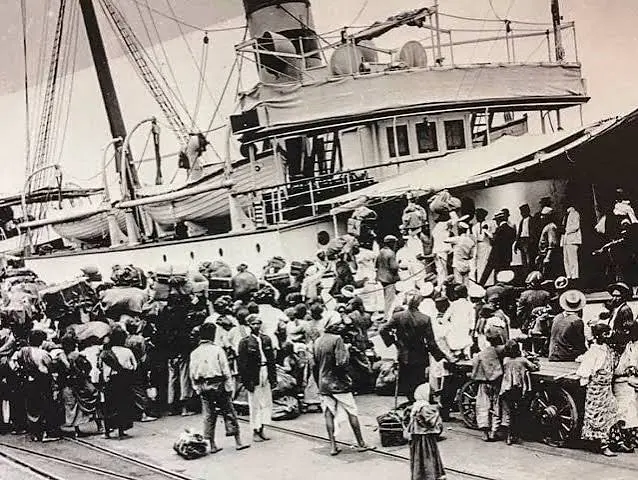
With Indian Arrival Day on 16 November marking 166 years since the SS Truro landed at Port Natal, the legacy of the indenture system continues to shape South Africa’s political and cultural landscape.
However, this rich heritage was carved on the back of labourers who were stripped of their identity. When they arrived in Durban in 1860, their names were replaced by numbers. Digits reduced them to a statistic devoid of humanity, history or backstories.
One hundred years later, a Trinidad-born descendant, Nobel Laureate VS Naipaul wrote A House for Mr Biswas. His novel voiced untold accounts and unflinching truths about indenture and its reverberations.
Today, writers garner gossamer threads of oral storytelling whispered in once frowned upon languages to craft a tapestry of chronicles that speak of this erasure, but also to show how music, dance, food, prayer and cohesive families prevailed.
This act of reclamation from South African descendants like Joanne Joseph, Aziz Hassim and Ronnie Govender, capture the tales of those who crossed the kala pani or black water to toil on Durban’s sugarcane fields. Their writing highlights how indenture also sowed intergenerational trauma to reap a unique harvest that mushroomed from the weeds of colonialism and apartheid.
Race, class, gender and identity hurtle towards one another in stories on indenture to present a prism of the richness and pathos of the 1860 settlers.
However, many narratives were only written after colonial and apartheid gatekeepers of news cycles, reports and history books had their iron-clad fists prised from publishing portals. Self-appointed custodians further sought to erase the history of the indentured.
Professors Ashwin Desai and Goolam Vahed in their book Inside Indian Indenture. A South African Story, 1860-1914 present facts and case studies on the brutal conditions the settlers endured: starvation, flogging, sexual abuse, loss of freedom. Prior to history books like these, South African descendants accessed bare-bone details.
I discovered that my paternal great-grandfather, Kirpan, was 22 years old when he travelled from Calcutta to Port Natal in January 1907. He boarded the Umzinto to work in the sugar industry in Estcourt. His 19-year-old wife, Maima, travelled with him. Their village, caste and employer are recorded.
The name Kirpan means mercy, compassion, kindness. It is derived from roots signifying honour and dignity. You see the irony: Indenture robbed him of his name, honour, dignity, and inflicted a distinct lack of mercy.
We now know arkartis or recruitment agents often coerced and made false promises to get young, strong men and women onto ships. Scholar Selvan Naidoo, writes that arkatis forced recruits onto ships. Similarly, Uma Dhupelia-Mesthrie researched kidnapping claims which were investigated in Indian and Natal.
There was really no recourse for those in servitude. Researcher Duncan Du Bois writes, “The experiences of the indentured were harrowing because the closed nature of colonial society discouraged intervention and interference.”
We also know that the promise of wealth and plenty was a cynical ploy. Low wages together with hefty fines for the slightest infractions, as perceived by colonial masters and their rigid hierarchy of henchmen, bound the settlers into servitude when they signed the girmit or contract. It often took more than five years to break free of spiralling debt.
Most of all we swallow the unpalatable cruelty: the quest for food led to labourers being deprived of rations. Many left India following famine, crop failures and exorbitant taxes
There has been a groundswell of local interest in migrant stories and a resurgence in the search for identity and belonging. Selvan Naidoo and Krish Gokool lead the initiatives of the 1860 Heritage Centre.
This reclamation of identity was fuelled last November by the High Commission of India in Pretoria who “decided to extend the registration facility for issuance of Overseas Citizenship of India (OCI) card to the descendants of 5th, 6th and 7th generations of the Indian origin immigrants who arrived in South Africa as migrants, indentured labourers and traders.”
Despite the punitive circumstances of their tenure, the story of indenture in Natal is one of triumph. They gave descendants a blueprint. To rise above their harsh conditions. To eke out a living from blue collar jobs, low paying clerical positions, tiny market gardens. To value education and build schools. To fight oppression, whether it was their colonial masters or the architects of apartheid. To preserve close-knit families and build community.
Despite their physical constraints, first during indenture when they were not allowed to leave a plantation without a pass, to apartheid, to the Group Areas Act, their continued displacement did not curtail their aspirations.
Their greatest legacy: their wealth of stories, continues to inspire their descendants 166 years later. There are stories told underneath the shade of a mango tree in a Chatsworth home, or a tale related in a Lenasia suburb or trending features on social media. Some are older, like that of golfer Sewsunker “Papwa” Sewgolum and anti-apartheid activist, Shantavothie “Shantie” Naidoo. Some stories went viral, like that of 2026 Nobel Peace Laureate jurist, Navi Pillay.
Their stories are not just a reclamation of the DNA of the indentured. They also inspire over one million diaspora. Indian Arrival day celebrates Natal narratives that rewrite history globally.
Sudhana Singh is an award-winning British author, journalist, speaker, former lecturer and school principal. She grew up in apartheid South Africa, the great-granddaughter of indentured labourers.