

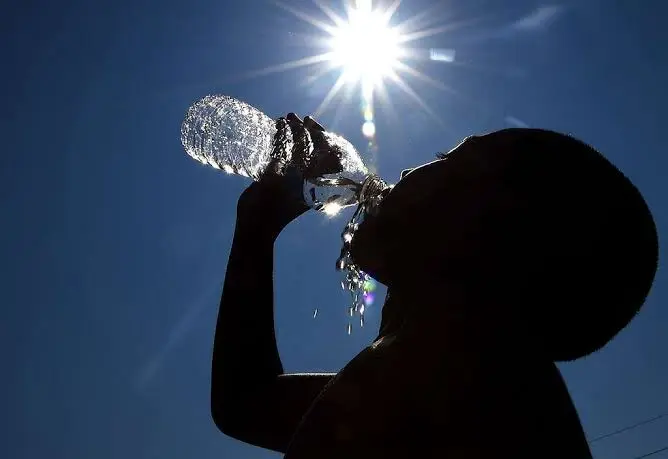
Scientists have warned of an impending El Niño that may be the strongest on record. El Niño is the warm phase of the El Niño Southern Oscillation, a naturally recurring climate pattern in which sea surface temperatures in the central and eastern equatorial Pacific Ocean rise above normal as the trade winds that ordinarily cool it weaken. It recurs every two to seven years, typically lasts nine to twelve months, and is classified as weak, moderate, strong, or very strong, the last popularly called a “super” El Niño. Though it begins thousands of kilometres away, it shifts rainfall and temperatures globally. In Southern Africa, a climate change hotspot, it is associated with below-normal summer rainfall and drought, heatwaves, crop failure and livestock losses, water shortages and an extended veld fire season. A very strong El Niño can push sea surface temperatures 2 degrees Celsius or more above average and cause a domino effect on global temperatures, a mark that only a handful of events have reached since 1950.
Why we should be alarmed
On 10 September 2026, the US National Oceanic and Atmospheric Administration (NOAA) gave a 75% probability that this El Niño will, by December 2026, be the strongest recorded since 1950, and its October update confirmed that the ocean is still warming. The South African Weather Service projects below-normal rainfall over most of the country this spring and record warmth in 2027. The World Meteorological Organization flagged El Niño’s likely return in April 2026, and South African forecasters had been tracking it since early 2026. Science has done its part, early and publicly. Why is the law waiting?
The record shows why this matters. The 2015/16 El Niño-induced drought, declared a regional disaster, overwhelmed the Southern African Development Community’s (SADC) disaster preparedness. In 2023/24, seven SADC states declared national disasters, and the United Nations recorded nearly three times as many people affected as in 2016. In August 2026, the SADC Executive Secretary warned that the coming season may surpass even that.
Not every El Niño brings drought; the very strong 1997/98 event brought near-normal rainfall to parts of the region. But the law asks whether harm is foreseeable; it does not require certainty before it demands preparation. El Niño has occurred before.
A test of preparedness and readiness?
South Africa recently adopted the Climate Change Act of 2024 (CCA), a law arguably built for this moment. Sections 19 to 21 require the Minister to set national adaptation objectives and scenarios and to publish a National Adaptation Strategy and Plan within two years. Section 17 requires provinces and metros to assess their climate risks and adopt response plans, and section 22 requires departments such as agriculture, water and energy to adopt sector adaptation plans. Ironically, these provisions remain dormant under Proclamation Notice 251 of 2025 while regulations are developed. The Act holds strong long-term potential but fails in an imminent emergency. An intense El Niño will not wait two years for a strategy to be gazetted.
A municipality in Limpopo or KwaZulu-Natal facing drought, heat and veld fires this summer has no obligation under the Act to have assessed or planned for El Niño. Its readiness depends on the goodwill and capacity of its officials, not on the law. The Western Cape, by contrast, is advancing summer readiness plans against extreme heat, wildfires and water insecurity, building on R17 million for aerial firefighting last season and allocating more than R65 million for water resilience in 2026/27. Commendable, but voluntary, and enabled by capacity rather than need.
Legally, the fallback remains the Disaster Management Act of 2002 (DMA), which in practice is activated only after visible damage. The 2018 Cape Town drought, the 2024 KwaZulu-Natal floods and the 2025/26 Limpopo floods were all declared disasters post facto. This perpetuates a justice gap, because the costs of delay fall unevenly: on the smallholder farmer who cannot replant after a failed first rain, on farmworkers and construction labourers in heatwaves with no binding threshold at which work must stop, on informal settlements where one fire can take a street, and on households already spending most of their income on food. This is “vulnerability enhancement” for those least able to absorb shocks or litigate after them.

What it means for law and social actions
Yet the DMA, already in force, is wider than its use. It defines a disaster as an occurrence that causes or threatens to cause death, injury, damage or disruption beyond a community’s capacity to cope. A strong El Niño with a forecast drought is such a threat, and nothing requires the National Disaster Management Centre (NDMC) to wait for failed crops, dry taps or public outcry. Section 23 obliges the NDMC to classify an event that occurs or threatens to occur; section 27 is specific to the Minister making a declaration; and sections 41 and 55 empower the Premier and the municipal council to declare a state of disaster and release contingency funds as soon as the NDMC makes a classification. Read with sections 24 on environment and 27 on water and food, the Constitution requires the state to bear a positive duty to prevent harm, and ignoring reliable forecasts invites structural interdicts and negligence claims. In Earthlife Africa Johannesburg v Minister of Environmental Affairs, the High Court held that climate change impacts are a relevant consideration that decision makers cannot ignore, and the International Court of Justice’s 2025 advisory opinion ties the duty of due diligence to the foreseeability of risk.
The CCA, however, defines climate change as change attributable to human activity, in addition to natural climate variability. Since El Niño is a natural variability, an official intent on avoiding responsibility may contend that the Act’s adaptation duties do not apply. That reading is erroneous: global warming makes each El Niño and each drought harsher, so what occurs is natural variability compounded by human-driven change. For legal certainty, Parliament should close this room for contention.
When a hazard is forecast months ahead with more than 90% certainty, failure to prepare is not misfortune but, arguably, an unreasonable exercise of public power, or an unreasonable failure to exercise it, and reviewable as such. Courts will ask not whether the hazards were natural, but what the state knew and did.
Four things are possible now. First, the President must proclaim sections 17-22 of the CCA, so that adaptation duties bind, and this El Niño is the last to arrive before they do. Second, the NDMC and the Minister must treat the forecast as the threat the DMA already contemplates, classifying early and declaring in time to release contingency funds. Third, the Department of Employment and Labour should set binding heat-stress thresholds for outdoor work. Lastly, every municipality in a high-risk district must publish an El Niño contingency plan, so residents know what will be done and who is accountable.
Organised labour, farmers’ associations, civil society and ward committees can request contingency plans, raise El Niño readiness in public participation processes and, where the state fails to act, go to court. Preparedness is a shared constitutional project.
A forecast is a warning, yet our law remains idle, waiting for the losses to be counted. If the forecast holds, the question will not be whether El Niño was natural, but whether decision-makers made the right choice.
Professor Ademola O Jegede is the DSTI/NRF Chair in Climate Change and the Rule of Law and director of the Ismail Mahomed Centre for Human and Peoples’ Rights at the University of Venda.
Dr Patrick P Maweto is a postdoctoral fellow at the Ismail Mahomed Centre for Human and Peoples’ Rights, Faculty of Management, Commerce and Law, University of Venda.