

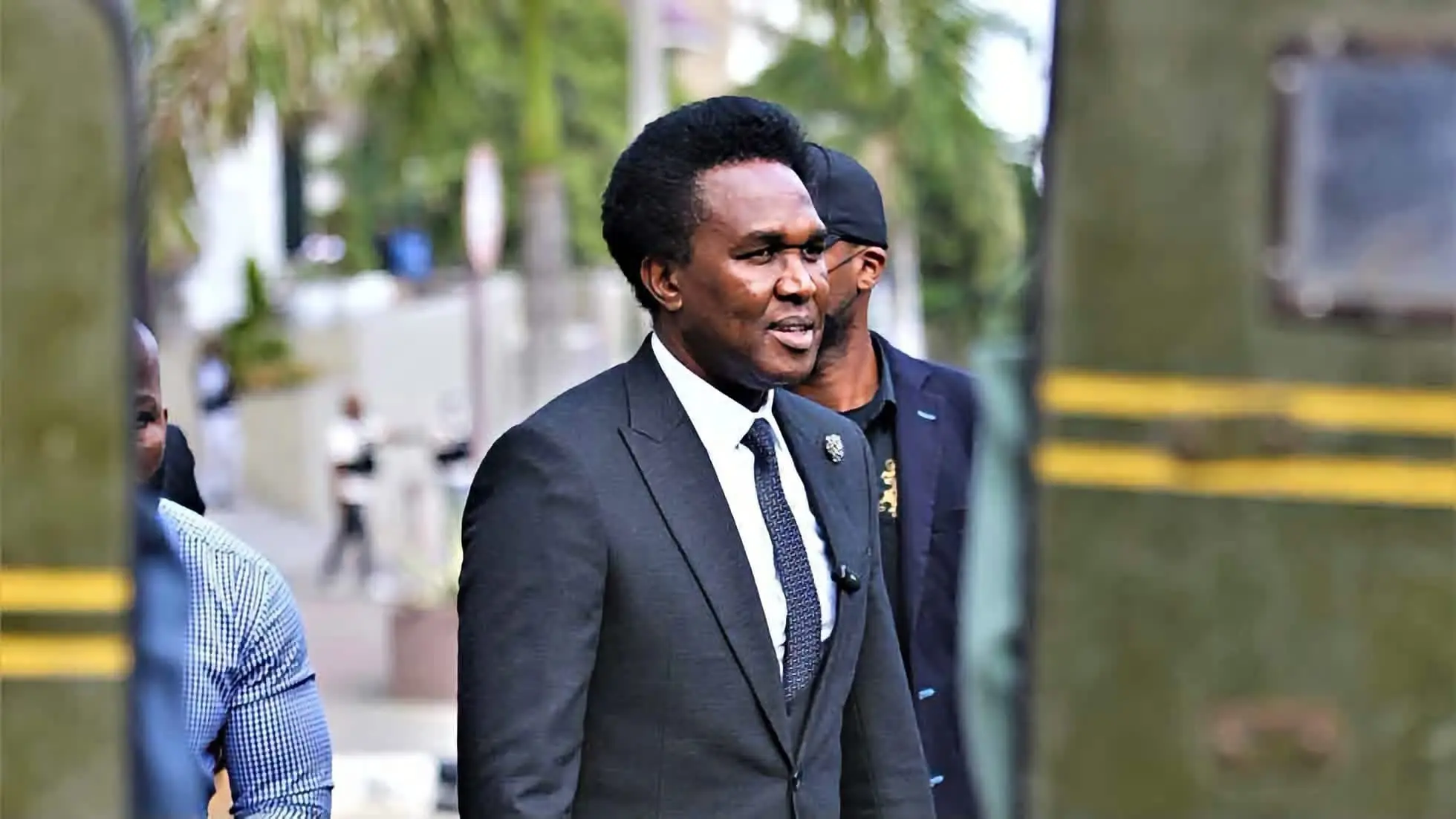
The trial of Mozambican opposition politician Venâncio Mondlane in the Supreme Court is raising questions that extend beyond the criminal charges against him, placing the country's judicial institutions under scrutiny at a particularly sensitive moment in its political history.
Three days into the proceedings, the central issue is becoming increasingly clear: whether the prosecution can establish a legally demonstrable connection between Mondlane's political mobilisation and public statements during the unrest after the disputed 2024 elections and the acts of violence and destruction recorded during that period.
Mondlane faces criminal charges arising from the post-election crisis. The prosecution's case seeks to establish his responsibility for conduct associated with the unrest, while the former presidential candidate has challenged the interpretation of his statements and the evidence presented against him.
The opening day, on 17 November, was marked by procedural disagreements involving the defence, legal representation and the conduct of the proceedings. The initial exchanges highlighted the institutional sensitivities surrounding a case involving one of the country's most prominent opposition figures.
The second day brought the evidentiary dimension into sharper focus, particularly through a disputed phone recording. The prosecution considers the recording relevant to its allegations against Mondlane. The defence challenged its legality and authenticity, questioning how it was obtained, verified and preserved, and called for its exclusion from the proceedings.
The dispute raises an important question about the standards governing the use of electronic evidence in criminal cases. The existence of a recording does not, by itself, establish its authenticity, legality or probative value. Those elements must be examined through the appropriate judicial procedures.
The third day shifted attention to the relationship between political speech and criminal responsibility. Questioned by a panel of five judges, Mondlane rejected the suggestion that his livestreamed speeches and calls for mobilisation could be directly linked to the destruction of public and private property during the post-election unrest.
He argued that the prosecution had failed to establish a specific causal connection between his statements and the acts attributed to protesters. The judges questioned him about references to retaliation, the so-called law of retaliation, calls for economic shutdowns and the potential consequences of mobilising large crowds.
Mondlane maintained that several of his statements were metaphorical or political. He also referred to previous demonstrations, particularly those held in 2023, arguing that mass mobilisation did not necessarily lead to violence.
Another issue concerned whether his failure to notify police and municipal authorities about demonstrations had contributed to the unrest. Mondlane responded that the matter was not part of the indictment. He also questioned the origins of the investigation, alleging that elements of the case had been assembled during the electoral campaign, before the events that later formed the basis of the prosecution's allegations. The claims have not been independently established.

The question of criminal responsibility
The exchanges in court have brought one of the most consequential legal questions in the case into focus: Where does political responsibility end and individual criminal liability begin?
The ability of a political leader to mobilise large crowds does not automatically establish criminal responsibility for every act committed during subsequent demonstrations. Equally, political speech cannot provide immunity where evidence establishes conduct that meets the legal threshold for criminal liability.
The prosecution must demonstrate the relevant elements of the offences charged and establish the connection between the defendant's conduct and the alleged crimes. The distinction is important in the context of Mozambique's post-election crisis, which exposed divisions over electoral credibility, political representation and public confidence in state institutions. The debate also extends to the legal requirements governing public demonstrations. Potential administrative violations relating to notification procedures must be distinguished from responsibility for criminal acts committed by individual participants. These are related questions but they are not interchangeable.
Civil society urges caution over the outcome
The sensitivity of the case has also prompted calls for caution from independent observers.
Baltazar Fael, a researcher at Mozambique's Centre for Public Integrity, considers it premature to predict whether Mondlane will be convicted or acquitted. According to Fael, the information available publicly remains insufficient to assess the possible outcome of the proceedings.
He argues that the trial could result either in the application of penalties provided for under the law or in Mondlane's acquittal.
His assessment highlights an important principle: the political significance of a defendant should not determine expectations about the outcome of a criminal trial. It also reinforces the need to distinguish between public perceptions of responsibility for the post-election crisis and the evidence required to establish individual criminal liability.
For Mozambique's judicial institutions, the challenge is to demonstrate that the proceedings are governed by legal standards rather than political expectations.
A test for Mozambique's institutions
The case is unfolding against the background of a country dealing with the consequences of the 2024 electoral crisis. The protests and their aftermath exposed institutional weaknesses and intensified questions about the relationship between citizens, political actors and state authorities.
For Mozambique's neighbours and international partners, the proceedings carry significance beyond the immediate political confrontation.
Mozambique is an important economic and security actor in Southern Africa. The credibility of its democratic institutions, the predictability of its legal system and the management of political tension have implications for regional stability and international confidence.
The proceedings also raise questions about transparency and public access to justice. In politically sensitive cases, the availability of reliable information about court proceedings is essential to public confidence, particularly when competing political narratives could shape perceptions of the outcome.
The Supreme Court must therefore balance the integrity of judicial proceedings with the public interest in understanding how a case of such national significance is being handled.
The verdict and the credibility of justice
The prosecution's questioning of Mondlane was postponed until Thursday after it requested additional time, citing the need to allow the defendant to return in better physical condition following several hours of questioning by the judges.
As the trial progresses, the court will have to assess the contested recording, the interpretation of Mondlane's statements and the evidence linking his alleged conduct to the offences charged.
The outcome remains uncertain, as Fael has cautioned. But the institutional implications are apparent. A conviction must rest on evidence that satisfies the legal requirements, while an acquittal must equally be respected as an outcome of judicial assessment rather than interpreted automatically through political loyalties.
For Mozambique, the significance of this trial will not be measured solely by whether Mondlane is found guilty or acquitted. It will also depend on whether the Supreme Court can demonstrate that individual criminal responsibility is established through evidence, due process and impartial judicial reasoning.
In a countrynavigating the aftermath of a contested electoral process, the credibility of justice may ultimately matter as much as the verdict itself.
Luis Nhachote is a Mozambican journalist and former Mail & Guardian intern 2011 (AmaBhungane).