


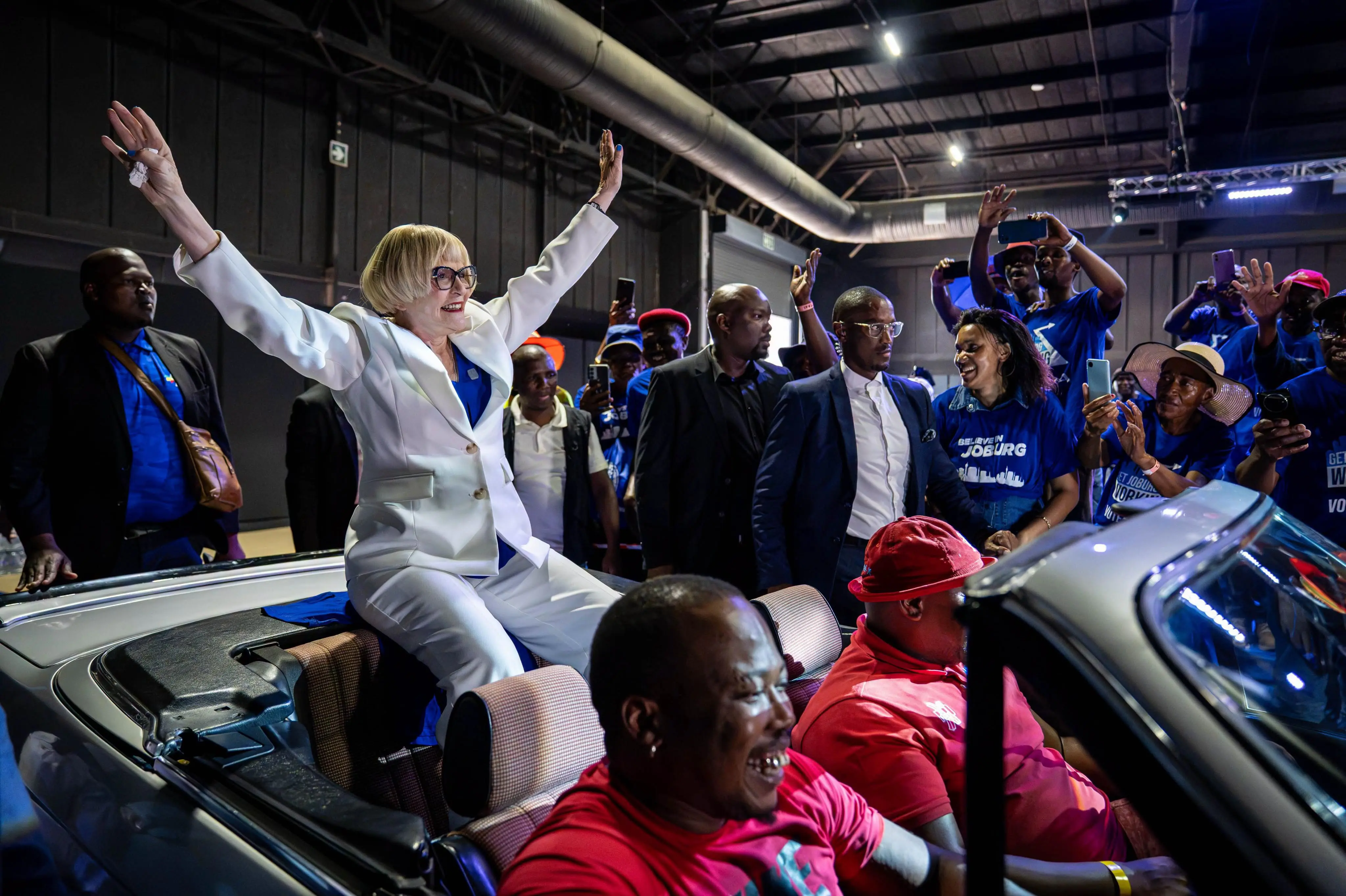
In the aftermath of the local government elections, a particular conversation has taken hold across South African political discourse, particularly on social media. Following the DA's gains in Johannesburg, a growing section of the commentary has turned its attention not simply to the party's electoral advance, but to the black voters, particularly the black middle class, believed to have contributed to it. The language has been revealing. References to “clever blacks” and “better blacks” have been used to characterise those who voted for the DA, often accompanied by accusations of historical amnesia, political naivety and an apparent willingness to overlook the party's ideological contradictions. Much of this criticism has centred on Helen Zille's campaign performances. Her singing of Brenda Fassie's Vulindlela and her arrival at the DA's final Johannesburg rally on 17 October in a gusheshe, all of which have been interpreted by critics as calculated attempts to appeal to black cultural sensibilities. The suggestion is that by appropriating familiar cultural expressions and playing into perceived black stereotypes and phenotypes, Zille was able to manufacture a sense of cultural proximity and ultimately beguile black voters into supporting a party they should otherwise have known better than to vote for.
What is particularly interesting about this reaction is not simply the criticism directed at the DA or its campaign, but the assumptions being made about the black people who voted for it. Beneath much of the commentary is an expectation that a black person who understands the historical realities of apartheid, the significance of the liberation struggle and the enduring racial inequalities of South African society should know better than to vote for a party whose political positions are perceived to contradict that history. The implication is that such a choice represents either a failure of historical consciousness or an abandonment of the political obligations that come with it.
There is an important distinction to be made here. If we are to accept the argument that black voters, particularly the black middle class, contributed substantially to the DA's electoral gains, we must also be willing to interrogate the assumptions that follow from that premise. That a black person could vote for the DA without having forgotten their history, abandoned their commitment to transformation or undergone some ideological conversion is not an inconceivable proposition. Yet much of the reaction seems to struggle with precisely this possibility.
This explanation presumes a degree of political naivety that deserves to be challenged. It reduces an electoral decision to susceptibility to political performance, as though the singing of a Brenda Fassie song or the arrival at a campaign rally in a gusheshe could adequately explain the political calculations of an entire constituency. It also assumes that the only reasonable explanation for a black person voting DA is that they have been deceived. In a world like that, perhaps we should entertain a less convenient possibility: that some voters understood precisely who they were voting for, remained unconvinced by aspects of the party's political and policy positions, and voted for it anyway.
This is not to suggest that the DA's electoral proposition should be accepted uncritically, nor that its positions on transformation and redress are inconsequential. Its approach to affirmative action, employment equity and Broad-Based Black Economic Empowerment reflects substantive differences about how historical inequality should be addressed and the role of the state in doing so. The party's proposed Economic Inclusion for All framework, for instance, seeks to replace existing BEE mechanisms with an outcomes-based approach that prioritises job creation, investment, skills development and support for small businesses. Its argument is that economic inclusion should be measured through broader participation in economic activity rather than compliance with race-based procurement and ownership requirements. But this is not an ideologically neutral alternative. It represents a different theory of redress, one that places greater emphasis on economic growth and opportunity than on the specific instruments of race-conscious transformation. Whether this approach can adequately address the structural exclusion produced by apartheid, particularly the concentration of ownership and capital, remains a substantive question. The distinction between expanding economic opportunity and correcting historically entrenched inequalities cannot simply be assumed away.
The same scrutiny must apply to the DA's governing proposition. Its claims about administrative competence and financial discipline must be measured against the lived experiences of the communities it governs. Cape Town provides an important example. The Public Protector's July 2026 findings on service delivery in Langa Flats and parts of Khayelitsha identified shortcomings in sanitation, municipal housing, infrastructure maintenance, refuse removal, sewer management and other basic services. The investigation concluded that the City had failed to progressively provide constitutionally required municipal services in the affected communities. These findings are particularly important because they expose the distinction between financial administration and equitable service delivery. A municipality can demonstrate strong financial management while communities within its jurisdiction continue to experience serious deficiencies in the provision of basic services. The DA's governing record, therefore, cannot be evaluated exclusively through its audit outcomes or the efficiency of its administrative systems. It must also be evaluated through the extent to which that efficiency translates into equitable material outcomes for residents. This is not to dismiss the party's achievements in municipal administration, but to insist that competence must be measured against the full obligations of government.

These are legitimate subjects of political scrutiny and disagreement. But they do not negate the agency of voters to make their own assessments. Political choice and political identity are not interchangeable. To vote for a party is not necessarily to endorse its entire worldview, just as rejecting a party at the ballot box does not require abandoning everything it once represented.
The black middle class occupies an especially interesting position in this conversation. It is a constituency whose material circumstances are, in many respects, inseparable from the promises and contradictions of the democratic dispensation. Its members may have benefited from the expansion of educational and economic opportunities since 1994, while remaining acutely aware of the structural inequalities that continue to define South African society. They may retain a deep appreciation for the historical significance of the liberation movement while becoming increasingly dissatisfied with its contemporary political expression. They may also hold reservations about the DA's approach to economic redress while finding its municipal governance proposition persuasive. These positions are not mutually exclusive. Indeed, expecting them to be so imposes an unnecessarily narrow understanding of political consciousness.
In a local government election, the material conditions of everyday life assume particular significance. Johannesburg is not an abstract political project. It is a city whose residents have had to contend with persistent water insecurity, deteriorating infrastructure, electricity disruptions, potholes and mounting concerns about its financial sustainability. For a professional whose livelihood depends on the reliable functioning of the city, or a household that has to repeatedly make alternative arrangements for the provision of basic services, these are not peripheral inconveniences. They are conditions that shape economic activity, household expenditure and the quality of everyday life.
It is against this backdrop that the DA's campaign proposition must be understood. Its emphasis on administrative competence, financial discipline and professional expertise was not an incidental feature of its campaign. It was a deliberate appeal to voters concerned with the capacity of municipal government to perform its most basic functions. When Zille speaks about appointing engineers who can engineer and financial professionals who can manage municipal finances, she is advancing a particular understanding of what government should look like. Whether the party can consistently translate that proposition into equitable outcomes is another question. But it is not difficult to understand why such a message might resonate with residents who have become frustrated with the condition of their municipality. This is an interpretation of the electoral proposition and the conditions in which it was presented, not a claim that we can definitively establish the motivations of individual voters from the election results.
The ANC, by contrast, has historically drawn much of its political legitimacy from a coherent ideological tradition rooted in the liberation struggle. Its commitments to redistribution, public ownership, social transformation and economic emancipation have provided the moral and political justification for the democratic state's intervention in an unequal society. There is, and remains, an intellectual coherence to the proposition that the state must play an active role in transforming the material conditions of its citizens. But ideological legitimacy cannot indefinitely substitute for the demonstrated capacity of the institutions through which that transformation is meant to occur.
The difficulty for the ANC is not necessarily that its ideological commitments have become irrelevant. It is that the translation of those commitments into the material experience of governance has become increasingly difficult to defend. The argument for public ownership, for instance, cannot be sustained by ideological conviction alone when the institutions entrusted with that ownership struggle to perform their functions. The question of whether the state should own and administer strategic infrastructure is inseparable from the question of whether it possesses the institutional capacity to do so effectively. For voters whose immediate concern is access to water, electricity and functioning roads, the ideological justification for state intervention is unlikely to be sufficient without the corresponding evidence of its effectiveness, especially in a local government election where service delivery is the name of the game.
This is where the DA's administrative proposition becomes politically consequential. It offers a different understanding of the relationship between the state, expertise and the delivery of public services. The electoral appeal of that proposition does not necessarily indicate that voters have embraced the party's broader ideological commitments, including its positions on economic transformation and redress. It may simply reflect a judgement about what they believe their municipality requires at a particular moment. The distinction matters because it allows us to understand electoral behaviour without imposing ideological consistency where none is required.
None of this requires us to dismiss the concerns of those who question the DA's appeal or its approach to transformation. Indeed, those concerns are legitimate and necessary in a society where the consequences of apartheid remain materially present. But criticism of the party and its political proposition should not become an explanation that denies the agency of those who choose to support it. The debate surrounding the so-called “matcha blacks” is revealing precisely because it raises the question of whether historical consciousness should produce a predetermined political conclusion. That an understanding of apartheid, the liberation struggle and the enduring inequalities of South African society must necessarily translate into opposition to the DA, irrespective of the immediate circumstances informing an electoral decision. This is an impoverished understanding of political agency. It assumes that political consciousness is demonstrated by arriving at the correct political affiliation rather than by the capacity to assess competing political propositions, their contradictions and their consequences.
Black voters do not cease to understand their history because they make an electoral choice that others find difficult to reconcile with. Nor does a vote for the DA, or any other party, necessarily constitute an endorsement of every position held by its leadership, just as disappointment with the ANC does not amount to a repudiation of the liberation struggle. People are capable of holding complicated, even contradictory political positions. They can recognise the historical significance of a movement while being profoundly disappointed by its contemporary political expression. They can disagree with a party's approach to transformation and redress while considering its administrative proposition more credible for the purposes of municipal government.
The task, therefore, is not to explain away these choices through accusations of historical amnesia or political naivety. It is to take them seriously, even when they unsettle established assumptions about political belonging. The black middle class is not required to demonstrate its historical consciousness through permanent electoral loyalty, nor should its political agency be conditional on making choices that affirm the expectations of others.
South Africa's democratic maturity must surely include the recognition that political belonging is not inherited in perpetuity, and that historical consciousness cannot become an obligation to suspend political judgement. The liberation struggle gave South Africans the right to participate in determining their political future. That right must include the freedom to make choices that are uncomfortable, contradictory and, at times, difficult to understand.
The more important question is not whether a black person who understands South Africa's history should vote for the DA. It is why we have become so accustomed to believing that their understanding of that history should dictate how they vote.

Thando Mzimela-Ntuli is the president of the National Executive Economic Collective