


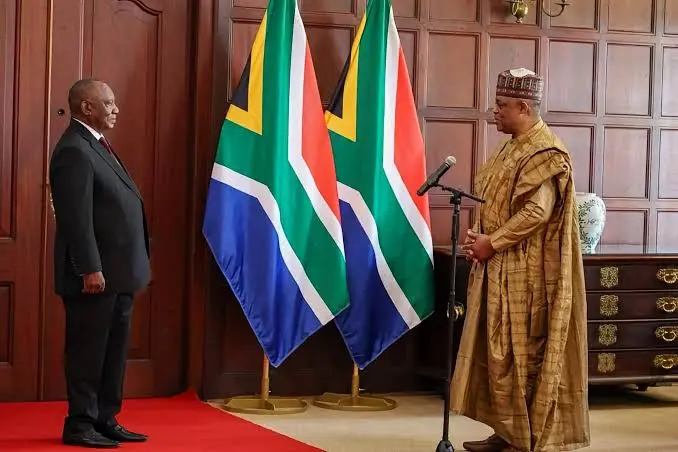
Nigeria's new High Commissioner to South Africa, Femi Fani-Kayode, has arrived in Pretoria armed with a number. In speeches since presenting his credentials, he has repeatedly invoked $61 billion as the measure of Nigeria's contribution to South Africa's liberation—and, implicitly, as the basis for a claim to recognition that supposedly sets Nigeria apart from other African nations that made comparable sacrifices.
That number does not support the weight he is placing on it. It is an unaudited estimate, buried in a single sentence of a 2010 SAIIA opinion piece, devoid of methodology or sourcing. Elevating it into a diplomatic demand is not statesmanship. It is the construction of a grievance on a foundation of sand.
What the record actually shows: The figure originates in one sentence from Dr Nomfundo Xenia Ngwenya's October 2010 SAIIA commentary: "Nigeria also supported the Frontline States through the 1980s and by the end of apartheid in 1994, it had contributed an estimated US$61 billion towards the anti-apartheid effort."
That is the entirety of the evidentiary trail. No breakdown. No calculation. No citation. No audit.
The paper does not mention $41 billion in forgone oil revenue—that decomposition emerged later in secondary commentary, itself unverified. Nor does it itemise the remaining portion.
It is an estimate in the loosest possible sense: a rhetorical device deployed to illustrate a political argument about Nigeria's regional standing, not a figure offered for diplomatic negotiation.
Even on its most generous reading, the sum is an aggregate spanning more than three decades. It bundles forgone oil revenue, regional aid to Frontline States, subventions to liberation movements, scholarships, hosting of exiles, and diplomatic costs.
Roughly two-thirds is opportunity cost—revenue Nigeria never earned—not cash disbursed. Presenting it as money given to South Africa's struggle is a category error.
The ISS Africa noted in 2015 that the number was widely circulated but unverified. Fact-checkers have since confirmed its origin while cautioning against treating it as fact. The envoy's error is not factual. It is diplomatic.
Fani-Kayode's invocation of the figure is not merely an imprecision. It is an attempt to convert an unverified estimate into a hierarchy of sacrifice.
That claim collapses under scrutiny. Tanzania, Zambia, Mozambique, Angola, Zimbabwe, and Botswana bore the brunt of apartheid's destabilisation in ways that are not measured in dollars but in blood and sovereignty.
Frontline States hosted liberation movements, absorbed military raids, and endured economic warfare. Nigeria's support was substantial and honourable. It was not singular.
The struggle was continental, and the liberation of South Africa was achieved through a coalition of states and peoples, not through one nation's cheque.
Questions have been raised about how much of the aggregate actually reached liberation movements as usable resources. This is not to diminish Nigeria's solidarity. It is to insist that solidarity be described honestly.
Why this matters now: tensions between South Africa and Nigeria have strained relations. A substantive diplomatic response requires credibility. When an envoy's central claim rests on a figure no one can audit, that credibility is squandered.
South African officials have acknowledged Nigeria's historic support but have not endorsed the $61 billion number.
A diplomat who treats an unaudited estimate as a diplomatic asset is not resetting relations. He is inflaming them.
The accurate formulation: Nigeria's anti-apartheid support between 1960 and 1994 has been estimated at approximately US$61 billion by SAIIA (2010), much of it forgone oil revenue and regional aid. It is an unaudited aggregate, not a fact-based cash transfer, and it does not establish a hierarchy of sacrifice among the nations that contributed to South Africa's liberation.
Nigeria's record in the struggle against apartheid is honourable. It does not require inflation. It requires accuracy.
Dr Lehlohonolo Gabriel Mambona (DBL, MBA) is an Implementation Systems Architect and Public Economics Commentator based in South Africa.