

The economic relationship between India and Mpumalanga already has firm foundations. Coal connects the province’s mining economy with Indian industry. Wood pulp and forestry products form another important commercial link. Indian travellers, drawn to wildlife and spectacular landscapes, bring business to the province’s tourism establishments. The opportunity now is to build a broader partnership around these connections—one that brings more investment, technology, skills and opportunities for local enterprises.
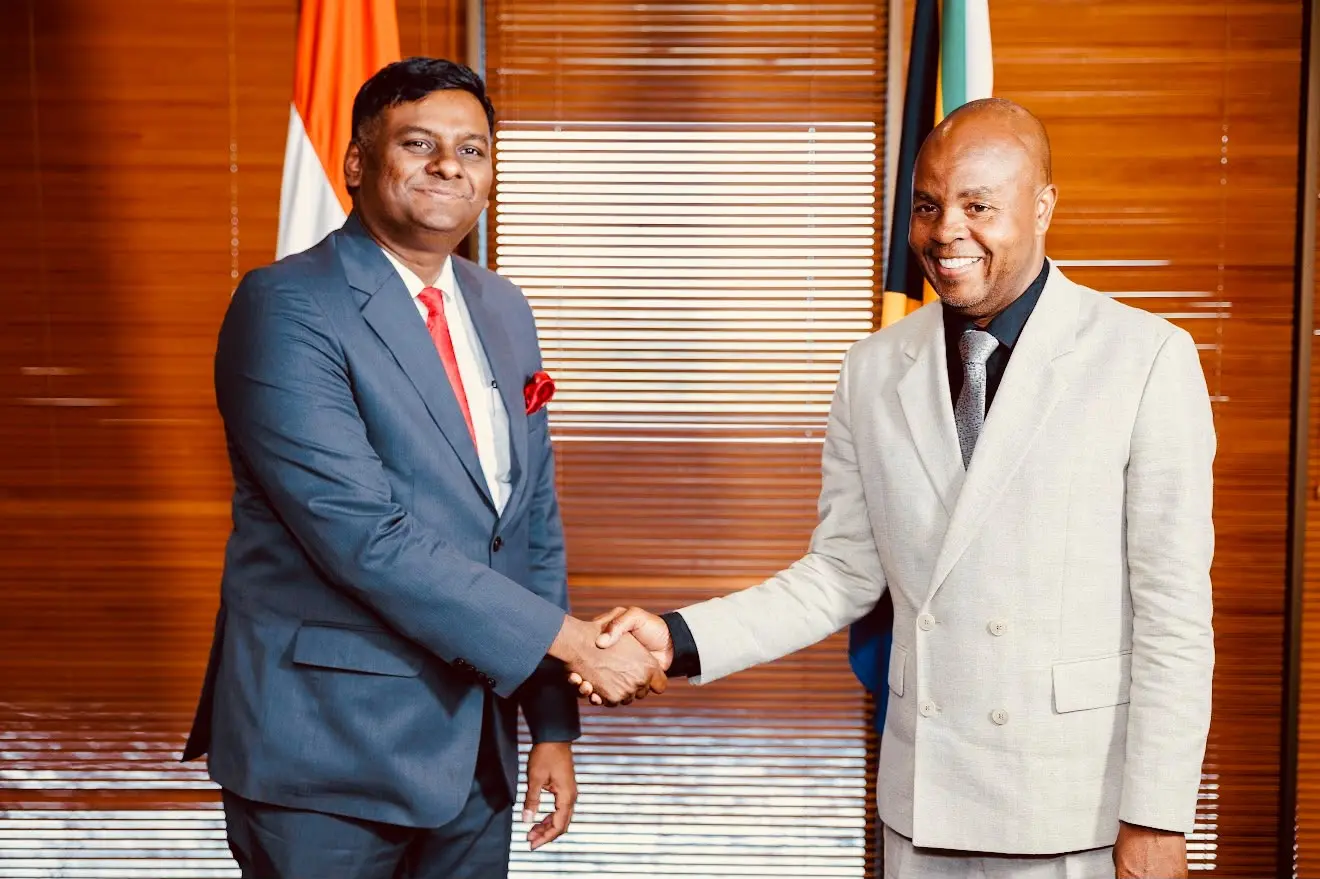
That ambition shaped the 29–30 September 2026 visit to Mpumalanga by India’s Consul General in Johannesburg, Sh. S. Koventhan, accompanied by Commercial Representative Harish Kumar and the Consulate’s Commerce team. The programme combined a delegation-level meeting with Premier Mandla Ndlovu, a “Doing Business with India” seminar and networking dinner, a breakfast roundtable between the Premier and Indian businesses, and an interaction with the Indian community. Participation by five provincial MECs, three mayors and representatives of 18 Indian businesses gave the engagement a practical commercial dimension.
The visit followed the Consulate’s mapping of Mpumalanga’s economic strengths against India’s capabilities. Its central purpose was to identify where existing trade could deepen and where new partnerships could take root.
Mpumalanga’s coal industry illustrates the established relationship. The provincial investment agency identifies India among the destinations for the province’s coal exports. These transactions connect mining, transport and related services in Mpumalanga with industrial demand in India.
Forestry offers a further connection. The province’s export base includes pulp, paper and specialised cellulose, while Sappi’s Ngodwana Mill produces dissolving wood pulp as well as paper products. This industrial strength provides a foundation for deeper engagement with Indian buyers and manufacturers across pulp-based value chains.
The significance of these links extends beyond the commodities themselves. Established commercial relationships provide a starting point for discussions on processing, machinery, technology, logistics and local supplier development. Indian companies familiar with buying from South Africa can also become partners in expanding productive capacity within the province.
Agriculture offers considerable scope for diversification. Mpumalanga’s Lowveld is an important citrus-producing region, and fruit and nuts contribute to the province’s agricultural export profile. Citrus, berries and other high-value horticultural products merit closer attention in developing connections with Indian importers, distributors and retailers. Realising that opportunity requires work across the supply chain. Product-specific market access, quality standards, dependable volumes, cold storage and transport all influence whether buyer interest becomes sustained trade. Partnerships in post-harvest technologies such as sorting, packaging, processing and irrigation could strengthen producers’ competitiveness while creating opportunities for Indian equipment and technology providers.
This connection between markets and production was central to the wider logic of the visit: expanding what the two sides trade while also exploring what they can develop together. At the bilateral meeting on 29 September, Premier Ndlovu was joined by the MECs responsible for Public Works, Roads and Transport and Economic Development and Tourism, alongside the Director-General, Chief of Staff and senior provincial officials. Discussions focused on mining, ICT, skills development, renewable energy and tourism.
For mining, potential cooperation extends to equipment, engineering, maintenance, processing and digital systems. Local partnerships in these areas could create opportunities for provincial suppliers and technical workers while helping Indian businesses establish a stronger industrial presence.
Renewable energy adds a forward-looking dimension. Mpumalanga’s future is closely tied to how South Africa manages the changing energy economy. New generation technologies must be considered alongside the livelihoods, businesses and communities associated with its existing industrial base. India’s experience in conventional power systems and expanding renewable technologies provides a basis for technical and commercial exchanges. Opportunities in renewable generation, storage and energy efficiency could be linked with training, helping local workers and enterprises participate in new projects.
Skills development also featured in specific announcements by the Consul General. He assured the province that two Indian Council for Cultural Relations (ICCR) scholarship slots would be earmarked for candidates from Mpumalanga and that Indian Technical and Economic Cooperation (ITEC) training slots would be earmarked for provincial officials. He also announced 24-hour business-visa facilitation for eligible business applicants from the province, subject to applicable requirements.
These measures give the partnership a direct human dimension. Scholarships can open educational pathways; professional training can strengthen provincial institutions; and business mobility can make it easier for entrepreneurs to explore suppliers, technologies and investment opportunities.
The “Doing Business with India” seminar and networking dinner on 29 September brought these possibilities before a wider audience. Five MECs and three mayors joined senior officials and representatives of 18 Indian businesses. Education, community safety and health were represented alongside economic development, tourism, public works and transport.
Indian Business Forum President Nihar Patnaik and sector heads presented business capabilities and interests. The provincial Head of Department for Economic Development outlined opportunities in Mpumalanga, while Invest India presented India’s economic outlook and investment proposition. The exchange placed two-way business development at the centre of the relationship. Mpumalanga enterprises could explore India as a market, sourcing base and investment destination, while Indian businesses examined opportunities within the province. The MEC for Economic Development and Tourism welcomed the initiative and expressed support for advancing cooperation.
At the breakfast roundtable on 30 September, the Premier held individual interactions with Indian business representatives and called for a focused approach. Joint teams were proposed, initially in mining and ICT. Discussions also covered the establishment of AI skilling laboratories in Mpumalanga by Indian companies. The two areas connect different parts of the province’s development agenda. Mining builds on established economic activity; ICT can support diversification and new employment pathways. AI laboratories could become a practical link between educational institutions and employers, provided training is connected to real workplace applications.
The Consul General emphasised that the next 6 to 12 months would be crucial for identifying targets and achieving progress. This gives the engagement a useful timeframe for turning expressions of interest into defined projects and institutional partnerships.
Tourism presents another avenue with an existing Indian connection. Mpumalanga’s wildlife, the Kruger region and its scenic routes are important attractions for Indian visitors. Closer cooperation with Indian tour operators could help broaden itineraries, encourage longer stays and bring visitors to additional destinations within the province. Premier Ndlovu highlighted Mpumalanga’s 17 provincial parks and its suitability for film shooting. His emphasis pointed to the potential for tourism and the creative economy to reinforce each other.
Indian productions filmed in Mpumalanga could generate demand for accommodation, transport, catering, local crews and technical services. Screen exposure could, in turn, introduce the province’s landscapes to new audiences. Developing this opportunity would involve connecting producers with local partners and providing clear information on locations, permissions and logistics.
Tourism cooperation could also support smaller enterprises. Guides, restaurants, transport operators, craft businesses and community tourism projects all have a stake in attracting visitors and encouraging them to explore more of the province. Understanding the preferences of Indian travellers—including food requirements and family travel needs—would help translate promotion into a stronger visitor experience.
The Consul General also met members of the Indian community during his visit to the province. These community ties are an enduring part of the relationship. People who live, work and run businesses in the province sustain connections with India long after official visits conclude. Their local knowledge can also help new commercial and cultural partnerships develop.
The high-level visit has brought these strands together: established trade in resources and forestry products, opportunities in agriculture, a strong tourism connection, and emerging cooperation in energy and digital skills. The next stage will depend on practical follow-through. Joint teams will need clear responsibilities. Businesses will need viable proposals and reliable counterparts. Training initiatives will need institutions ready to deliver them.
Mpumalanga and India have both an existing commercial foundation and a wider field of opportunity. The promise of the September engagements lies in connecting the two—so that familiar trade flows can support new enterprises, new skills and a more diverse economic partnership.