


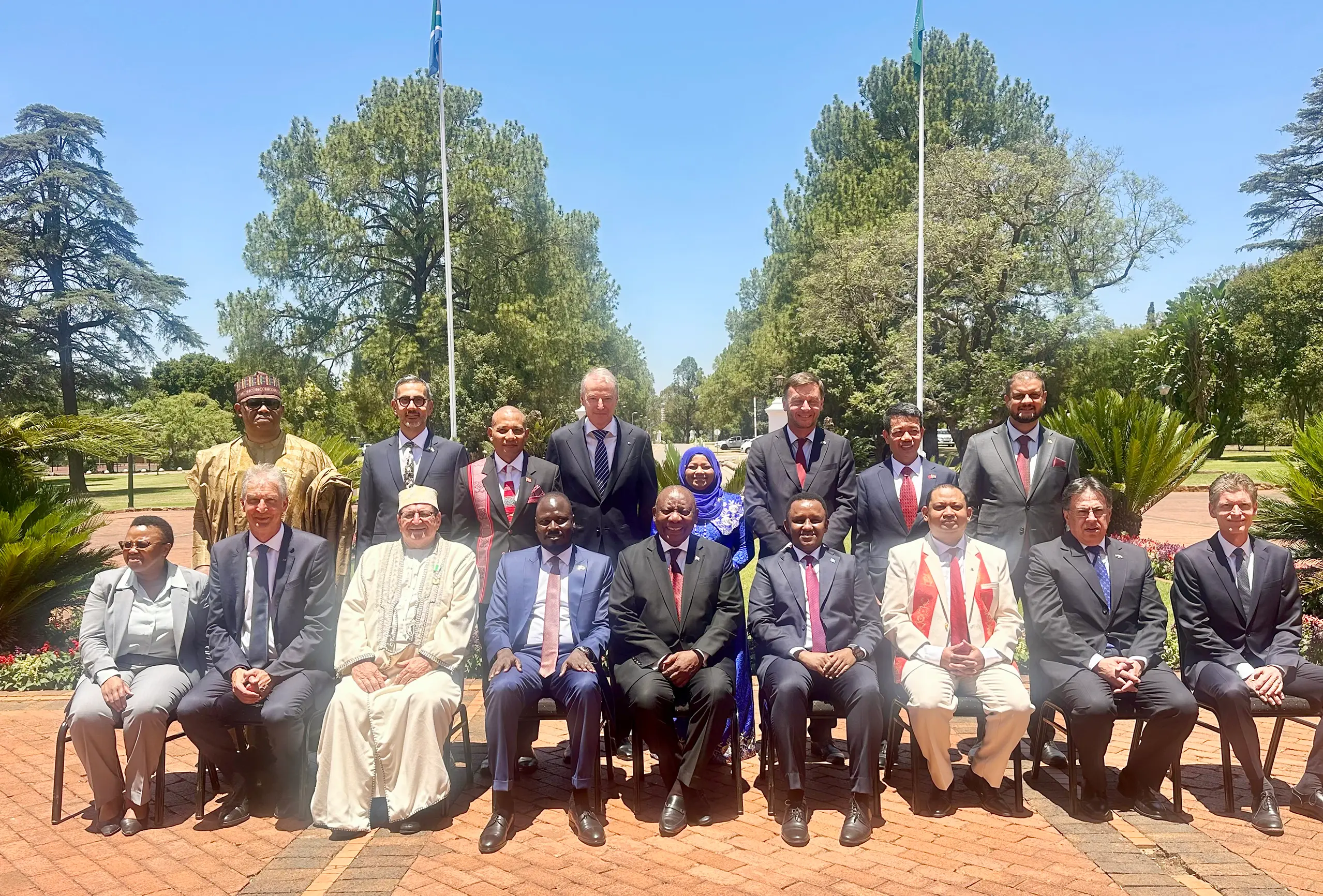
President Cyril Ramaphosa received Letters of Credence from 15 newly accredited heads of mission at the Sefako Makgatho Presidential Guest House in Pretoria, in a diplomatic ceremony that highlighted South Africa’s commitment to strengthening international relations and building partnerships across the globe.
The representatives were from South Sudan, Somalia, the Union of Comoros, Madagascar, Germany, Uruguay, Vietnam, Seychelles, Belgium, the European Union, Cyprus, Timor-Leste, the Maldives, France and Nigeria.
Welcoming the newly appointed diplomats, Ramaphosa said their presence reaffirmed the importance their respective governments placed on relations with South Africa.
He assured them of the South African government’s support and cooperation as they assumed their diplomatic responsibilities, expressing the country’s readiness to deepen bilateral relations and develop new partnerships of mutual benefit.
The ceremony took place against a backdrop of international uncertainty, with the president highlighting heightened geopolitical competition, shifting alliances and conflicts in several parts of the world.
Referring to the situations in the Middle East, Ukraine and Sudan, he noted the devastating human cost of war and the consequences of failed diplomacy. The conflicts, he said, also disrupted global trade and undermine food and energy security, placing additional pressure on countries such as South Africa.
The president emphasised that international law and the principles of the UN Charter must be respected by all nations, regardless of their economic or military influence.
“International law must apply consistently, without exception or favour,” he said, reaffirming South Africa’s commitment to dialogue, the peaceful resolution of disputes, the protection of civilians and human rights.
He said the answer to the challenges facing multilateralism was not less cooperation but a stronger, more representative and effective international system.
South Africa’s foreign policy, he explained, remained rooted in the values of the Constitution, which celebrated its 30th anniversary this year. Human dignity, equality, non-racialism, non-sexism, freedom and justice continued to shape the country’s engagement with the international community.
Africa remained central to South Africa’s foreign policy priorities. The president highlighted the country’s chairpersonship of the Southern African Development Community for 2026 and 2027, with a focus on regional industrialisation, infrastructure development, agricultural transformation and food security.
He also called for greater beneficiation of Africa’s critical minerals, emphasising that the continent must move beyond being a supplier of raw materials and become a centre of production, innovation and value addition.
The newly accredited diplomats were encouraged to explore opportunities for investment, technology transfer, skills development, infrastructure financing and trade.
Ramaphosa further highlighted South Africa’s engagement through BRICS, the G20 and the UN, calling for reforms to global governance institutions, particularly the UN Security Council and international financial institutions, to better reflect the realities of today’s world.
He stressed that diplomatic relations should deliver tangible benefits to citizens through economic growth, industrial development, job creation and skills development.
Encouraging the diplomats to engage with South Africa’s provinces, municipalities, universities, research institutions and private sector, he described diplomacy as an important instrument for creating opportunities and strengthening relationships between societies.
“Diplomacy must create opportunities, build bridges between societies and improve the lives of ordinary citizens,” he said.
Concluding his address, Ramaphosa welcomed the new heads of mission, expressing the hope that their assignments would strengthen friendships, deepen cooperation and bring their respective nations closer together.
The presentation of Letters of Credence marks the formal beginning of a head of mission’s diplomatic duties in South Africa, opening a new chapter in the relationship between the sending country and the host nation.