Accounting violations: Steinhoff’s chief executive Markus Jooste has been charged in Germany, but not here yet. (David Harrison/M&G)
The state bodies charged with investigating and prosecuting commercial crimes in South Africa have seen a more than 30% increase in budget allocations over the past five years. But they claim this has not been enough.
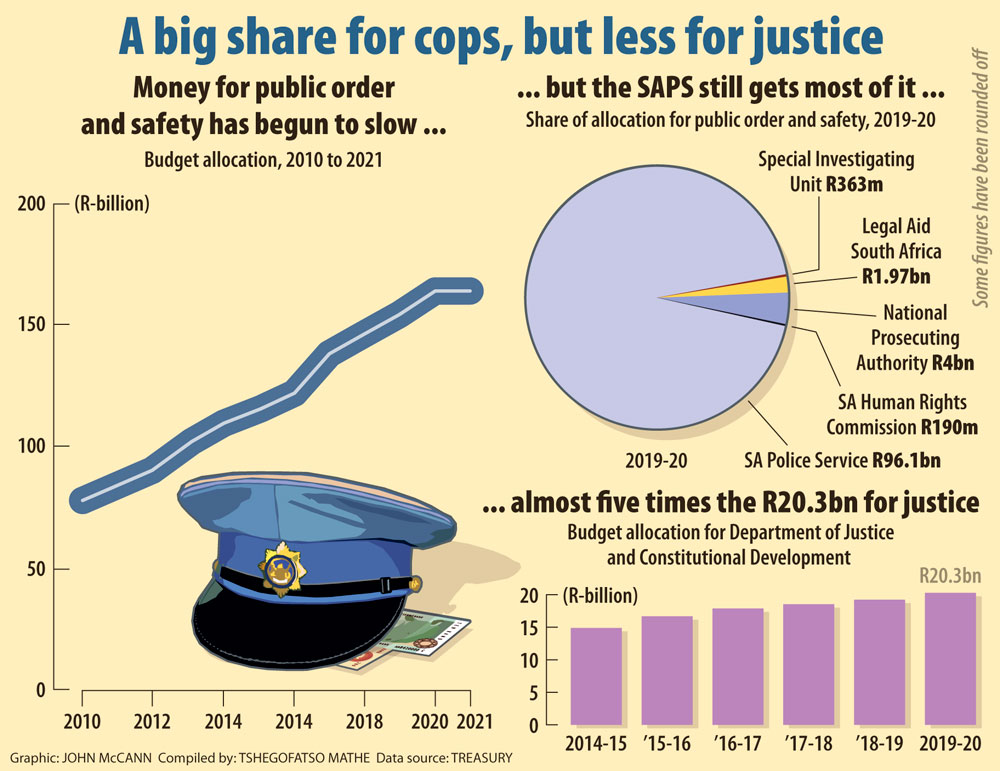
Looking at the overall budget, funds to keep the peace and provide security in South Africa commands 12.1% of the total budget.
Though smaller than the budget for the learning and culture cluster, which is at 23.5%, it’s close to that of health, at 14% and economic development, at 12.2%
The security arms, such as the National Prosecuting Authority (NPA), have previously complained of not having enough money and resources to prosecute criminals.
On Tuesday, while addressing the parliamentary portfolio committee on justice and correctional services, NPA head Shamila Batohi said that “we will never have enough resources, that is why I raised the issue of prioritisation”.
General Godfrey Lebeya, the national head of the directorate for priority crime investigation (DPCI), or Hawks, said his directorate was operating with a 47% staff complement and needed more employees, but added that the DPCI was working to hire more people.
Lebeya said his department had 21 000 cases with fewer than 2 000 investigators dealing with them. Of those cases, 11 000 accused people are currently on the court roll.
Money to fight commercial crime seriously
However, these problems have hampered the entities’ abilities to solve cases such as the Steinhoff saga.
It has been four years since the matter was reported to the police, and so far, there are no signs that investigators are narrowing in on the culprits or that arrests are imminent.
Instead, early this month, it came to light that last year, Steinhoff paid R30-million to fund PricewaterhouseCoopers (PwC) to further investigate the disgraced company on behalf of the South African Police Service (SAPS), the Hawks and the NPA.
PwC has previously probed the matter. In 2017, after the news broke, Steinhoff appointed the audit firm to investigate the irregularities. When the report was concluded two years later, the Hawks and the NPA were given access to it.
Last week, the NPA’s Sipho Ngwema said it was distancing itself from the matter. He said the funding of the forensic investigation fell squarely within the domain of the SAPS.
However, the SAPS did not respond to why it needed the R30‑million from the company it is investigating.
Though the NPA’s financial woes stretch back more than a decade, Steve Mahlangu, speaking on behalf of the department of justice and constitutional development — which oversees the NPA — attributed its challenges to the economic downturn that has affected the government’s purse overall.
He added that the NPA’s and the justice department’s work was labour-intensive. As a result, the most significant portion of the budget was used for employee compensation and personnel expenses.
How SAPS spends its budget
SAPS, however, is another matter. A deep dive into the financials by the M&G Data Desk shows that it’s trial-ready dockets for commercial crimes have decreased steadily.
Treasury documents and SAPS’ annual reports over the past five years show that the department received a total of R504-billion to R503-billion over the past five years, with the highest spend in 2019-20 at R96.7-billion.
The SAPS budget has increased by 33%, from R73-billion in 2014-15 to R96.7-billion in 2019-20.
However, the department of justice and constitutional development has received a smaller piece of the pie. In the past five years, it has received R108-billion with an annual average of R18-billion. This department’s budget, however, has increased over this time by 36%, from R14.9‑billion in 2014-15 to R20.3-billion in 2019-20.
The NPA has received more than R21-billion from the government in the last five years.
Although Finance Minister Tito Mboweni’s 2021 budget has cut money allocations across departments, SAPS’ expenditure is expected to increase at an average annual rate of 5.2%, from R96.7‑billion in 2019-20 to R112.7‑billion in 2022-23.
However, looking at the SAPS annual reports for 2019-20, the department confirmed fruitless and wasteful expenditure amounting to more than R91-million. In its annual report of 2018-19, an irregularity expenditure of R20.7-million had been reported, but that had escalated to R1.2-billion during the audit.
A closer look at their annual report for the period using Vulekamali — a platform by the treasury and civil society — showed that SAPS’ administrative programme budgeted more than R322-million on fleet services and just over R4-million.
In the same period, the department’s administration programme had budgeted R21-million on catering, while the detective services budget came in at just more than R4-million.
 (John McCann/M&G)
More money, more woes
Kirsten Pearson of Corruption Watch said that SAPS’ budget has been substantial. She added that the country was at a place where austerity is affecting the economy, but the department had received billions every year.
She said slow action in the Steinhoff matter was a case of misplaced priority, and a reflection of the extent to which criminal justice had been eroded as well as how political influence had affected SAPS’ ability to carry out investigations.
Pearson said the German government had made strides in the matter while South Africa was lagging.
In early March, Bloomberg reported that Steinhoff International Holdings chief executive Markus Jooste was among four people charged in Germany in connection with accounting violations.
Pearson explained that the NPA was in this situation because it was reliant on the chain of investigation of other bodies.
On Wednesday, while briefing parliament’s oversight committee on public accounts, Batohi said that the PwC ‘s report is due to be released at the end of this month and it “will make a huge difference in terms of moving this case forward.”
Not the only unresolved case
Last year’s SAPS financial report shows that the percentage of trial-ready case dockets for serious commercial crimes charges decreased by 10.58 percentage points from 74.37% to 63.79% from the previous year.
It said the decline was due to witnesses in municipal fraud and corruption investigations who are sometimes reluctant to come forward or hand over evidential material, delays in the finalisation of forensic audit reports and some delays in case dockets submitted to the NPA for a decision, due to the high volume of cases.
“The underperformance can be attributed to the complexity of serious commercial crime case dockets. There is ongoing consultation between the DPCI and NPA, to resolve the difference in the threshold for serious commercial crime cases,” the report added.
The treasury, which is focusing its efforts to stabilise the country’s debt by limiting spending, told the M&G that funding alone would not solve corruption in this country.
“Funding must also be complemented with consequence management, among other things.”
[/membership]