Rollercoaster: Pumpjacks in the South Belridge oil field in California. Oil prices cratered with the spread of Covid-19 and are now seeing a resurgence, but not quite to the levels of 2019. (David McNew/Getty Images)
Big oil companies have reported better-than-expected results for the first quarter of 2021. This comes after last year’s unprecedented collapse in demand, triggered by pandemic lockdowns around the world.
But even as prices and demand recover, aided by efforts to rebalance supply to demand and the reopening of the global economy, the next couple of years may be the oil market’s last hurrah before the transition to a low-carbon future.
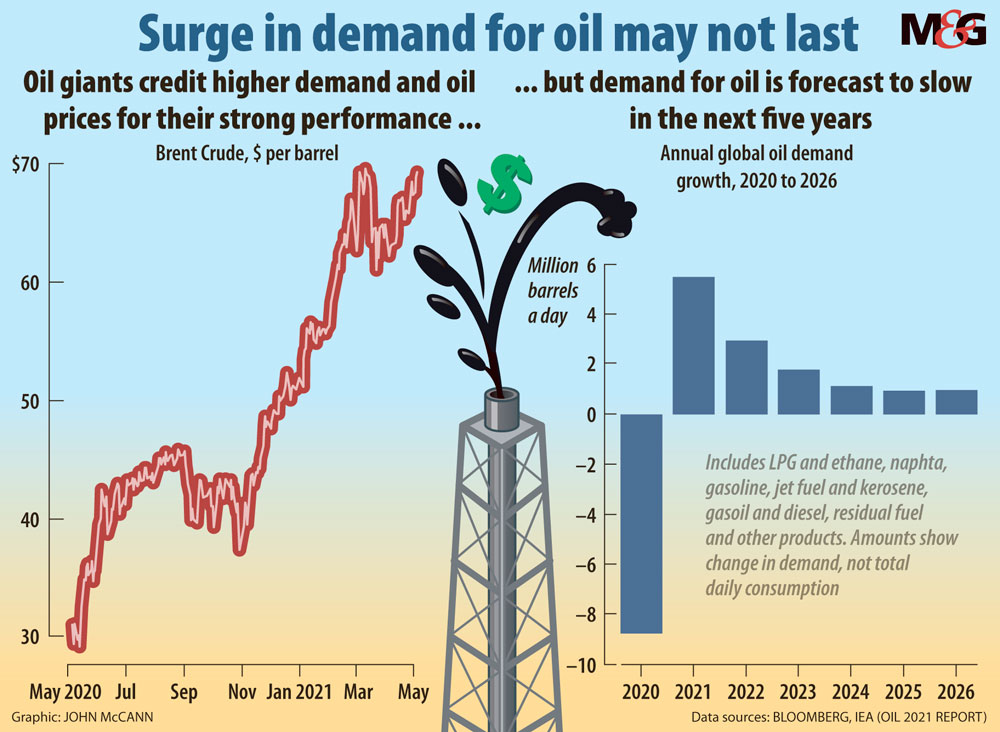
In the past two weeks, some of the world’s biggest oil companies — including Shell, BP, ExxonMobil, Chevron and Saudi Aramco — have reported a stronger performance compared with last year, when global demand for oil dropped to 8.7-million barrels a day (mb/d).
Last week, Shell and BP presented better-than-expected first quarter results.
Shell reported a profit of $3.2-billion for the first quarter of this year, a more than 700% increase compared with the $393-million it made in the last quarter of 2020. BP’s profit came in at $2.6-billion. This is compared to $115-million in profit the British oil company brought in at the end of last year.
Last Friday, American oil giants ExxonMobil and Chevron reported a return to profitability for the first months of 2021.
ExxonMobil, which reported losses throughout last year, reported profits of $2.7-billion in the first quarter. The Texas-based company’s revenues rose 5.3% to $59.1-billion. California’s Chevron, which reported losses for the past three quarters of 2020, reported profits of $1.38-billion. But this is still 60% lower than a year ago.
This week Saudi Aramco reported it had exceeded forecasts. The state-run oil company posted a 30% year-on-year increase in net income to $21.7-billion and declared a dividend of $18.8-billion to be paid next quarter.
All the companies cited the break in last year’s demand slump, as well as higher oil prices, as the reasons for recovery.
Saudi Aramco chief executive Amin Nasser said: “Given the positive signs for energy demand in 2021, there are more reasons to be optimistic that better days are coming. And while some headwinds still remain, we are well-positioned to meet the world’s growing energy needs as economies start to recover.”
The return to relative normalcy for the oil giants was achieved partly through rebalancing efforts by key exporters, which last April voluntarily adjusted production in response to 2020’s unprecedented demand contraction. Recovery is expected to pick up speed in the second half of the year.
Reductions in the staggering inventory surplus that built up last year, paired with the rise in demand, has resulted in higher oil prices. At the time of writing, Brent crude futures were priced at $69.67 a barrel.
At a meeting last Thursday, the Organisation of the Petroleum Exporting Countries and other exporters emphasised the importance of ongoing rebalancing efforts, especially as uncertainty over a resurgence of the pandemic prevails.
Energy expert Ted Blom said last year’s slump was never going to be the death knell for oil giants, because demand would inevitably pick up with the rollout of vaccines and the re-opening of economies.
Last month, the International Energy Agency (IEA) indicated that global energy demand is set to increase by 4.6% in 2021. This will more than offset the 4% contraction in 2020 and push demand 0.5% above 2019 levels, the IEA noted.
Demand for fossil fuels will grow significantly in 2021, the IEA added. But despite an expected annual increase of 6.2% in 2021, global oil demand is set to remain around 3% below 2019 levels — a result of lower demand from aviation.
Blom said there is a good possibility oil prices will rise above $70 a barrel and stay there for the near future. This is the estimated break even point for Canadian oil producers.
Companies have also developed a degree of resistance to harsh industry cycles, Blom said. “Most of them are pretty resilient. Because when they make money, they make big money … As soon as they break even, they are highly leveraged, and they really print money.”
But some say the recent strong performance by oil companies this quarter could be one of its last, as the push towards a low-carbon gains momentum.
 (John McCann/M&G)
In its Oil 2021 report, released in March, the IEA said the world oil market may never return to normal. Oil demand will probably only return to pre-Covid levels by 2023, the report noted.
According to the report, by 2026 global oil consumption is projected to reach 104.1mb/d. This would represent an increase of just 4.4mb/d from 2019 levels. Moreover, oil demand in 2025 is set to be 2.5mb/d lower than was forecast by the IEA a year ago.
“The pandemic has forced rapid changes in behaviour: from new working-from-home models to cuts in business and leisure air travel. At the same time, more and more governments are focusing on the potential for a sustainable recovery as a way to accelerate momentum towards a low-carbon future,” the report reads.
“The outlook for oil demand has shifted lower as a result of these trends, raising the prospect of a peak sooner than previously expected if governments follow through with strong policies to hasten the shift to clean energy.”
South African National Energy Association board member Dave Wright said there may be greater pressure on policymakers to drive the clean energy transition, especially with the United Nations Climate Conference coming up in November. But, he said, “there are still a lot of unknowns in all aspects of the oil game”.
Wright added: “Is this a sustainable performance from the oil companies? I don’t think it is.”
He said it was important for oil companies to have a good performance now, so they can retain the investors they still have.
“So I think, you know, they need to still retain their position as being interesting companies to invest in, or interesting companies to remain in. But I don’t think the first quarter performance this year is anything like what we can expect their average performance could be.”
[/membership]