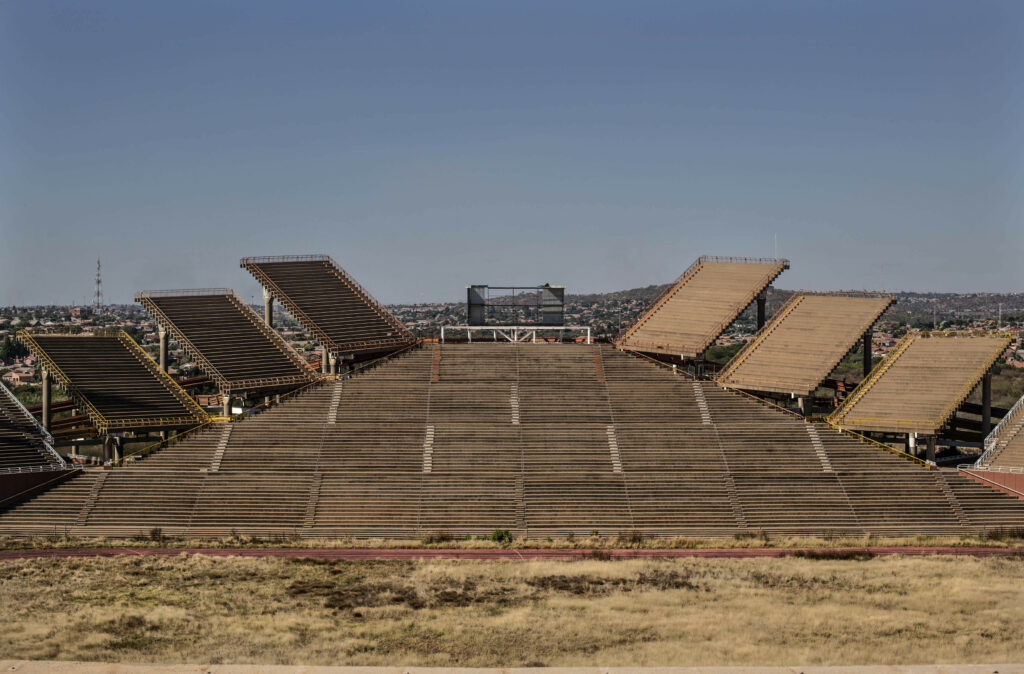
Grand old master: The Odi Stadium in the former Bophuthatswana bantustan is now only used by a few athletes, who still train on its Tartan running track. (Paul Botes/M&G)
There are few venues more peculiar than Odi Stadium. Its signature elevated stands fan out around it, each one giving the illusion of floating in mid-air. Clasping the stands on each corner are four old-school floodlights — giant, white frames that are equally distracting. It looks almost comical in photographs; it seems to parody 20th century communist architecture.
And yet the place has an undeniable majesty. It towers over the surrounding Mabopane area, unmistakable from afar. Approaching it you can’t help but peer up through the car window for a clearer view. With a capacity of 60 000, it is the third biggest venue in the country — only FNB Stadium and Ellis Park can hold more people.
It’s easy to imagine how tens of thousands of fans once lined the streets on game day, a mass of colour pouring into its wide halls.
Now Odi Stadium lies broken. Professional sports have not been played there for 15 years and accompanying their disappearance has been that of regular maintenance.
Recent media reports have said that residents have grown uneasy living in its shadow because the ground’s fraying fences allegedly provide a sanctuary for criminals and drug users.
Local government, meanwhile, has largely been quiet about its plans for Odi. Two years ago, former Tshwane mayor and the Democratic Alliance’s Gauteng leader Solly Msimanga said “the only option is to demolish the venue”, but he, or anyone else, is yet to publicly release any concrete proposals.
The legend of Odi
The first thing to note about Odi Stadium is that it’s not technically unique. It has a twin — the Mmabatho Stadium, about 300km to the west in Mahikeng.
Formerly known as the Independence Stadium, it was designed to be a stand-out spectacle in Mmabatho, the capital of what was then the Bophuthatswana bantustan. It was a monument to the rule of strongman Lucas Mangope, ostensibly a gift to the masses but really his own sporting Tower of Babel.
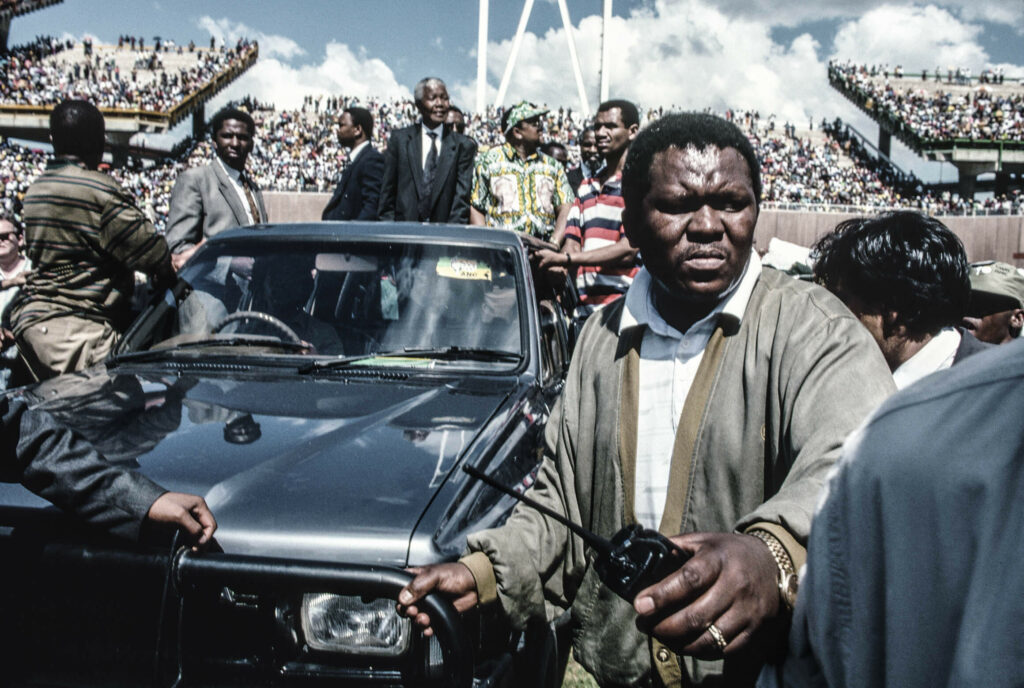 Nelson Mandela on the Campaign Trail (Photo by David Turnley/Corbis/VCG via Getty Images)
The design of the two stadiums offer a view into a fascinating page of South African history. In what scholar Arianna Lissoni describes as the “not-so-secret ties with Israel”, the former bantustan had built a strong relationship with Jerusalem, regularly exchanging commerce and expertise. This was epitomised when an Israeli architect and construction firm were appointed amid sketchy tender processes to execute the lofty design in the mid-1980s.
But with the fall of apartheid, and its transfer to the Gauteng governance, the Odi Stadium would take on an identity of its own. It became a favourite site of political rallies, music festivals and, of course, football matches. The adopted home for Mamelodi Sundowns, it held a number of high-profile domestic and international matches.
For renowned goal-scorer Daniel Mudau, it would provide the altar at which he christened his legacy.
“People around Odi were supportive to us. My memories of that stadium are so wonderful. It made my name Mambush into a brand thanks to the Sundowns supporters,” he says.
“The goals that I scored in that stadium were so wonderful.”
It was some rare acrobatics that stood out from his club record — 110 PSL strikes. (Siyabonga Nomvethe is the only player to have scored more in the league).
“When I scored a bicycle kick at Odi Stadium, people thought I couldn’t score a goal like that. I got across the goal and then I bicycle kicked it. It went to the top corner. That was my best goal at Odi Stadium.”
Along with the incredible, Odi also produced one of the more bizarre episodes of South African football. On a rainy day against Moroka Swallows in March 1997, with the score tied at 1-1, coach Stanley “Screamer” Tshabalala would collapse after conceding a last-minute strike. It was an open invitation for ridicule from merciless opposition fans; that the goal was so imperious it had “killed” the boss.
“That memory is still in my mind,” says Mambush. “Aubrey Lekwane had the ball in the centre line, he hit a rocket and it went into the top corner. It was so painful to see our coach, Screamer Tsabalala, fall down. Paramedics came and helped him. People laugh about it but it was serious … he even went to hospital. By God’s grace they checked him and said he was okay.”
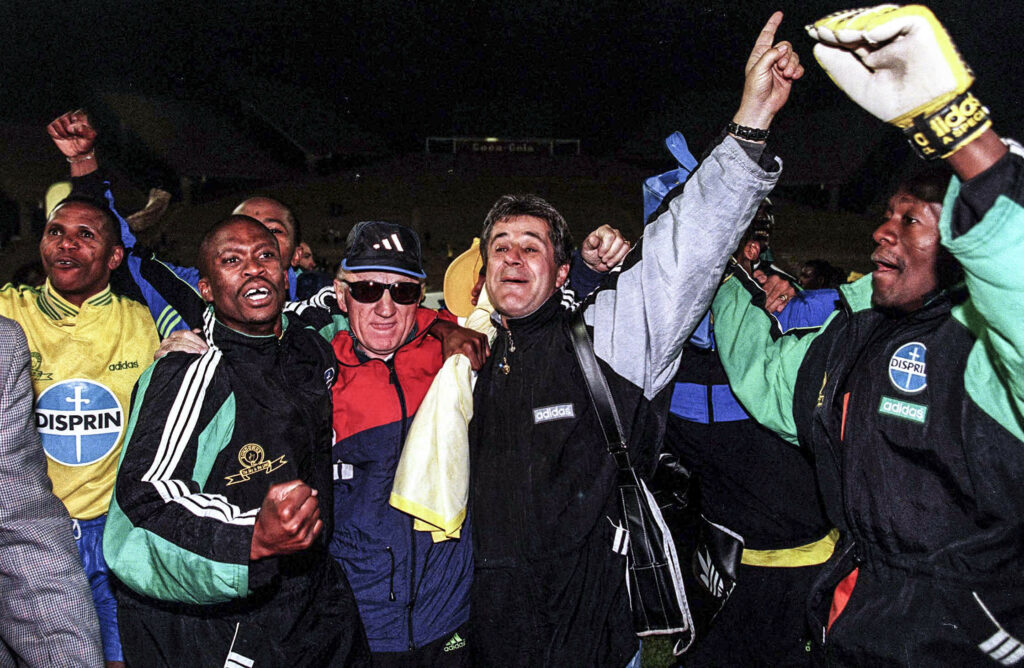 The stadium was also a popular football venue, including Sundowns’ 2-0 victory over Cape Town Spurs in June 1999, resulting in Downs winning the league. Photo credit: Gavin Barker/Gallo Images
In the following years the Brazilians cemented themselves as the dominant force in the land, securing three consecutive league titles (their first in the PSL era). Mudau captained the side when they clinched it in the most remarkable races in 1998-99.
With Kaizer Chiefs locked on an equal 72 points heading into the final day, the league trophy hovered in a helicopter, ready to fly to Soweto or Mabopane. Despite a 5-1 Glamour Boys win over Dynamos, the flight would be made to Odi — a 2-0 win over Cape Town Spurs was good enough to give Sundowns the crown on goal difference.
But the fond times in Mabopane were numbered.
On April 11 2001, the darkest day in the nation’s sporting history, 43 people were crushed to death in a stampede during a Soweto Derby at Ellis Park. With an angry public demanding accountability, the incident permanently changed the way stadium security was considered.
With Odi’s stands hovering nauseatingly high in the air and accessible only through a single entrance, it was front-of-mind in a safety-first mentality. Coinciding with reports that the ground was overdue for major renovations, events began to be phased out.
But there would still be time for one more trophy parade. Odi was controversially chosen for Sundowns’ title-clincher against Orlando Pirates in 2006. A gritty 0-0 was enough to secure title number four and one last Masandawana party in the area.
With PSL games no longer possible, Odi lost its tenant anchor (stadium parlance for a team or attraction that brings in regular income). Without the cost-benefit to secure regular maintenance, it became the most dreaded of derogatory building terms: a white elephant.
Afterlife
Through the prism of weeds on the pitch, those glory days seem a lifetime away.
We had arrived at Odi Stadium unsure of what to expect or where to enter. Our first attempt led us to the rear of the grounds where we found worshippers, dressed in pure white, making use of the idle space. They neither knew about or had any interest in the history of the giant structure that towered over them.
 A crowd of estimated 40 000 people listen to the address of ANC president Nelson Mandela during a mass rally in Mmabatho 15 March 1994 prior to the 27 April general election. (Photo by Walter Dhladhla/AFP)
The single entrance still in use was at the other end. It was manned by a single security guard, an affable man named Piet Chauke. He said he had been working there since 2014, keeping watch to ensure the facility was not completely ripped apart by vandals. He was happy to extend an invitation for a free tour.
What once was a football pitch now more closely resembles overgrown veld. The dense, thick grass — the kind you wade through at your own risk — was knee-high. The fences are rusted and most doorways and windows have been ruggedly bricked up.
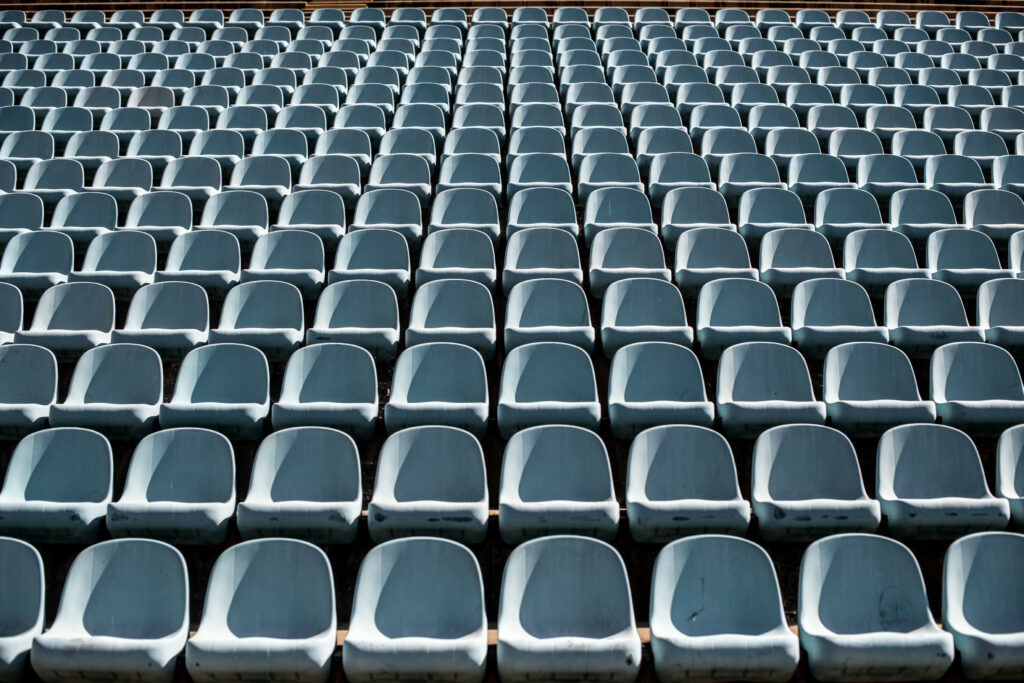
And yet the sense of gravitas in Odi remains undiminished, palpable from up high in its barren seats.
It’s also still very much in use.
Peter, who didn’t want to give his full name, had spent much of our visit sweeping bird excrement from under the cavernous archways at the front. He introduced himself as a representative of Athletics Tshwane West, a body he said that trained over 200 athletes. With little to no assistance, it had fallen on him and three others to maintain the grounds so at least practice sessions could be held there, something that has happened three to four times a week since 2019.
“We’re not doing it for the money, we’re doing it for the love of athletics,” Peter said. “This stadium is the only one within the whole of region one with a Tartan Track. We try to use this stadium so that we can develop athletics in this area.
“We hope government can realise that the facility needs someone to take care of it. Since the stadium has got no one, we try and take care of it until someone comes.”
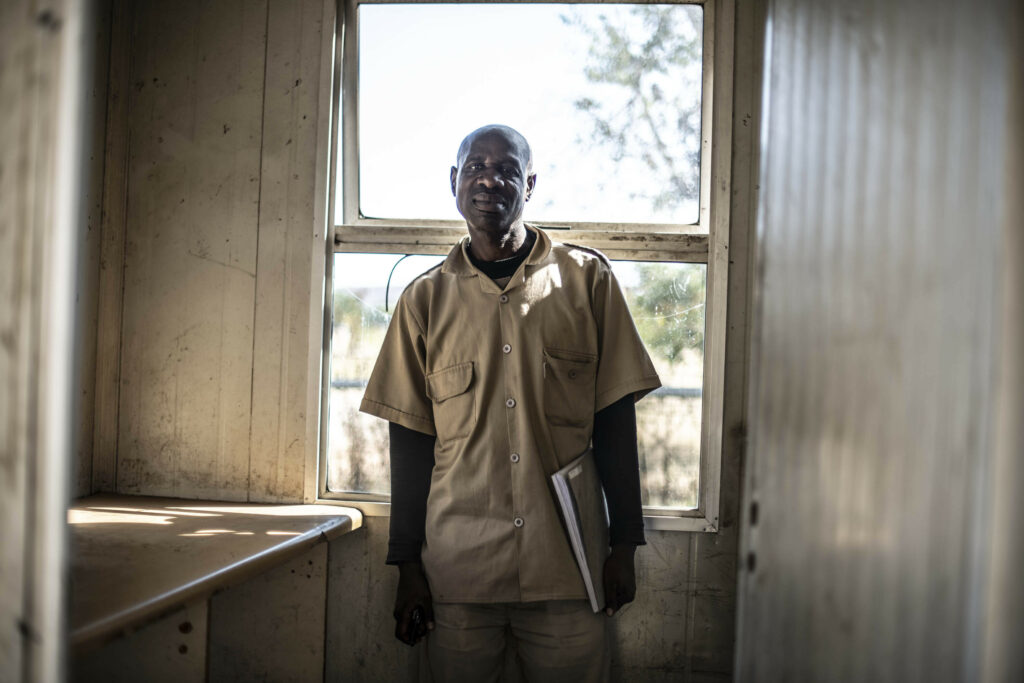 Piet Chauke guards the premises. (Paul Botes/M&G)
The 400m track in question was in surprisingly usable condition. The colour had deteriorated and needed to be resurfaced but it still retained its bounce. If the wild thickets adjacent to it are ignored there is no reason athletes might regularly run on it. There is also a sandpit in good nick for long jumpers.
Through one of the offshoot doors that remained unbricked, Peter led the way into a makeshift gymnasium where he had to start a generator so he could turn on the lights. They showed a sparse but utilitarian setup, replete with working treadmills, exercise bikes and a bench press.
Hanging punching bags were accompanied by a dozen or so boxing gloves on the wall. There was even a kimono to be used in Shotokan karate — the philosophy of Athletics Tshwane West is to introduce youngsters to a wide range of sports; to encourage dabbling outside the ubiquity of football.
“We here in this community try and keep this place safe,” Peter said. “Safety is of most concern to us. This stadium is very big, it’s something like 1.5 kilometres around the whole stadium. You can imagine with only one security guard. The gates are being vandalised again … usually the problems are in school holidays — children grow up not knowing about this stadium.”
But it could be worse, he added, it could be the HM Pitje Stadium in Mamelodi.
Reign of uncertainty
In a recent Daily Sun article, the Mamelodi venue was described as a “pigsty and a hideout for nyaope boys”. It is one of a few Tshwane stadiums that, like Odi, has been the subject of irate Twitter posts and the occasional media coverage about its degradation.
Last month, a shade of hope appeared for these grounds. Caledonian Stadium, another that is rich in history but has similarly fallen into disrepair, was pegged for a R120-million redevelopment. During a turning of the sod ceremony, plans were revealed to transform the famed home of Arcadia Shepherds into a PSL-level site within the next 36 months.
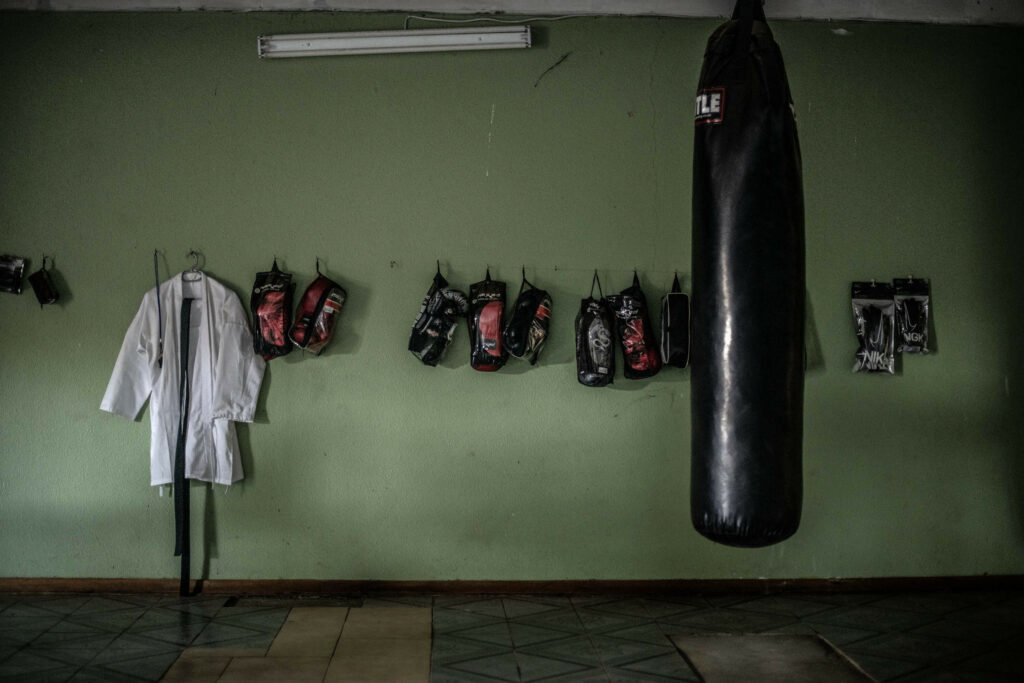 Inside is a gym with equipment, including punch bags and boxing gloves. (Paul Botes/M&G)
Asked by the Mail & Guardian whether there are intentions for other locations to receive similar treatment, the Tshwane community and social development services department said it had “identified the following similar facilities for future upgrading”: Ekangala Stadium, Odi Stadium, HM Pitje Stadium and Pilditch Stadium (in which a new World Athletics-standard track was completed in March).
Regarding Odi, the department did acknowledge that only security is provided and “minor maintenance is done at the facility mostly because of the identified unsafe aspects of the stadium”. There are no plans for its demolition.
The department said that reports about the venue have been ongoing since 2008. Unsurprisingly it is not technically compliant with modern PSL or Fifa standards, which rules out its use as a professional football ground without a complete overhaul. Still, pressure from the residents has resulted in many meetings. At one such meeting in September 2013, it was agreed that the stadium should be converted into a “multipurpose sport and recreational park”.
Although that is the de facto stance of the department, the future of the stadium is uncertain and will remain so until Mabopane witnesses tangible actions taken by the authorities. In the meantime the nostalgia and Odi’s condition will continue to fade.
[/membership]