Power of the gun: King Mswati III of Eswatini inspects a Kalashnikov in Russia in 2019. (Donat SorokinTASS via Getty Images)
Watching from a distance on Wednesday, Phumlani Mncina saw his brother Msimisi shot in the back. He fell on the dusty road and died on the spot.
“I was sitting here at home watching from a distance. There were three soldiers and one police officer. When they were a few metres away from the protesters, they opened fire and killed my brother. His body was left on the road. After shooting my brother, they chased everyone. People ran for their lives.”
Msimisi Mncina’s body was returned to the family. He will be buried this weekend. His brother, Phumlani, told the Swaziland News that Msimisi was shot in the back, and the bullet went through to damage even his eyes.
Calls by civil society, members of political circles and the international community are intensifying for Eswatini monarch King Mswati III to be charged for crimes against humanity on allegations that he unleashed the army to kill civilians for demanding democratic reforms.
Eswatini is in the middle of a political crisis after the king allegedly launched a crackdown on protestors calling for reforms. According to banned opposition parties, dozens of people have been killed, more than 200 treated for gunshots, and hundreds are missing.
As a result, the ANC, the Southern African Development Community (SADC) and other international bodies have urged the government of Eswatini and stakeholders to engage in a dialogue to find a lasting solution to the ongoing crisis.
Msimisi was a Bachelor of Science and Engineering student at the University of Eswatini. He is among the casualties, after being allegedly shot and killed by soldiers during a protest at Nkhungu, about two kilometres away from the Oshoek border post.
Phindile Dlamini, his mother, said after killing his son, who was among the protestors blocking traffic along the Ngwenya-Mbabane highway, the soldiers allegedly left the body on the road and disappeared.
“What is happening now is that police officers are now moving around with the body, they first took the corpse to Pigg’s Peak, and I later gathered that they were trying to remove the bullet to destroy evidence,” she said.
No replies were received to questions sent to Superintendent Phindile Valakati, the Eswatini police spokesperson.
Mlungisi Makhanya, the president of the People’s United Democratic Movement, told the Mail & Guardian that his party’s call for an inclusive dialogue to resolve the ongoing political crisis does not mean Mswati and others who are allegedly responsible for the killings should not be prosecuted.
“We are collecting evidence, and we are clear that Mswati must be taken to the International Criminal Court (ICC). Our view is that there must be prosecution, people must be held responsible. Even the call for national dialogue should not be a call that seeks to downplay the call for consequences; that is why we are meeting as the Political Parties Assembly (PPA). We want to take a final collective decision.
“Others were suggesting that Mswati should facilitate the dialogue, but now Mswati does not qualify to convene anything because his hands are dripping with blood,” said Makhanya.
On Sunday, the SADC troika on politics, defence and security visited the Kingdom of Eswatini on a fact-finding mission. They engaged the government and a few members of civil society.
But on Monday, Foreign Affairs Minister Thulie Dladla told the Swaziland News that it was not true that the civil society members were sidelined, adding that the troika would have another meeting to listen to the voices of civil society and others.
“Unfortunately, the invitation to [the] troika was at short notice, and we could not reach out to all the stakeholders. Cango [Eswatini’s coordinating body of NGOs] will assist in identifying them,” said Dladla.
Emmanuel Ndlangamandla, the executive director at Cango, one of the few civil society leaders who met with SADC troika, said the government must first acknowledge that lives have been lost and work towards solving the problem.
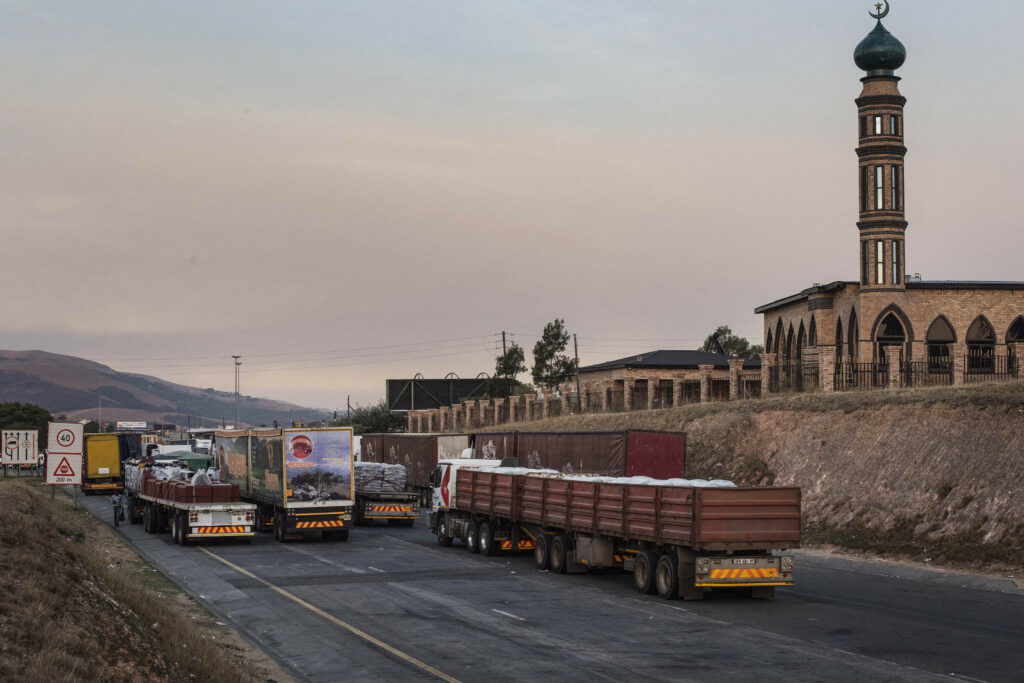 Trucks line up outside the Oshoek border-post on the South African side of the border with Eswatini. Demonstrations escalated radically in Eswatini this week as protesters took to the streets demanding immediate political reforms.
Activists say eight people were killed and dozens injured in clashes with police.
Internet access has been limited while shops and banks are shuttered, straining communication and limiting access to basic goods under a dawn-to-dusk curfew. (Photo by RODGER BOSCH / AFP)
Trucks line up outside the Oshoek border-post on the South African side of the border with Eswatini. Demonstrations escalated radically in Eswatini this week as protesters took to the streets demanding immediate political reforms.
Activists say eight people were killed and dozens injured in clashes with police.
Internet access has been limited while shops and banks are shuttered, straining communication and limiting access to basic goods under a dawn-to-dusk curfew. (Photo by RODGER BOSCH / AFP)
“It is important that we meet stakeholders and renew our country. Eswatini has been ranked as one of the most unequal countries in the world. If you don’t have a political connection, you will remain poor. In the midst of protests in other countries, even if one person dies, that government accounts, and that’s what we need here, accountability”, said Ndlangamandla.
Meanwhile, women and children are among the casualties of the political chaos that erupted in the kingdom.
Simile Sangweni, a textile worker whose brother is the People’s United Democratic Movement spokesperson Brian Sangweni, was allegedly gunned down at Mathangeni in Matsapha during the pro-democracy protests.
Her brother confirmed her death, saying that his 33-year-old sister was shot by soldiers two weeks ago around Matsapha in the kaHlobile area.
“She was shot in the left knee. She would be one of the many who would have been amputated if she survived. She bled heavily until she died as she could not reach the hospital on time. She was transported to the hospital in the early hours where she was certified dead.”
Nonhlanhla Dlamini, the executive director of Swaziland Action Against Abuse, said women and children were the most affected during the political crisis, adding that soldiers went as far as moving around people’s homes beating and harassing women.
“Furthermore, you will note that in such situations where many people have been killed, women are expected to participate in funeral preparations fully. Some are poor and cannot afford such costs; hence this crisis affects them directly and indirectly,” said Dlamini.
On Tuesday, Liz Throssell, the spokesperson of the UN High Commissioner for Human Rights, urged Eswatini authorities to fully adhere to human rights principles in restoring calm and the rule of law.
The statement called for an independent investigation into human rights violations, including those by law enforcement personnel and that those responsible be held to account.
“We remind the authorities that peaceful protests are protected under international human rights law, including under Article 21 of the International Covenant on Civil and Political Rights, to which the Kingdom of Eswatini is a state party,” reads the statement in part.
As the political tension intensified on Wednesday, sources alleged there was a plot to arrest or assassinate the three pro-democracy members of parliament critical of Mswati’s government.
These pro-democracy MPs are Mduduzi “Bacede” Mabuza from Hosea, Siphofaneni, MP Mduduzi “Magawugawu” Simelane and Ngwemphisi MP Mthandeni Dube.
Simelane confirmed the matter but said he was not in a position to comment further “as I am busy with strategies on how to handle this”.
Speaking to the M&G this week, human rights lawyer Thulani Maseko said there was growing sentiment that those responsible for the murder, torture and injuring of protestors should be held accountable.
“Voices are suggesting countries that are signatories of the Rome statute should ensure His Majesty the King as the commander in chief of the armed forces as well as those generals and advisers who have caused this mayhem answer for crimes against humanity,” he said.
Maseko said that the total number of confirmed identified deaths is 54, adding more people were missing and more bodies may still be found.
“We must apply ourselves to the post-conflict scenario. International law is already full of precedence of how such a situation should be dealt with, to the extent that if it were to happen that His Majesty lands in South Africa, attempts must be put in place that … [he] be arrested and brought to book through the Rome statute mechanism,” Maseko said.
Eswatini, the tiny landlocked kingdom in southern Africa, has about 70% of the population living below the poverty line, yet the king is counted among the richest monarchs in the world. King Mswati rules Eswatini as an absolute monarch. He appoints the prime minister, ministers, a majority of senators, judges and all members of the various governing councils.
[/membership]