Selective: The Freedom Front Plus, whose posters hang in the streets of Danville in Pretoria, says it is contesting all eight metros but believes it can be a kingmaker in Tshwane. Photo: Lefty Shivambu/Gallo Images
Smaller parties are looking to battle it out for kingmaker status in their respective municipalities to gain more leverage over the top two: the ANC and Democratic Alliance.
The newly launched Northern Alliance (NA) in Nelson Mandela Bay is hoping to take a chunk of DA votes to bolster its chances of becoming kingmakers in the metro.
The party is contesting 32 seats of the wards in Nelson Mandela Bay but its greatest ambition is to unseat the DA in the Northern Areas, leader Gary van Niekerk said.
The party was formed at the height of gang violence in the Northern Areas when residents began protests to demand more action from law enforcement.
The party quickly morphed into a community outreach programme for activists to deal with service delivery issues in the area, Van Niekerk said.
It has a service delivery contact centre where residents can call in to report problems with water shortages, power cuts, burst pipes and blocked drains.
“Our slogan is that we will not make promises, we will make commitments. Promises have been broken. We commit to a cleaner Northern Areas, a cleaner metro and zero corruption. There is enough money to deliver services in the metro but that money is being stolen,” said Van Niekerk.
The Northern Areas became a DA stronghold in the 2016 local government elections. The party won the council by 46.71% with the ANC garnering 40.92% and the Economic Freedom Fighters (EFF) 5.12%. With the introduction of smaller parties in the area, the DA might see some losses.
“The DA has proven over and over that when they go into coalition, they undermine the smaller parties,” Van Niekerk said. “The ANC still carry on with their corrupt activities so it would be difficult to go into a coalition with either of them. We are hoping that the other smaller parties will take a better chunk of the council seats so we don’t have to. What we will demand from coalition partners is for the Northern Areas to become a priority and we have to agree that there is no corruption or jobs for pals. We want a fair share of the budget to be allocated to the northern areas.”
Abantu Integrity Movement
Another party that has hopes of slicing into the DA and the ANC support base is the Abantu Integrity Movement (AIM) founded by former ANC leader and businessman Mkhuseli Jack.
Jack defected from the ANC to the Congress of the People (Cope) when Jacob Zuma emerged as the ANC president after the ruling party’s Polokwane conference in 2007.
The former ANC struggle activist told the Mail & Guardian that while he was more popular in the black and coloured areas of Nelson Mandela Bay, he also appealed to the white community.
“The constituency I appeal to is broader than it would have been. We are able to contest all the wards with our limited resources and given that we haven’t even completed a year,” said Jack.
“We are confident that wherever we go our message has not been disputed anywhere. People say they agree that these elections must be about the character rather than brand of the organisation because people have seen flashy manifestos, volumes and volumes over the years … Manifestos are just manifestos. We are coming up with a plan.”
He touted AIM’s candidates as credible, capable and experienced in local government and academia, calling this a critical requirement when it comes to fixing problems in a metro.
Jack said the party had a 10-point plan to revive Nelson Mandela Bay and make it more fertile for job creation, as well as to rebuild and fill the council with credible councillors and to build a customer-focused municipality.
“We want to speed up and improve service delivery and infrastructure that is in place and we are convinced that we can create conditions that are good for allowing the economy to grow. We have a fiscal plan that will make sure that not a cent is wasted and we have a plan for women and youth development,” he said.
Much like ActionSA leader Herman Mashaba, Jack is reliant on his reputation as an astute businessman to boost his electoral appeal. He said should AIM go into coalitions, its partners must appeal strictly to the norms and values featured in the party’s charter.
Al Jama-ah
As one of the parties poised to notch some growth in the 1 November elections, Al Jama-ah is hoping to extend its role as kingmaker in the Tshwane, Johannesburg and Cape Town municipalities.
The party is targeting to gain six seats in Johannesburg, Al Jama-ah leader Ganief Hendricks said, which would help the ANC should it be a hung metro after the vote. Hendricks said the party would continue with its coalition agreements with the ANC and this had already been communicated to ANC deputy secretary general Jessie Duarte.
Al Jama-ah has two councillors in the City of Cape Town, one in eThekwini, one in the Inkosi Langalibalele local municipality (Estcourt), two in KwaDukuza, one in the Umdoni local municipality and another in Msunduzi.
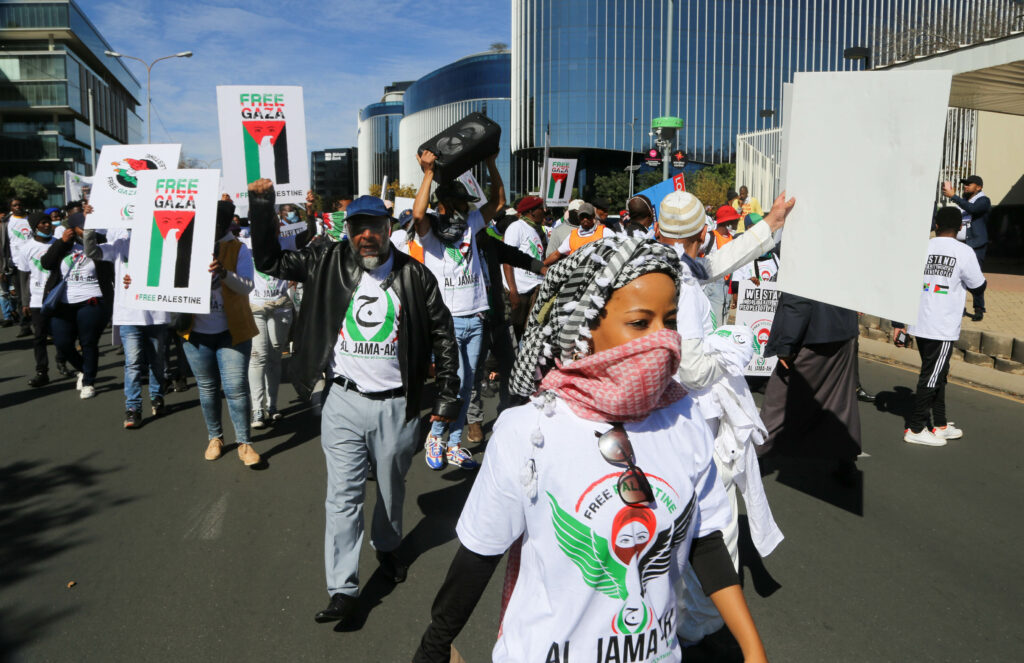 Setting targets: The Al Jama-ah party, whose supporters are pictured at a Free Palestine march in Sandton in May, says it wants to gain six seats in Johannesburg. Photo: Luba Lesolle/Gallo Images
Hendricks said the party was also hoping to gain council seats in Tshwane — targeting the Indian and Muslim communities in areas such as Laudium — as well as three seats in Nelson Mandela Bay.
In its manifesto, Al Jama-ah commits to creating jobs, strengthening businesses at the municipal level, providing water and dignified housing and securing budgets for every ward.
“For us, it’s not about positions and money. I make less money than I did in the corporate world.
“We just feel that we need to make a contribution to our community and carry out those ideas we had in the liberation struggle. We want to be seen as the new liberators,” Hendricks said.
Freedom Front Plus
Freedom Front Plus (FF+) leader Pieter Groenewald said the party was contesting all eight metros but placing its biggest elections machinery in Tshwane, Nelson Mandela Bay and Cape Town, where it believes it could be a kingmaker. Altogether, the Freedom Front Plus is contesting 3 158 wards in 154 municipalities.
“If you look at the results from 2019, we can also be kingmakers in about 20 other municipalities across the country. The provinces where we don’t really have a lot of candidates are the Eastern Cape and KwaZulu-Natal,” Groenewald said.
He said the FF+ was willing to go into another coalition with the DA, but would not do so with the ANC or the EFF.
The FF+ were the biggest gainers in the 2019 national elections, which saw many smaller parties suffer a decline in support.
The mainly white and Afrikaans-speaking party received more than double its previous votes and was responsible for the DA’s decline in 2019, taking a chunk of the main opposition party’s traditional voters.
In last year’s “super Wednesday” by-elections, the FF+ snatched one seat from the DA in the JB Marks municipality in North West province.
The MAP16 civic movement
Sixteen councillors in the Maluti-a-Phofung local municipality, who were expelled by the ANC after they voted with the opposition to oust a “corrupt mayor”, went on to form MAP16, which has risen to become the ANC’s biggest electoral challenge in the area.
In hopes of curtailing the growing popularity of the group, the ANC in the Free State’s interim provincial committee led by Mxolisi Dukwane made overtures to woo the group back to the party.
The group rejected the attempts and instead submitted its own list to contest this year’s local government elections.
MAP16 spokesperson Paratlane Motloung said the party was confident of a win in all 35 wards in the municipality that is currently in the hands of the ANC.
“We are aiming for complete control. The community is behind us. Actually, we are the last hope of the municipality. We are the only threat to the ANC. If you look at the composition of the opposition, really we are the last hope,” he said.
Maluti-a-Phofung was previously placed under administration. The municipality has been rocked by service delivery problems, including water shortages, power cuts and ageing infrastructure, leading to several protests by the community.
Motloung said the party was not prepared to have any coalition negotiations with the ANC.
“We are prepared to speak to the smaller parties but for the ANC it’s a no-no,” he said.
[/membership]