MG Investigation
If you are a shareholder in platinum group metals (PMG) company Tharisa Plc you would be delighted to know that the group’s shares rose more than 62% in the last year.
But Mmadithlokwa residents, who are shareholders in Tharisa Minerals, through the Tharisa Community Trust, say they are yet to receive part of their dividend or see the benefits they expected from that shareholding.
Tharisa Minerals is a South African subsidiary of Tharisa plc, a family business headquartered in Cyprus and listed on the London Stock Exchange and the JSE. Tharisa mine is in the Bushveld Complex in North West, and 10km from Marikana on the platinum belt.
In June 2021, Tharisa plc declared a R153-million interim dividend, its best performance yet. The company’s performance was largely driven by the South African chrome mine Tharisa which is its core asset, with ten other subsidiaries that include Ubhova Security, a company registered with murder accused William Mpembe as a director.
The Mail & Guardian previously reported that Tharisa brought in for security purposes the former North West police deputy police commissioner, William Mpembe, who is a registered director for Ubhova Security, a subsidiary of the mine.
Mpembe headed police operations during labour unrest at Marikana on the platinum belt in 2012. He is on trial for the death of four people including two miners and two Saps members on 13 August 2012 and the attempted murder of five other miners during strike related unrest that led to the deaths of 34 miners on 16 August.
Mmadithlokwa and the mine have been rocked by protests over governance, financial and development grievances with Tharisa since it relocated 400 graves and hundreds of households. The residents of Mmadithlokwa settlement near Marikana became 6% shareholders in 2011 as part of a 26% black economic empowerment deal which included the shareholding as a donation to the community trust.
Mmadithlokwa is an undeclared settlement, disqualifying it from government services, but residents are on the land included in Tharisa’s mining right according to civil activists in the area. Part of the area forms the boundary of chrome pits and blasting zones.
One resident, a miner who sits on a task team dealing with issues regarding blasting, said a number of households are expected to leave their homes for 35 minutes when blasting occurs, almost daily. Three women who later spoke to M&G about the evacuations, said they experienced rockfalls, heavy vibrations and dust during blasting.
“Tharisa is playing a game, they just say they will do this, they will do that,” he said. He was flanked by a man who said many of the outdoor toilets were out of order because there was no waste collection.
The mine said it employs 3 000 people — but it is unclear how many are from Mmadithlokwa — trains scores of youth and set up the Tharisa Community Trust. But a closer look at the trust has raised questions about whether there have been any benefits for the Mmadithlokwa residents since its establishment.
Dividends remain unpaid
Bhoikhutso Tshelane and John Salang, the two Tharisa Community Trust trustees representing the people in Mmadithlokwa, showed the Mail & Guardian evidence that despite Tharisa plc declaring dividends to shareholders in 2021, and Tharisa SA confirming that money was due to the trust, that money had not reached the trust account. The two became trustees in 2016.
Salang said the only resolution collectively taken was the one in which the trustees insisted that a bank account be opened.
The records show that the trust’s Nedbank account was only opened in March 2021 — 10 years after its establishment.
In a series of questions posed to Tharisa, the mine denied that the dividends were not paid to the trust.
The trust is structured to have two community trustees and three trustees from the mining company. This means that the company trustees can reach quorum in the absence of community input.
Chartered accountant and political commentator Khaya Sithole, who looked at Tharisa’s financial reports, said the nature of empowerment transactions involving community organisations is that they need to be structured primarily to benefit the community.
“In a simple model; the 6% of shares owned by the community trust would translate to direct economic benefits matching the 6% shareholding. These may be in the form of annual dividend distributions to the trust. The trust should then spend that amount on a range of activities that seek to empower the community. Additionally, within the governance of the trust, it is important to avoid diluting the voice of the community.”
In other words, said Sithole, trustees representing the Mmadithlokwa community should be able to participate meaningfully in the decision-making and other critical activities of the trust.
“If they are overpowered by the company-appointed trustees then the wishes of the community relating to the funds received by the trust may actually be ignored,” he said

Company under the trust
In addition to the unpaid dividends to the trust, the M&G’s investigation found that a company, Rocasize, was set up for, and is wholly owned by the Tharisa Community Trust. But it is unclear what business and activities the trust-owned company is doing with Tharisa mine.
The Tharisa executive director for community and transformation, Thabang Maluke, and the Tharisa Plc chief operations officer, Michelle Taylor, are the only registered directors of Rocasize.
Tshelane and Salang said there has been no transparency regarding Rocasize business activities, employment activities and revenue, which they said should be benefiting the trust.
Salang said that since they were appointed as trustees in 2016 little is said about what is happening.
“We are only contacted to sign documents after resolutions,” he said.
“In terms of the executive decisions that are taken, it should be all of us … according to the deed Rocasize must be managed by the community and trustees. It is our right to oversee what is happening with that community project. We are supposed to know what is happening but we do not,” Salang said.
“The problem is that they are making money and we should be getting shares from that operation but over the past few years we did not get anything.”
Rocasize was acquired from The Shelf Company Warehouse, a company that sells shelf companies for their age and black economic empowerment scoring, among other things. The sale of shelf companies is legal.
Rocasize is registered to Tharisa Minerals’ head office in Bryanston, Johannesburg.
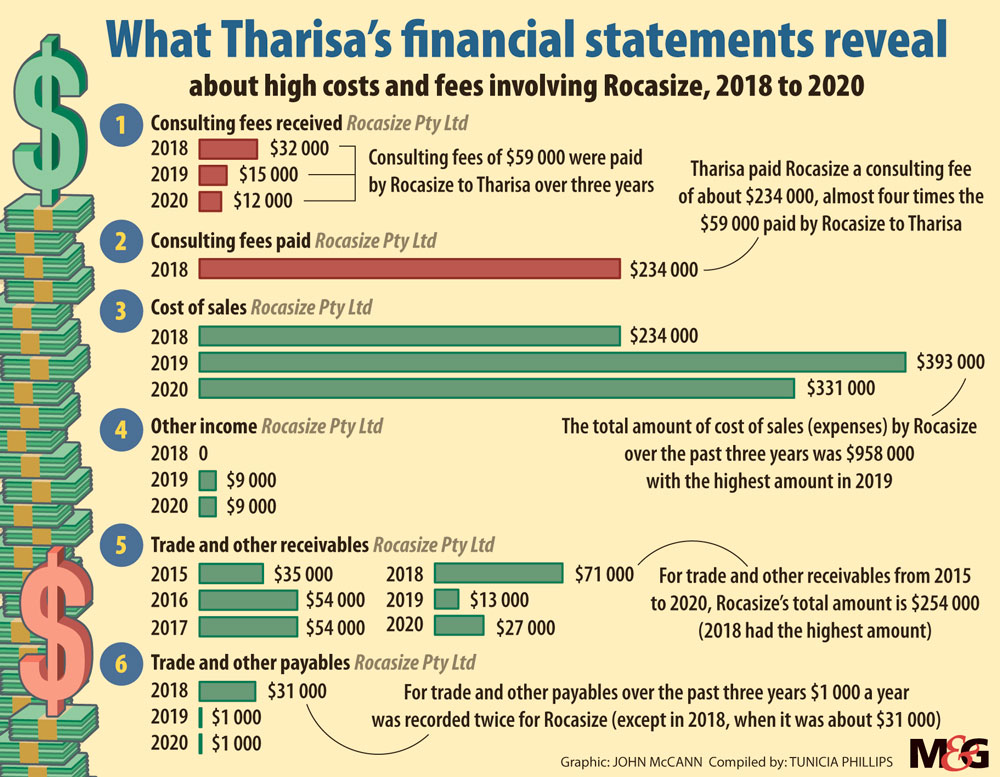
Tharisa’s annual financial statements show transactions between the company and Rocasize. These include a USD $288 000 donation in 2014 from Tharisa when Rocasize was set up and annual consultation fees paid by Rocasize to Tharisa and vice versa.
Rocasize remains unprofitable. In 2020 it recorded $331 000 in costs and only $27 000 in sales.
Salang said he and Tshelane have no access to information on Rocasize and “it becomes a problem because people think we are eating that money”.
 The chrome mine development, needed to relocate graves and family of the deceased were promised compensation. (Image: Andy Mkosi)
Mine remains silent
Tharisa said it has employed more than 60 people from “the local community” in various small, medium and micro enterprises.
“As part of Tharisa’s SLP [social labour plan] and EGS [Environment, Social, Governance] obligations, the company undertakes a number of initiatives for the benefit of the community, these range from providing basic services such as water supply and refuse collection, water being provided 24/7, while the government previously only supplied this twice a week,” the mine said.
It also said that it built a community centre and roads in Mmadithlokwa.
But Cecilia Manyane, a resident of Mmadithlokwa, said that borehole water from Tharisa is of poor quality and she was unaware of Tharisa building a community centre.
“We know nothing about that trust or these things Tharisa says it has done in Mmadithlokwa,” she said.
Tharisa’s annual financial reports declares director exposures to several community trusts but does not disclose Taylor and Maluke’s interests in Rocasize.
Tharisa has refused to answer questions relating to the trust and Rocasize and insists both entities are independent of the mining company, which cannot comment on its business activities.
But, when the M&G contacted Maluke directly, he was surprised to hear that Tharisa’s media officer, Ilja Grualich, refused to answer questions about Rocasize after he had furnished him with responses to the newspaper’s questions.
Graulich had previously demanded an extension for the company’s response to questions sent by the M&G despite having had four months to do so. He would later not comment on key questions about the Tharisa directors’ control of the trust and its subsidiary, Rocasize. Instead he threatened legal action against M&G.
“The company will ensure that the dividends, which have been paid, and received by the trust, are allocated bona fide and for the benefit of many and not just a few. No Tharisa employee receives monies from the trust, nor have any resolutions ever been taken without all trustees present. Any trust activities need to be referred to the trustees themselves for comment,” Graulich said.
The publication sent another request for details on monies owed to the trust from its shareholding in Tharisa SA.
*This story is updated. The M&G has removed an error in the calculation of the Tharisa Community Trust shareholding, and updated facts relating to the BEE shareholding and donation made to the trust company, Rocasize. By the time of the update, Tharisa complained of the error but failed to disclose how much the dividends amounted to, despite repeated requests for this information*
[/membership]