Superspreader: Workers have been contracted to remove the hyacinth in the dam, but it’s too little, too late, as the coverage area can double every week. (Andy Mkosi)
Moses Sibanda sits in the shade of a large tree on the banks of the Roodeplaat Dam in Tshwane, waiting for the fish to bite.
He’s been here for hours, but there’s no sign of supper tonight. “It looks like I’ll go home with nothing for my family to eat today,” says the fisher from Mamelodi, looking worried. Usually, he can catch up to six fish a day.
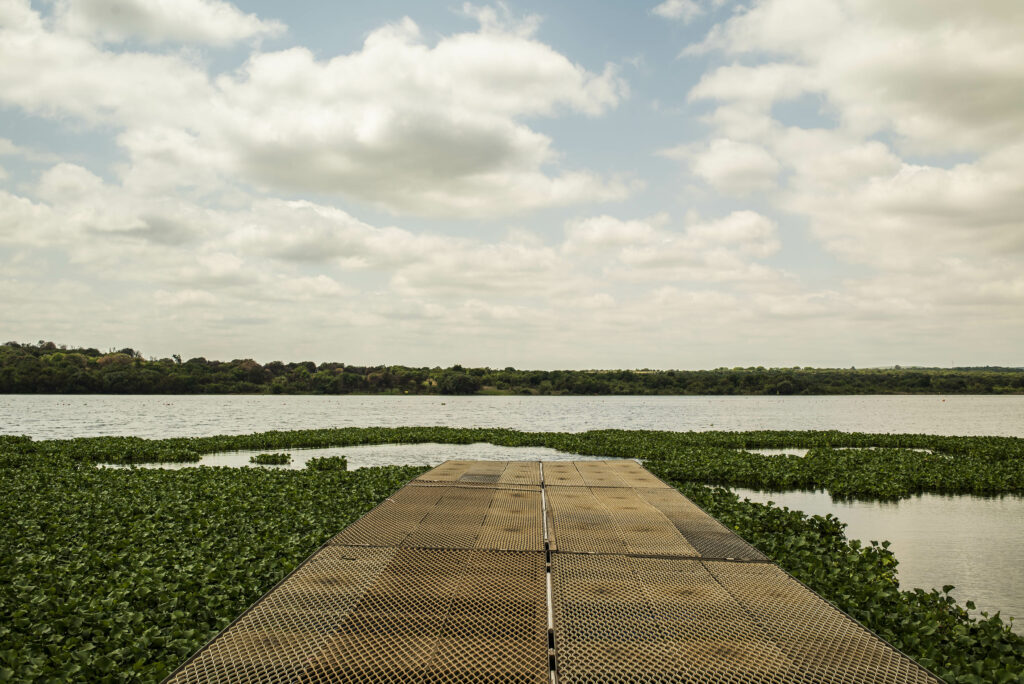
The reason for his empty bucket lies stretched out in front of him — a thick green carpet of invasive water hyacinth that is choking parts of the dam. “This blom is too much,” says Sibanda.
Earth’s superweed
The fast-growing plant is described as the world’s worst aquatic weed because of its invasive potential, its destructive effect on aquatic biodiversity — and the heavy costs of trying to control it.
Selwyn Jackson, of Rowing SA (RowSA), knows this all too well. “Look how terrible this is,” he says, showing how the hyacinth has overrun key rowing areas on the dam. “It looks like a golf course.”
With its 2km racing course and 6km stretch for distance training, Roodeplaat is the home of rowing in South Africa and the only venue of its kind in the country. It’s where the country’s Olympic medal-winning teams train. But its pollution meant that last year, the national rowing squad had to train at the Katse dam in Lesotho, 560km away, to prepare for the Olympic games in Tokyo.
For more than 20 years, poorly treated wastewater from wastewater treatment plants have caused it to become eutrophic, unleashing dense mats of hyacinth and blooms of toxic cyanobacteria, or blue-green algae.
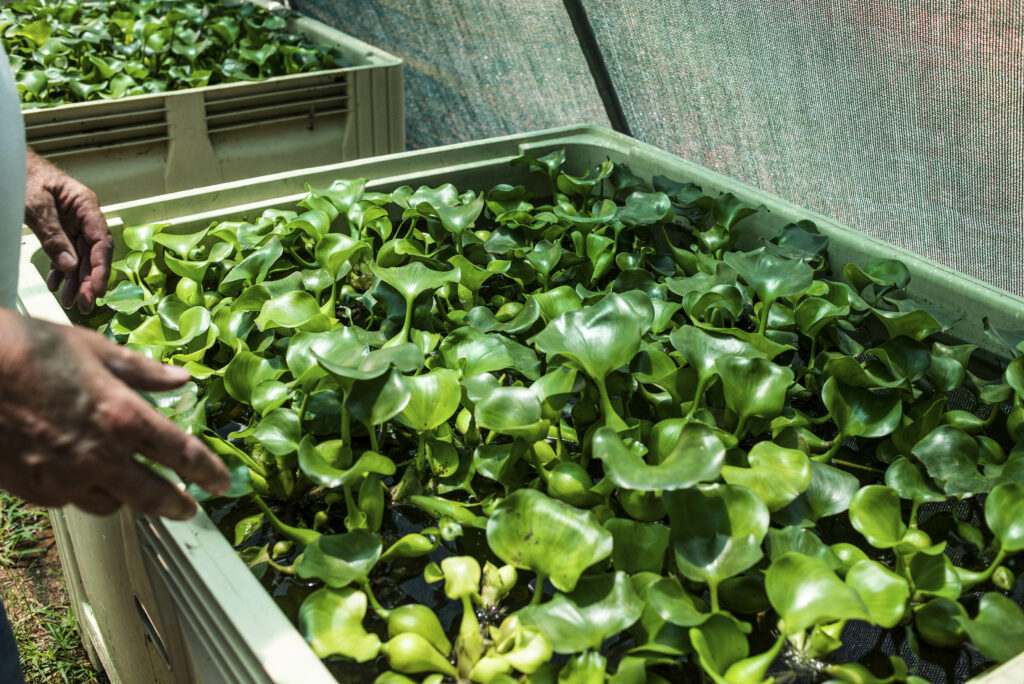 Water hyacinth, a highly problematic invasive plant. (Andy Mkosi)
“The problem is that the water is like liquid fertiliser because of all the nutrients — the phosphates and the nitrates,” Jackson says. “It’s an ideal growing medium for the hyacinth. If you don’t have the hyacinth, then you get the cyanobacteria. The sewage works that are spewing out raw sewage makes it 10 times worse.”
Poor quality of effluent
Water hyacinth was first noticed on the dam in 2000, says Julie Coetzee, the deputy director of the nonprofit organisation Centre for Biological Control (CBC) at Rhodes University.
By 2008, 60% was covered and the then-department of environmental affairs and tourism initiated an aerial herbicide spray programme, which carried on until 2014, keeping the dam relatively clear of the plant.
“From 2015 until 2018, herbicide was supplied by the department to local landowners and stakeholders to keep the plant in check, requiring relatively small-scale localised applications, but this provision was stopped in 2019, and local stakeholders took on the responsibility of keeping the plants in check themselves.
“However, herbicide application was restricted by the department of forestry, fisheries and the environment in February last year, for three weeks, and with no other control measures in place, the plant rapidly invaded the dam.”
Tshwane’s ‘devastating’ pollution
Tshwane’s freshwater sources, including the Roodeplaat dam, are being polluted with untreated and partially treated sewage and sludge because of the City of Tshwane’s failure to maintain its wastewater treatment works, a report by the South African Human Rights Commission found last month.
It follows an inquiry it held in February, after repeated complaints about malfunctioning plants discharging untreated or partially treated sewage into the Apies and Pienaars rivers and the Roodeplaat and Leeukraal dams. “The effects of the pollution on the water, its ecosystems and the people who use the water have been devastating,” Jackson said.
This is “made clear” by the Magalies Water Board’s water sample analysis carried out in June last year, which showed “horrendous levels” of faecal coliforms and E.coli”.
The analysis showed the faecal coliforms being discharged into the Pienaars river exceeded 380 000 colony forming units (cfu) per 100ml, far exceeding the permitted limit of 10 units. E.coli levels were 280 000cfu/100ml when the level should be zero.
At the inquiry, the department of water and sanitation said the Pienaars River and consequently the Roodeplaat dam, a major source of drinking water for northern Gauteng and parts of the North West and Limpopo, had become a “dumping area of waste sludge”.
‘Basically raw sewage’
In September, Jackson was alerted to complaints about the nearby Zeekoegat wastewater treatment works. “I went to investigate and found lots of sludge being released into the dam … and was told that the plant has had multiple failures since July 2021.”
Results from the water and sanitation department confirmed high levels of E.coli. The maximum allowed for recreation in South Africa is 400cfu/100ml. At Zeekoegat Bay, these were 141 360cfu/100ml.
“That’s basically raw sewage. At that time, there were 200 children on a rowing camp with polluted water. Thank goodness no one got ill, but one of the canoers who capsized got violently ill … The day I saw this mess in the bay there were fishermen on both sides fishing,” Jackson said.
All rowing activity has now been suspended. Baviaanspoort has released sludge for the past four years. “Fortunately, the E.coli is neutralised by the time this water reaches Roodeplaat dam. But this has led to a build-up of nutrients … in the dam, which promotes the growth of hyacinth and cyanobacteria.”
Mess of hyacinth
During last year’s Covid-19 lockdown, the hyacinth covered over 65% of the surface area of the dam and as this mass moved, it wiped out the rowing course. Jackson and his team salvaged half of the equipment and replacements cost over R250 000.
The forestry, fisheries and the environment department, he says, did a sub-lethal aerial spray of glyphosate herbicide, and the CBC released a number of bio-control agents on the hyacinth, cutting it to less than 2%, but this is still too much to host a rowing regatta.
RowSA employed a team to manually remove the hyacinth from the dam and the rowing course was installed again. By August this year, there was less than 1% coverage. Now, it is spiralling out of control again, covering 27% of the dam, mostly in the rowing section. “Even if the E. coli is under control, the dam is still not usable for rowing, and the rowing course is likely to be damaged again.”
Insects to the rescue
Last year, the CBC was asked to establish a biological control programme for the dam, given its success in controlling the water hyacinth at Hartbeespoort dam, Coetzee says. “Biological control is an ecologically friendly method of controlling alien invasive plants, and relies on the use of natural enemies [biocontrol agents] of the invasive to feed on and reduce the populations of the weed.”
It has released more than 50 000 biological control agents on the hyacinth, primarily the hyacinth planthopper, reared at the CBC’s mass rearing facility at Rhodes University. Three insect-rearing stations have been set up around the dam, where thousands more planthoppers have been released.
According to Coetzee, the introduction has resulted in significant declines in hyacinth populations, rapidly reducing the rate of growth at the dam since December 2020.
But while it consults and provides insects free of charge, there has been a delay in the awarding of contracts by the forestry, fisheries and the environment department “so the CBC is now acting with reserve funds, and we have had to retrench staff too,” he says.
DFFE spokesperson Albi Modise says it is one of the key funders of biological control research. “The research units secure funding from other organisations, including both domestic and international organisations.”
These units, Modise says, were contracted by the department, with all contracts ending in the second and third quarters of the financial year. “In its commitment to transparency, the department had advertised tenders, which includes biological control research. The evaluation of received bids is being finalised and all bidders have been informed of the progress of the evaluation.
Coetzee says that, “despite the lack of funds, we remain open and will keep working to assist our collaborators at Roodeplaat and other dams in the area, such as Hartbeespoort and Bospoort dams to keep biological control agents on the dam to help reduce the damage caused by water hyacinth and other invasive species.”
Sleepless nights
In 2019, RowSA won the rights to hold the World Rowing Masters Regatta in September 2023 at Roodeplaat dam — the first international rowing regatta to be held in Africa and a showcase for the continent’s rowers.
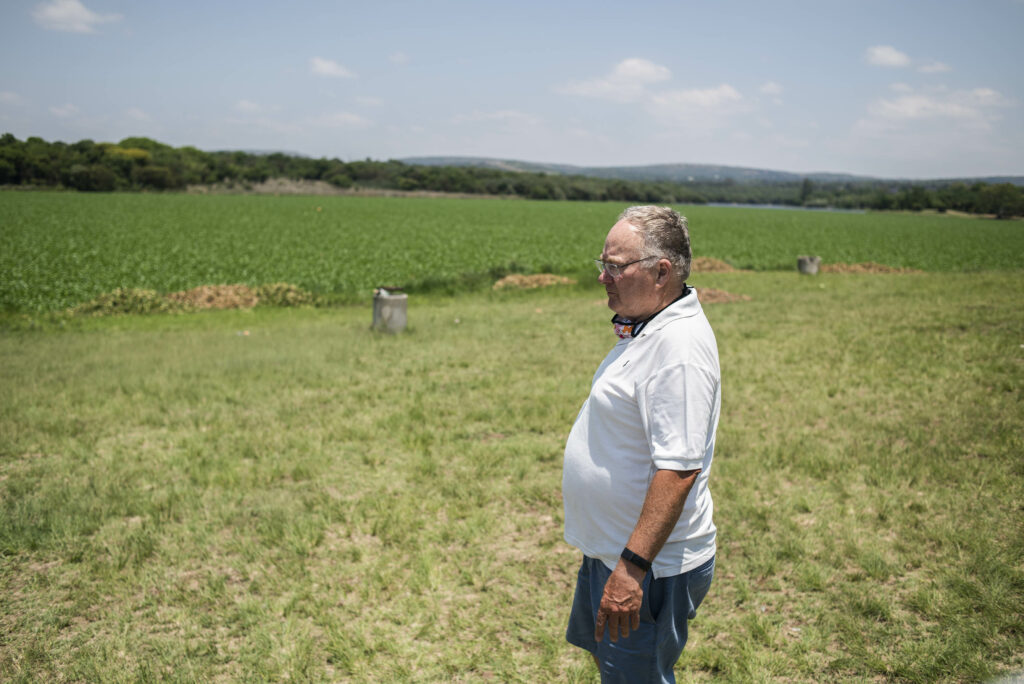 Rowing SA’s Selwyn Jackson says the country’s Olympic rowers cannot train at the dam.
But the poor state of the dam is giving Jackson sleepless nights. “If we cannot ensure there is no E.coli in the water and that the hyacinth and cyanobacteria are under control, we will lose the rights to host this event. Not only will the country lose the huge tourism benefit, but RowSA will lose a huge amount of money that was spent on the bid, infrastructure improvements and the promotion of the event.”
On the dam’s shores, Precious Ratsaka grins as she heaves a pitchfork into a clump of hyacinth, hauling it onto a decaying pile behind her. She is part of three Working for Water teams deployed by the forestry, fisheries and the environment department in October to manually remove the plants.
“They have started here too late,” says Jackson, frustrated. “This stuff doubles every seven to 10 days.”
Modise says its teams were deployed on 4 October and will continue until the end of the financial year. “The DFFE is procuring cables to contain the water hyacinth to enable the team to remove the plants easier, protect the rowing lanes and establish biocontrol reserves”.
It needs the approval of the department of water and sanitation (DWS) to aerially spray the water hyacinth through a general authorisation under the National Water Act. The DWS did not respond to the Mail & Guardian’s enquiries.
“The glyphosate used by the DFFE does not contain polyethoxylated tallow amine and is safe for aquatic organisms, but to safeguard the biocontrol agents targeting the plants, a sub-lethal spray is applied in strips in the centre of the dam at least 10m from the shoreline,” says Modise.
“Furthermore, not more than 60% of the biomass is sprayed at any one time to comply with the risk assessment requirements as guided by the general authorisation.”
City of Tshwane’s response
Selby Bokaba, spokesperson for the City of Tshwane, says the Zeekoegat wastewater treatment works experienced multiple equipment failures and the remedial actions are “being attended to”.
“Repairs and putting the equipment back in operation were delayed due to the older infrastructure of the older section of the plant. The effluent produced from Zeekoegat is clear and further maintenance will improve on the quality of effluent that is discharged,” Bokaba says.
In the meantime, fisher Sibanda’s livelihood remains under threat.
“It’s a mess,” he says sadly, as he looks out at the hyacinth-infested waters. “The fish tastes nice here, but now I will have to go somewhere else to find fish.”
*The CBC has started a crowdfunding campaign to help fund its field work, insect rearing and to maintain its staff until the New Year, particularly those that work at the insect rearing facility at Rhodes University. To donate, click here
[/membership]