New and old: Johannesburg mayor Mpho Phalatse of the Democratic Alliance. The DA took all three Gauteng metros. (Sharon Seretlo/Gallo Images)
The ANC may have lost control of five hung metro councils to the Democratic Alliance this week, but the DA faces five years of governing them with a gun held to its head by the Economic Freedom Fighters and ActionSA — or the failure of the councils it now runs.
ActionSA’s “flip-flopping” Herman Mashaba has seemingly dragged the DA into its worst nightmare of needing the EFF to govern the Gauteng metros it won last week. The Inkatha Freedom Party (IFP), which had previously announced a “governance agreement” with the ANC in hung councils in which either party led, also joined the EFF and ActionSA in the surprise decision to back the DA.
 eThekwini mayor Mxolisi Kaunda of the ANC. (Gallo Images/Darren Stewart)
By voting for DA mayoral candidates in the metros, the EFF and ActionSA have effectively outmanoeuvred the official opposition — which had rejected their coalition terms at the weekend — and have forced it into “unstable coalition’’ governments at council level.
This ploy came as a huge surprise and left the party between a rock and a hard place, according to DA insiders.
One even said the EFF now has the DA “by the balls” — alluding to the fact that the party cannot simply refuse to listen to others because they disagree on principles.
The DA is now faced with the stark choice: making concessions to the two parties that it has averred it will not work with and forming coalition governments to run the metros for the next five years; or sticking to its guns and seeing the councils it just “won” control of collapse by the middle of next year.
“It will destabilise the councils and will make voters think we are immature and we can’t be trusted to play nice with others. Essentially, if you want to have the power it will come with a bit of a mess. Obviously, Helen [Zille] and John [Steenhuisen] didn’t want us to get into government with the EFF, but we could not say no to the positions, because the voters would punish us as it would seem we are giving it to the ANC,” one DA source said.
The failure of the DA-led councils would result in by-elections in the metros, which the DA can ill afford, having lost actual support across the metros in the 1 November local government vote. Both the EFF and ActionSA made significant gains in the municipal elections and would be happy to contest by-elections.
The DA will also want to avoid going into the 2024 national and provincial elections with governance failures in the metros attributed to its inability to work with other opposition parties — in a forced coalition or not — given the role of failed service delivery in last month’s poll.
The party will have to turn to the EFF, ActionSA — and the IFP — if it hopes to pass municipal budgets next May, because it will be unable to do so without their backing in Johannesburg, Tshwane and Ekurhuleni.
A precedent was set in June 2018, when the City of Joburg passed its budgets at the proverbial 11th hour after Mashaba, who was then a DA mayor, made concessions to the EFF in reducing tariff hikes for mostly township households and increasing those homes’ share of the city’s extended social package programme.
After the 2016 local government elections, the DA had 104 seats and the EFF 30 to the ANC’s 121 in the 270-seat council.
The programme included giving households with monthly incomes of less than R9 245 free provision of about 15 kilolitres of water and 150 kilowatt-hours of electricity a month for the 2018-19 financial year.
In November 2016, the EFF filed a successful motion, with the help of the DA caucus, to place a moratorium on land evictions on illegally occupied land in Johannesburg.
Currently, with the DA having only 65 of the 224 available seats in the Ekurhuleni council, for example, the party will need the combined 46 EFF and ActionSA votes, as well as the eight from the Freedom Front Plus, to get the required 50% +1 to get motions passed.
However, the DA’s Gauteng leader Solly Msimanga chastised Mashaba as a “flip-flopper”, alleging that the ActionSA leader was a liar, who had dragged the DA into this predicament.
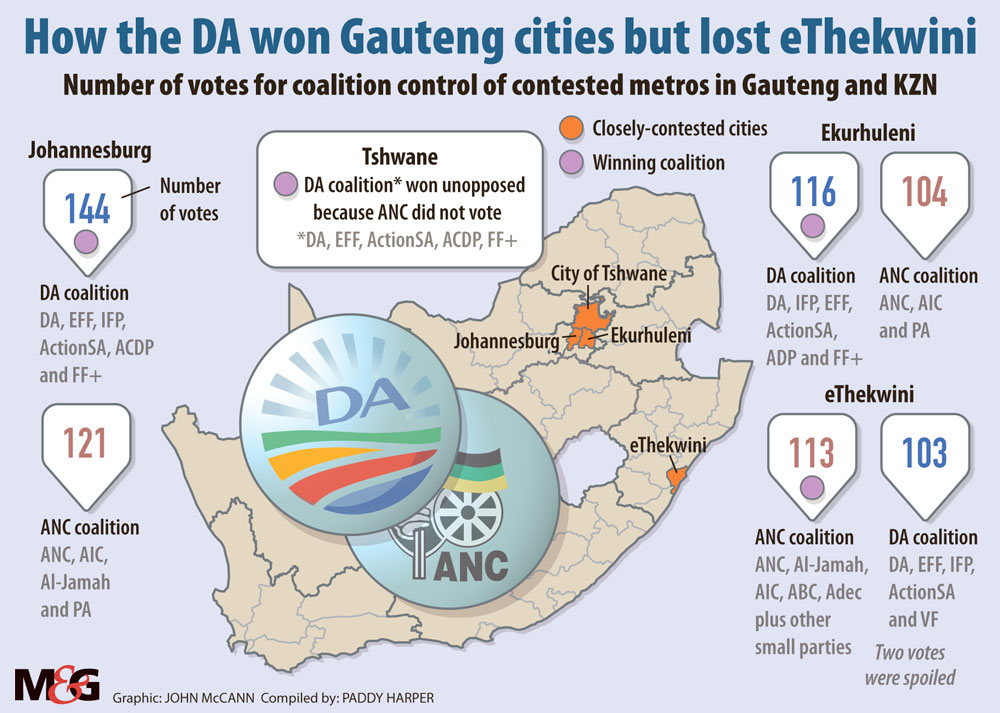 (John McCann/M&G)
“Herman has been flip-flopping left, right and centre. One moment he says he is not going to be working with the EFF, or maybe that was a lie to try to lure the voters,” Msimanga contended. “The next moment he says he will work with them, or he is coming with them. So, again, [he is] exposing himself for not being an honest person from the get-go.”
Msimanga said the DA would continue to meet the other political parties it has been having talks with, including ActionSA, and that, should other parties be involved, they would have to adhere to what Msimanga said was the standard document that the DA’s coalition partners had adopted.
According to insiders, the DA’s federal executive meeting will be held next week and some of the discussions will focus on the fact that some party members did not want to enter into these coalitions.
“Aside from the EFF and their demands, the ANC is going to make life difficult because they can break quorum at any time and I don’t put it past them. They are also in the provincial government. If, after a few months, you can’t get [a] quorum or pass budget, then they would be required to dissolve the municipality,” said one insider.
Another insider said the so-called coalition all hangs in the balance.
“What is worrying is that it’s an empty minority government. The moment the EFF decides it has had enough of us they will drop us. They are playing with the stability of the council and this throws everything up in the air. The only people who are going to suffer are the residents of those municipalities,” they said.
Shocked at winning on Tuesday, DA leader Steenhuisen addressed his supporters in a recorded message, admitting that the voting strategy of the other opposition parties had caught the DA unawares and placed the party in a difficult position.
“We didn’t ask for help from the EFF to lead these governments, and we did not expect to leave these meetings with two new DA mayors,” Steenhuisen said.
“There was absolutely no compromise on our principles to stay in government. We are certainly not here to cling to power at all cost and would rather return to the opposition benches than give way to demands that are unrealistic, corrupt or require us to govern badly.”
Steenhuisen said the DA’s priority would be to “ensure stability” in the metros and to “work at solidifying coalitions with parties that share our governing principles and our commitment to the people”.
The DA had refused to “budge for a minute” in the coalition talks that had failed at the weekend and would not “put ourselves in a compromised situation in unstable or paralysed minority governments”.
The DA would also contact parties that had not been part of earlier coalition agreements to try to build “unassailable” majority coalitions, he added.
By Wednesday, the DA had already contacted some of its partners in the de facto coalitions, including the IFP, which wants the human settlements and transport portfolios in Johannesburg and Ekurhuleni from the DA.
ActionSA insiders say the party will make similar demands on the DA about infrastructure portfolios in the metros — and more positions in Ekurhuleni, where the DA’s skills base is lower and where it will need to rely on other parties to fill the leadership gap.
ActionSA believes that the current situation favours it going into 2024, because as it has kept the ANC out of the Gauteng metros, while forcing the DA to return to the table.
ActionSA chairperson Michael Beaumont said that the party had been put in a “powerful”’ position and one of “great responsibility” because it had put voters ahead of “petty politics”.
Beaumont said that, despite the poor relations with the DA, it was willing to “overcome our issues”, because this is what voters expected ActionSA and other parties to do.
All ActionSA structures and activists had been instructed to “cease any form of public criticism” of all parties except the ANC to create an environment conducive for coalition talks to take place.
This would assist in lowering political temperatures between the parties and ensure that they focused on common issues on which to work.
[/membership]