Too little protection: Slain corruption fighter Babita Deokaran was not safe after making disclosures relating to personal protective equipment fraud at the Gauteng health department. (Fani Mahuntsi/Gallo Images)
A young South African democracy first welcomed specialised whistleblower legislation at the turn of the millennium when the Protected Disclosures Act of 2000 (PDA) was born and implemented a year later.
Fast-forward 20 years and sentiment is swelling that the current dispensation is untenable.
President Cyril Ramaphosa acknowledged as much in the aftermath of the August killing of Babita Deokaran — a senior finance official in the Gauteng health department who had exposed corruption there.
“While numerous systems are in place to enable whistleblowers to report anonymously, we need to tighten up existing systems and provide greater support to those who publicly come forward with information,” Ramaphosa said.
The call reiterated his praise for whistleblowers at the Zondo commission of inquiry a few months earlier; an occasion at which he also called for legislation to be tightened to protect those who choose to come forward with information.
But what exactly is it that needs tightening? What is the loose screw in the written law that allows a group of people to be victimised for doing objectively the right thing?
For most activists, the issues have their roots in the Act’s inception.
Shortly after South Africa’s first democratic elections in 1994, then-deputy president Thabo Mbeki would establish the Open Democracy Advisory Forum — a group of more than 60 organisations (mostly from civil society) that would work with the government to construct new legislation around information access and protection. The Open Democracy Bill emerged from the process.
But parliament in the late 1990s decided the bill was too broad and ordered it to be separated into parts. Conversations began into what a specific whistleblower legislation might look like.
Richard Calland, an academic keenly involved in the process, says the discussion naturally gravitated to the different precedents of the US and UK — two of a handful of countries that had fledged out regulations on the matter.
The former effectively glorified the whistleblower; holding them as American-style heroes amid much fanfare.
The latter, meanwhile, preferred to handle things more discreetly, seeing the whistleblower as someone carrying out their duty; delivering a message to their organisation which is then obliged to take it seriously.
“That seemed very appealing because it seemed to fit the organisation culture of South Africa,” Calland says.
“It seemed to fit, in particular, the approach of the ruling party. Which is, in broad terms, to wash dirty linen behind closed doors.
“Therefore our supposition, and our lobbying position, was that we had a better chance of persuading parliament that this was a good approach. In that respect we were correct.”
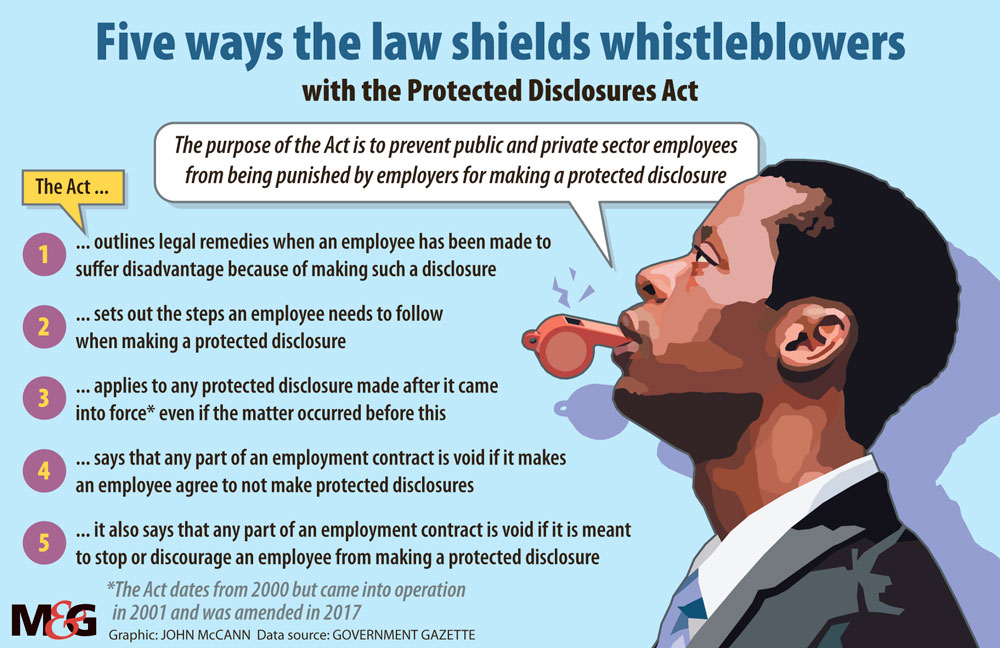 (John McCann/M&G)
Fundamental flaws
A consensus forming among critics of the PDA is that its issues begin in the documents framing it as a device that is operated in the context of an employee-employer dynamic.
The PDA’s opening purpose states: “To make provision for procedures in terms of which employees in both the private and the public sector may disclose information regarding unlawful or irregular conduct by their employers or other employees in the employ of their employers.”
The most obvious limitation of the above is that the law only emboldens employees of the specific organisation to make protected disclosures. This was somewhat corrected with an an amendment Act in 2017 that expanded and tightened up certain definitions. Most notably, workers were understood to also be those on the periphery and not necessarily in a full-time engagement. These could include contract workers, freelancers and so forth.
There is still a strong call, however, to abolish the labour terminology altogether. The argument is that anyone should be able to blow the whistle on anybody else — and be protected by law — regardless of whether they are linked to that person or entity.
Further problems arise on the assumption that a symbiotic relationship exists between organisations and those who work for it; that combating corruption is in the best interests of all within a given structure. On the evidence of the epidemic of political murders in KwaZulu-Natal or multiple testimonies at the Zondo commission, that seems to be a far reach.
“In a way that’s obvious, because so often the whistleblower gets cut off at the knees by their employer,” says Calland. “You don’t need to be a Marxist to recognise that the interests of the employer and employee are not the same.
“That’s particularly so in a rugged environment such as South Africa. Whether it’s the institutional-organisational-cultural tendencies of employers or just the sort of violent, and often deadly, character of corruption, it makes this an implausible proposition. That the whistleblower should quietly come forward, hand over the information and the message will be heeded and the messenger will not be shot is a flawed approach.”
The prevalence of high-profile violence bleeds into another significant shortcoming of the Act as it stands: the lack of protection it offers, or rather, what form the protection takes.
In keeping with its de facto status as a cousin to the Labour Relations Act, the “protection” that the PDA offers falls mainly under the scope, again, of the workplace relationship.
Its first objective (2a) states: “To protect an employee, whether in the private or the public sector, from being subjected to an occupational detriment on account of having made a protected disclosure”.
The “occupational detriment” covers dismissal or any other reprisals that the person in question might face. As necessary as such safeguards are, they do nothing for anybody who is staring at the prospect of defamation, or even assassination.
This was chief among the concerns listed by civil society’s Active Citizens Movement in its written submission to the Zondo commission earlier this year.
It stated: “The organisation believes that the plight of the whistleblower and the lack of legal protection and personal support is a matter of extreme importance, as whistleblowers make huge sacrifices when calling out malfeasance and corruption.”
The movement further called for witness protection mechanisms to be incorporated into the legislation.
Support and guidance
The correction of whistleblowing legislation is unlikely going to be as simple as changing the wording on the PDA, with most activists and critics arguing that there needs to be a complete rethink of the structures that underpin it.
Social worker John Clarke is one such person. After becoming aware of the difficulties whistleblowers face, he began to offer his services in the form of psychosocial support to those afraid to speak out or those who already had, and now feared the repercussions.
“You have a source who’s willing to blow the whistle, they’re suffering as a consequence, they’re scared and paranoid, and they need support,” he said.
“As a social worker part of our jobs is advocacy for the rights of the most disadvantaged. I’d never have imagined that you’d have highly paid people, or at least once highly paid, coming to me for social work services. That in itself has to say something! Normally we’re dealing with the down-and-outs of society, not people who have been persecuted out of their jobs and rendered marginalised simply because they are doing what good citizens should be doing.”
Clarke is another who has delivered an impassioned submission to the Zondo commission, calling for the disclosure framework to be overhauled.
Civil society work like his has seemingly become increasingly important to assist the PDA in recent years. While the Act does technically provide provision for the employee in question to go outside their organisation, it is scant on the details of the best way to do this. There is also no state-mandated body that can provide assistance — practical or otherwise — to anybody wishing to bring forward information.
The common request made to the government is that the services that are offered to whistleblowers are commensurate with the value their risk adds to society.
“It’s been the whistleblowers of this country that gave the state capture commission its traction,” Clarke continues. “If it wasn’t for them and the media, what would Justice Zondo be doing? The prosecuting authorities and the police were all way behind the eight-ball.”
Indeed all eyes are now on acting Chief Justice Raymond Zondo to see how strongly he addresses the issue in his final report — which must be handed over to Ramaphosa by New Year’s Day. A final recommendation from him, combined with the previous presidential rebuke, will likely be enough to spark a lengthy re-evaluation process, beginning in earnest as early as next year.
[/membership]