Many companies are revising their requirements as the pandemic continues to upset business plans. (Andrei Pungovschi/Bloomberg via Getty Images)
Businesses’ plans to have employees move back to offices after many months of working from home have been derailed by the emergence of the Covid-19 Omicron variant, among other factors.
“This office market is expected to see its national average vacancy rate continue to climb in 2022, as many companies revise their office space needs down,” said John Loos, a commercial property finance economist at FNB.
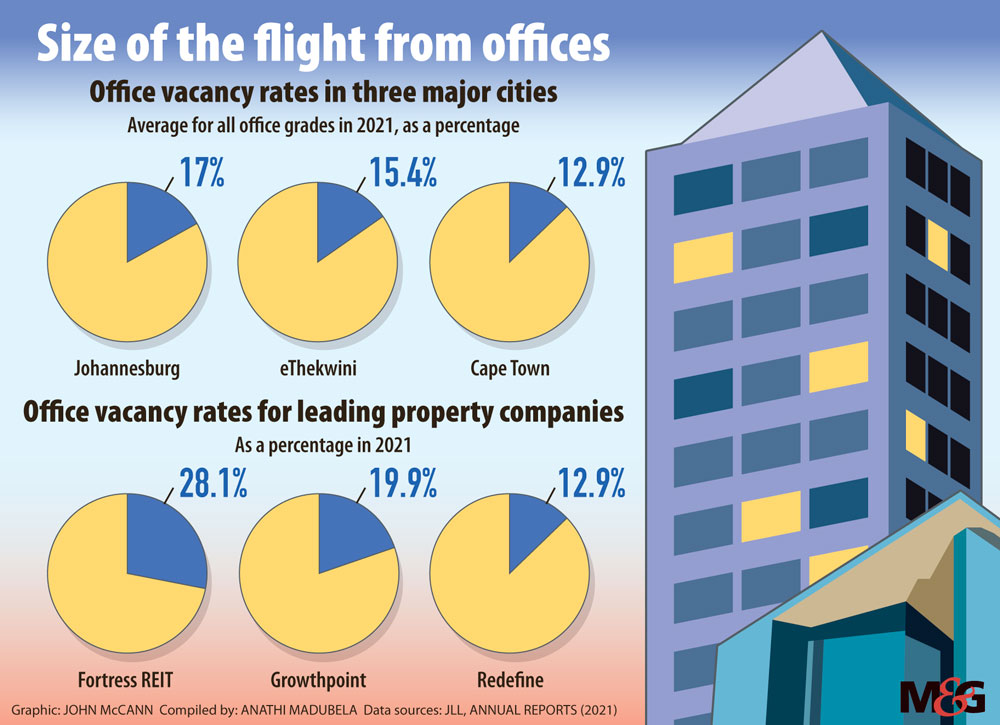
Growthpoint Properties recently announced that its office sector vacancies increased from 19.9% during the 2021 financial year ended June to 20.9% in the first quarter of the 2022 financial year. The sector remains under pressure, particularly in Gauteng — and specifically Johannesburg’s wealthy Sandton district — the property company said.
So, what will happen to big business hubs with millions of square metres of office space?
Johannesburg already has an oversupplied office market and now, because of the pandemic combined with a general shift in corporate demand dynamics, it has come under severe pressure.
The South Africa Real Estate Market report for the second quarter of 2021 showed Johannesburg had more than 1.7-million square metres available for leasing at the end of the second quarter of 2021.
The city has about 10.4 million square metres of office space.
Johannesburg’s vacancy rate now stands at 17%, the largest in the country. Durban came in second with vacancies of 15.4% and Cape Town third with 12.9% vacancies.
Vacancies in Sandton are on the rise both in the commercial and residential space. Loos said that even if some companies were to convert these office buildings into residential ones, this would not only pose structural difficulties, but there would not be a market for them.
“The case for repurposing and refitting old vacant office space is still strong; however, traditional residential conversions in commercial nodes may be less viable than in the past, given the shift in demographic demand dynamics,” the real estate market report reads.
Loos said: “Realistically, I think the income demographic of a place like Sandton will change. Sandton will be a lot less focused on luxury and [have to become] more affordable to bring about a lower income demographic that can take up a significant portion of office space. That is the direction Sandton has to go and how far it has to go.
“We know what happened to Jo’burg CBD once upon a time,” he said. The worst case scenario for Sandton was that it would look like the Johannesburg or Durban central business districts, which have empty office spaces as businesses moved to working remotely.
“Although, I’m not saying it will [definitely] end up like that,” Loos added.
The type of employees who are likely to be office-bound will be at the lower end of the labour force, while the higher end, highly-skilled and affluent worker will continue working remotely, allowing the lower income demographic to move into areas such as Sandton, Loos said.
As much as the work-from-home trend has played a big part in the rising office vacancy rates, the recession has caused a major drop in employment numbers in the office-bound sectors of the economy. In other words, Loos explained, even without any increase in remote work, there are fewer employees in sectors such as finance, real estate and business services, which implies less office space is needed.
“That is a big sector which drives serious demand for office space … the big employment loss in the sector that matters most for office space has dampened the demand for office space,” he said.
Data from Statistics South Africa released on Tuesday showed that the official unemployment rate increased to a new record 34.9% of the labour force for the third quarter of 2021.
 (John McCann/M&G)
For the finance industry, employment decreased by 2% year-on-year in the quarter.
Gauteng was most severely hit by job losses during the period, shedding 200 000 jobs.
The accelerated semigration trend of people moving further away from the city to work from home is also placing pressure on Johannesburg vacancy rates.
“I certainly would not be queuing to go live in Sandton, in a high-density building right now,” said Loos.
A number of property companies are accepting shorter lease terms rather than completely forgoing rent.
Growthpoint said its office portfolio had a lease renewal success rate of 56.6%, with the average lease renewal term decreasing to 2.8 years from 4.4 years.
Tenants are uncertain about the changing nature of work and the debate is about how much time employers want their employees to spend in the office, which will then answer the question of “how much space do we need”, said Loos.
“Tenants don’t really want to commit to long leases when there might be significantly lower market rentals in a few years’ time. You’d want to be flexible to move if something better comes up because there is a lot of vacant office space.”
“Hotelling”, a new phenomenon that refers to a system in which employees book a desk for a day, is also contributing to rising high office vacancy rates.
“Gone are the days when every employee had a desk reserved. This sharing of desk space will further reduce the need in the coming years for office space,” said Loos.
Hotelling is different from the “hot desk” practice of not assigning permanent desks in the workplace, so that employees may work at any available desk.
“When you reserve desks for everyone, it’s quite wasteful because, at any given time, there is a portion of your workforce on leave, sick leave or travelling,” said Loos.
He likened this practice to the time when companies stopped reserving parking spots for everyone because they realised that there could be a lot less parking space required if it was on a first-come, first-served basis.
“They are doing the same with desks. This is all moving the demand for office space down and this is something FNB has recently implemented,” Loos said.
Anathi Madubela is an Adamela Trust business reporter at the M&G
[/membership]