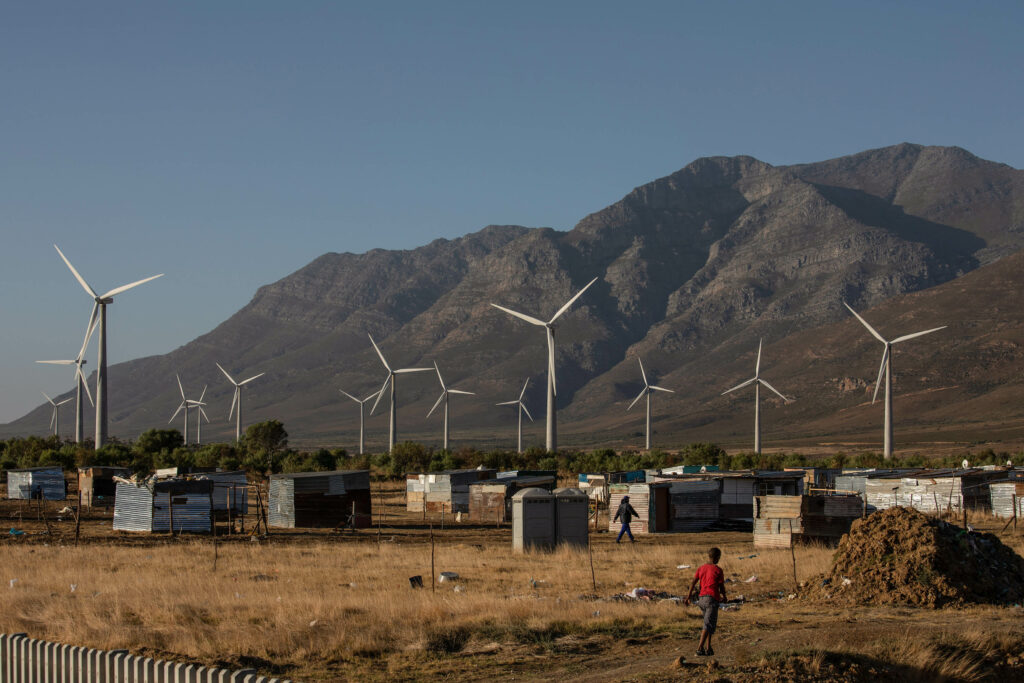
The World Bank has said that it's in South Afica's best interest to move from coal to renewables. (Photographer: Waldo Swiegers/Bloomberg via Getty Images)
More than 14 years of load-shedding has led to questions about state-owned Eskom’s relevance. The privatisation of energy in South Africa is gaining traction as consumers and businesses alike grapple with constant power cuts. It is now possible to imagine a future without the power utility.
Companies have long spoken about getting off the grid but only now are they acting, especially after the mineral resources and energy minister, Gwede Mantashe, issued new rules allowing independent producers to generate power of up to 100 megawatts (MW) without a licence.
Attacq property company and owner of Waterfall City in Johannesburg has recently said it is considering getting a wheeling licence. Wheeling is the transfer of electrical power through a utility’s transmission or distribution system between different grid or network service areas. A wheeling licence would allow Attacq to rely less on Eskom-generated power.
South African Breweries also recently announced that it will cut its reliance on Eskom’s grid by 2025. It said it will produce its Castle Lite beer using only renewable electricity and it would use all options available to reduce its load on the national grid.
Stanlib chief economist Kevin Lings said: “It seems so futuristic imagining a future without Eskom” but added that it is possible.
But the private sector has been gearing up for a time when it would not be reliant on Eskom for years already.
In the mining industry, companies such as Anglo Platinum are at an advanced stage of getting off the grid and are seeking contractors to build a 100MW solar photovoltaic plant.
Roger Baxter, the chief executive of the Minerals Council, said the mining industry is at various stages of building plants, conducting studies, planning and applications for up to 3 900MW of renewable solar, wind and battery energy projects, which could provide Eskom with some much-needed supplementary capacity.
“Renewable energy projects in the mining sector could go a long way towards easing the pressure on Eskom to the benefit of other industries and the country as a whole,” said Baxter.
Lings said the future “would look something like a decentralised system of energy providers where some energy could be provided by the local government or privately … There would be a diverse mix of energy that would be provided and it wouldn’t just be mostly coal.”
He said the private sector would be able to sell energy back into the national grid and even households would be encouraged to develop solar energy and sell the excess.
 The shift to alternative energy production will mean using wind, solar power and gas. (Photographer: Dwayne Senior/Bloomberg via Getty Images)
Businesses could be encouraged to set up energy intensive factories in areas where they can build their own energy supplies and rely on themselves, he added.
But Maarten Ackerman, chief economist at Citadel, is of the view that although Eskom is connected to negative sentiment, it does not mean the utility cannot return to its top spot with the right management, the right maintenance and the right investments.
“Probably 20 years ago Eskom was one of the most successful energy companies in the world. I’ve done some research some time ago and we ranked in the top five in the world at the time in terms of efficiency and also in terms of the amount of energy that was generated for South Africa and its neighbouring countries,” he said.
Ackerman said Eskom is hugely important for South Africa because at the moment it is the only capacity generator.
“Yes, we are busy generating off the grid but Eskom is still the one doing the transmission. So, from that point of view, the utility is crucial especially in terms of its infrastructure. Going forward, Eskom will remain crucial even when they speak of the break-up of the generation, transmission and distribution [divisions], Eskom can actually start playing a bigger role with the distribution and transmission of electricity.”
Ackerman does agree that the generation of electricity may be begging to shift to the private sector. He said the crux of the problem was that generation issues, and not transmission and distribution, was leading to load-shedding.
“You could argue that there is a future without Eskom. But then again, if it’s not Eskom, who will it be? There has to be someone looking after this infrastructure and that is the point of Eskom.”
Lings, however, notes that one of the big criticisms of going the private sector route is that the private sector may well end up only supplying the most profitable areas, leaving those who can’t afford in the dark, “but that can be controlled with regulation”.
“Part of the private sector’s licensing agreement could be that it is required to provide for the smaller towns … Putting up solar panels is expensive, you can’t expect small towns to afford that. Where is the money going to come from?
“You would have to find a way for society to collectively subsidise the provision of electricity to certain parts of the country, so that you make sure the distribution is available,” Lings said.
A study by global strategy consulting organisation EY-Parthenon found that the pipeline for as much as 184 renewable energy projects in South Africa will need investments of more than $37-billion, the majority of which can be sourced from the private sector.
“Private organisations are the primary driver behind the size of the pipeline,
with the majority of projects still in the permitting phase. Most projects are expected to reach financial close in the next 24 months,” researchers at EY-Parthenon said.
This, it said, can add 10.3 gigawatts of electricity capacity to the system.
But, the researchers said, it would need the government to increase the size of future renewable energy procurement rounds, implement binding off-taker contracts
to create greater certainty for developers and return confidence to the market, as well as an expansion of transmission infrastructure in provinces such as the Northern Cape.
Citizen power
Unplugging from the main grid is not a new phenomenon for a few suburbs in South Africa. Just after load-shedding was first introduced, people began to imagine a self-reliant future when it came to their electricity needs.
In 2010, Tim Cohen wrote in the Mail & Guardian about his trial-and-error DIY mini off-grid power system with solar panels in the Karoo, where he and his partner lived. It cost them about R7 000 for 120-watt, 12-volt panels to power up their household. A system with 12 of these panels produced about seven kilowatt hours a day. To store excess power it also required 20 deep-cell 12v batteries at an additional cost.
 Sunspot solar panel installation at a private residence in Cape Town.
“Your electricity bill will normally tell you how much electricity you use, but I know from living in Joburg in a two-person household in Parkhurst that we typically used three times that,” wrote Cohen.
The trick to reducing capacity, according to those moving off Eskom’s grid, is in embracing a mixture of sources — for example, using gas to power a geyser and stove and then solar power to power everything else, as in Cohen’s case.
Installing solar panels and the battery storage to accompany could cost up to R300 000, making the solution limited to the upper middle class in South Africa. But service providers believe the average monthly Eskom bill multiplied by several years, plus interest, would amount to the same or even more.
Municipal independence
By March this year about six municipalities in the Western Cape began planning to produce power independent of embattled Eskom. Cape Town is gunning to become the first city to move off Eskom’s grid.
And Parkhurst’s residents association has a green team that began planning to switch 2 000 homes off Eskom’s grid and on to solar power by 2020, although the Covid-19 pandemic may have affected their schedule.
In 2015, when the initiative to take residents off the grid emerged, a postgraduate researcher at the University of Pretoria conducted a survey. Among the concerns residents had was whether the government would subsidise renewable energy expansion through micro-grid solutions or charge consumers additional tariffs for moving off grid.
In November, the City of Johannesburg unveiled its plans to wean off Eskom. Former mayor Mpho Moerane launched the Energy Sustainability Strategy, which will see an extra 500MW capacity of alternative energy added to the city using gas and solar sources.
The city plans to have 35% of its energy supply from renewable energy sources by 2030.
“This means the city is set to reduce our reliance for generating capacity on the national power utility by up to 15%, and thereby minimising the chances of Eskom scheduled load-shedding,” Moerane said at the launch.
[/membership]